
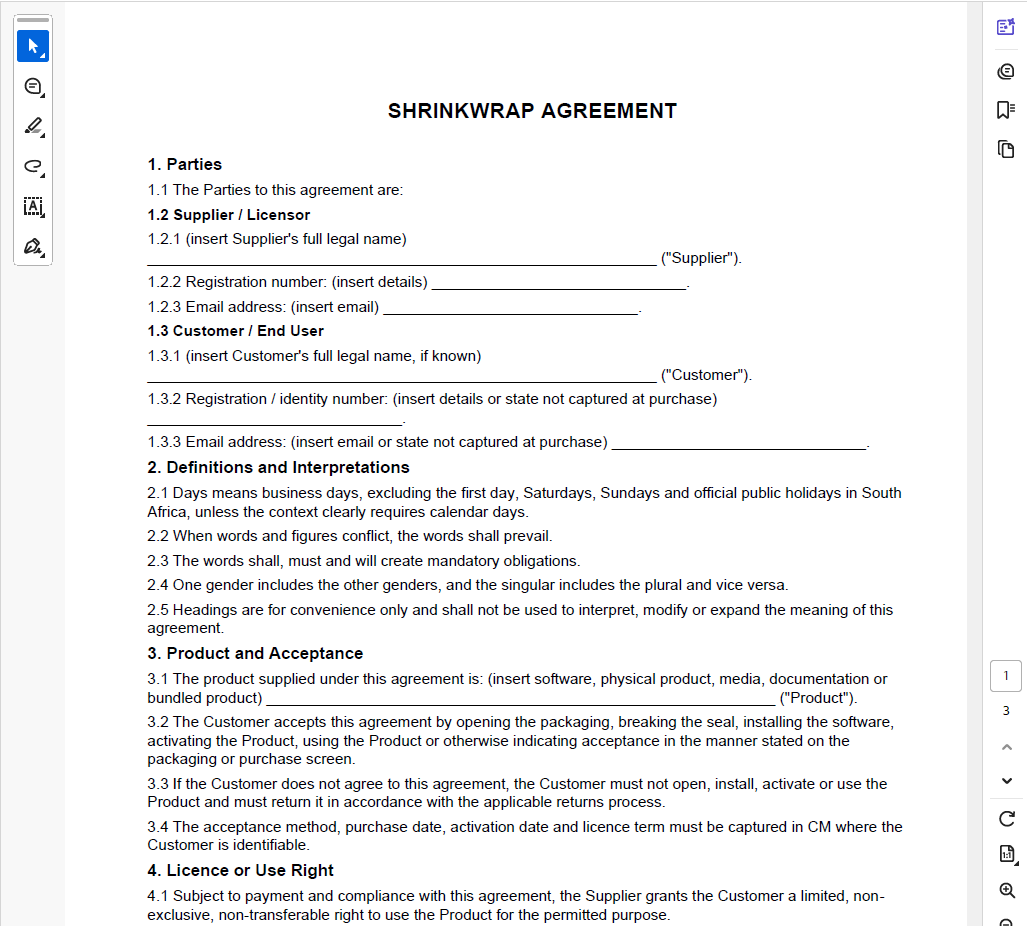
Shrinkwrap Agreement
Essential Protections for Your Software Assets
Introduction
Imagine buying a box of high end software from a store. You tear off the plastic wrap to open the box. By that simple action, you just signed a legally binding contract. This unique legal tool helps tech companies protect their intellectual property without manual signatures. Modern teams must understand these terms to avoid legal risks. For instance, Contract Corridor helps companies track all their vendor obligations in one place. Therefore, knowing how a shrinkwrap agreement works will save your business time and money. This article explains the rules, risks, and best practices for these common documents.Quick Answer Summary
What Is This Agreement?
A shrink wrap contract is a boilerplate legal document often found with software or hardware. The term comes from the clear plastic film used to wrap retail products. Specifically, the agreement states that opening the box constitutes your legal consent to the terms. Most legally binding deals require a signature from both parties. However, this model relies on the buyer's actions rather than a pen and paper. Companies use this method to distribute licenses quickly to thousands of customers. This fits into the broader field of "notice and consent" law within modern contract management.Why It Matters
Getting these terms right protects your profit margins and your brand. If your terms are weak, users might copy your code or sue you for giant sums. Conversely, strong terms act as a shield for your intellectual property. Moreover, courts generally enforce these deals if they are fair and clear. If you ignore these documents, you might lose your right to sue in court. Instead, you might find yourself stuck in a costly arbitration process.The Cost of Contract Confusion
- Businesses lose roughly 9% of their yearly revenue due to poor contract management.
- Clear liability limits can reduce legal defense costs by up to 60%.
- Over 75% of software companies use some form of automated licensing.
Key Components and Elements
Every effective shrink wrap license agreement needs specific parts to hold up in court. You must ensure your customers can see the notice before they commit to the purchase.- Acceptance Clause: This explains exactly which action binds the user to the deal.
- License Scope: This lists what the user can and cannot do with the software.
- Liability Limits: This section caps the amount of money a customer can win in a lawsuit.
- Warranty Disclaimer: This tells the buyer that the product is sold "as is."
- Refund Policy: This provides a way out for users who disagree with the terms.
- Termination Rights: This allows the company to end the license if the user breaks the rules.
Types and Categories
Not every automated contract looks the same. Some rely on physical boxes, while others use digital triggers. Here is a breakdown of how a shrink wrap business might categorize these documents.| Type | Description | Best For | Key Consideration |
|---|---|---|---|
| Physical Wrap | Terms printed on or inside the box. | Retail hardware and software. | Terms must be visible or referenced on the outside. |
| Clickwrap | Users click "I Agree" on a screen. | SaaS and mobile apps. | Requires an active mouse click. |
| Browsewrap | Terms linked at the bottom of a site. | Informational websites. | Harder to enforce in court. |
Step-by-Step Implementation Guide
If you want to use these contracts, you must follow a strict process. Otherwise, a judge might decide your terms are not valid.- Draft Clear Terms: Write your rules in plain language that a regular person can understand.
Why: Judges often strike down confusing or hidden terms.
Pro Tip: Keep your font size large enough to read easily. - Place Notice on the Box: Print a clear warning on the outside of the packaging.
Why: Buyers must know a contract exists before they open the product.
Pro Tip: Use bold colors for the "Notice" header. - Include a Full Copy Inside: Put the entire shrink wrap license inside the box.
Why: This gives the customer the chance to read every detail.
Pro Tip: Place the document on top of the instruction manual. - Establish a Return Window: Give users 15 to 30 days to return the product if they skip the terms.
Why: Fairness is the key to legal enforcement.
Pro Tip: Mention the return policy in the external notice.
Common Mistakes and How to Avoid Them
Many companies fail to make their agreements stand up to scrutiny. Avoid these pitfalls to keep your business safe.| Mistake | Why It Happens | How to Fix It |
|---|---|---|
| Hidden Terms | Burying terms under several layers of wrap. | Make the notice visible on the exterior shell. |
| Unfair Terms | Trying to take away all buyer rights. | Follow standard consumer protection laws. |
| No Refund Option | Forgetting to offer a way out. | Allow returns for those who decline terms. |
| Tiny Font | Saving space on the packaging. | Use at least 10-point font for legal text. |
The single most important thing to remember is visibility. If a customer cannot see that they are entering a contract, the contract usually does not exist.
Industry Examples and Use Cases
Different sectors use these tools in unique ways. Specifically, the technology world relies on them the most. Software Retail A gaming company sells a physical disk for a console. The shrinkwrap agreements inside prevent the user from copying the game files. As a result, the company protects its sales from piracy. Hardware Manufacturing A printer company includes a shrink wrap licence inside the box. The terms state that the buyer can only use official ink cartridges. Consequently, this helps the company maintain its supply chain revenue. Medical Devices A lab equipment manufacturer sells specialized testing kits. The package includes an example of shrink wrap agreement that limits the company’s liability for test results. This protects the firm from massive lawsuits if a test fails.Frequently Asked Questions
Are shrinkwrap agreements legally binding?
Yes, most courts find them enforceable if the terms are fair and the buyer has a chance to return the item. You must provide a clear notice on the package to ensure the court upholds the deal.
What is the difference between shrinkwrap and clickwrap?
Shrinkwrap applies to physical products like boxes and disks. Clickwrap applies to digital products where you click a button on a website or app to agree.
Can I return a product if I disagree with the terms?
Specifically, most valid agreements must allow you to return the unopened software for a full refund. If the company denies a return after you read the terms, the contract might be void.
Do I need a signature for a shrink wrap contract to work?
No, your action of opening the package or using the product serves as your "signature." This makes high-volume sales much faster for the seller.
Why do companies use a shrink wrap license?
Companies use them to limit their legal liability and prevent unauthorized copying of their products. It is the most efficient way to manage thousands of individual customer relationships at once.
How Contract Corridor Helps
Managing different types of licenses is a difficult task for any growing team. Contract Corridor simplifies this by centralizing all your legal documents in one secure place. First, our platform allows you to store and categorize every shrinkwrap agreement your company accepts. This ensures you never miss a renewal date or a hidden restriction. Second, our search tools let you find specific liability clauses across hundreds of files in seconds. Finally, Contract Corridor provides automated alerts for your compliance needs. You can track which vendors use these licenses and monitor changes in their terms over time. Are you ready to master your contract workflow? Start using Contract Corridor today to protect your business and streamline your legal operations.
About the Author: Melissa Jooste
Melissa Jooste is the Head of Marketing at Contract Corridor, where she shapes the voice, narrative, and market positioning of a leading contract lifecycle management platform. Recognized for her expertise in contract lifecycle management content, Melissa is known for producing insightful, high-impact thought leadership that challenges conventional approaches to contract management. Her work goes beyond surface-level marketing, offering clear, strategic perspectives on how organizations can unlock value, reduce risk, and gain control through more effective contract lifecycle practices. Her writing is widely valued for its clarity, depth, and relevance, bridging complex legal, financial, and operational concepts into content that is both accessible and commercially meaningful. By combining strong storytelling with data-driven insight, she consistently delivers content that resonates with senior business leaders, legal professionals, and operational teams alike. Through her work, Melissa plays a key role in establishing Contract Corridor as a leading voice in the contract lifecycle management space, shaping how organizations think about contracts, not as static documents, but as dynamic drivers of business performance.
Connect on LinkedIn
About the reviewer: Jenna Kretzmer
Jenna Kretzmer, CA(SA) is an Executive at Contract Corridor, where she plays a key role in shaping the strategic direction and market positioning of a leading contract lifecycle management platform. A global executive with over a decade of experience, Jenna has led large-scale, international operations and driven growth, transformation, and market expansion across multiple regions. She is recognized for her ability to operate at the intersection of strategy, execution, and commercial performance. Jenna is a leading voice in the contract lifecycle management space, known for her perspectives on contract governance, revenue optimization, and operational efficiency. Her work challenges traditional approaches to contract management, advocating for a shift toward greater visibility, accountability, and value realization across the entire contract lifecycle. She is driving Contract Corridor to enable organizations to move beyond static contract storage toward proactive, value-led contract management, where contracts are treated not as legal documents, but as dynamic instruments that drive measurable business outcomes.
Connect on LinkedInShrinkwrap Agreement
The templates and resources available through Contract Corridor are provided for general informational purposes only. They do not constitute legal advice, and their use does not create an attorney-client relationship between you and Contract Corridor or any of its affiliates.
While every effort has been made to ensure that the templates are up to date and relevant, Contract Corridor makes no representations or warranties, express or implied, regarding their accuracy, completeness, adequacy, legality, or suitability for any specific purpose. The templates may not reflect current legal developments or the laws applicable in your jurisdiction.
You are solely responsible for reviewing, customising, and validating any template before use, to ensure that any document meets your specific needs and complies with applicable laws and regulations.
To the fullest extent permitted by law, Contract Corridor, its owners, employees, and affiliates disclaim all liability for any loss, damage, or consequence arising directly or indirectly from the use of, or reliance upon, any template, resource, or related material provided on or through this platform.
By accessing, downloading, or using any template, you acknowledge and agree that such use is entirely at your own risk.
Contract Corridor Contract Templates