
Vendor Contract
Essential Frameworks for Secure Partnerships
Introduction
Running a business often feels like a balancing act. You must juggle delivery dates, product quality, and payment schedules every day. Without a clear agreement, small misunderstandings can quickly turn into expensive legal battles. A vendor contract solves this problem by defining exactly what each side expects from the other. It protects your budget and your reputation by putting every detail in writing.
This page provides a vendor contract template that you can use immediately. You can copy the text, customize the details, and sign it with your partners. Small business owners, event planners, and procurement teams often use this format to secure their supply chains. Specifically, this template helps you move from a verbal handshake to a professional legal relationship.
Furthermore, using a structured vendor agreement form saves you hours of drafting time. You do not need to start from a blank page. Instead, you can focus on the specific needs of your project. This sample vendor agreement contract covers the essential points to keep your operations running smoothly.
What Is a Vendor Contract?
A vendor contract is a legal document where one party agrees to provide goods or services to another party for pay. It acts as a roadmap for the professional relationship. This document governs how products move, how money changes hands, and who carries the risk if something goes wrong. Consequently, it creates a binding promise that courts can enforce.
People also call this document a vendor agreement or a supplier contract sample. Sometimes, it appears as a vendor agreement contract in corporate settings. Regardless of the name, the purpose remains the same. It outlines the specific scope of work and the delivery timeline. It also explains what happens if a party fails to meet their obligations.
Finally, this agreement creates a clear boundary between the buyer and the seller. It ensures both sides understand their roles. For instance, it defines whether the vendor is an independent contractor or a long-term partner. By setting these rules early, you prevent confusion later.
Why Vendor Contract Matters
Imagine you hire a caterer for a large corporate event. You expect food for five hundred people, but they only bring enough for two hundred. Without a vendor contract, you might struggle to get a refund or prove the original deal. This mistake could cost your company thousands of dollars and ruin your brand image. Furthermore, disputes over payment terms can lead to stalled projects and lost revenue.
Using a vendor agreement provides clarity of expectations for every person involved. It allows you to hold the other party accountable if they miss a deadline. This legal enforceability gives you peace of mind when spending company funds. Also, having a signed document increases your professional credibility with banks and investors. They want to see that you manage your risks carefully.
Specifically, a template helps you avoid missing small but vital details. It acts as a checklist for your business deals. If you use a sample vendor contract agreement, you ensure you cover insurance and liability. This proactive approach saves time and prevents future headaches. It turns a risky transaction into a stable business process.
Business Impact Metrics
- Cost Savings: Clear terms can reduce dispute resolution costs by up to 40%.
- Time Efficiency: Using a template contract reduces drafting time by 60%.
- Risk Reduction: Written agreements lower the chance of litigation by clearly defining liability.
Who This Template Is For
- Small Business Owners: Use this for hiring recurring services like cleaning, IT support, or inventory delivery.
- Event Planners: This works for securing photographers, florists, or DJs for specific dates.
- Procurement Managers: Use this to standardize how your company buys raw materials or software.
- Startup Founders: This helps establish professional habits when your company begins to scale operations.
This template serves anyone who needs a simple contract agreement form. You do not need a law degree to understand or use these terms. It works best for people who want standard protection without complex legal jargon.
When to Use a Vendor Contract
- Hiring a consultant: Use this when you need expert advice for a short-term project.
- Buying bulk office supplies: This ensures the price stays the same over several months.
- Booking a venue for a wedding: An event vendor contract agreement protects your deposit if the venue closes.
- Ordering custom machinery: This defines the exact specifications the machine must meet.
- Setting up a food stand at a fair: A food vendor agreement template handles electricity and waste disposal rules.
- Subcontracting work: This moves your business to a business contract template for clear professional boundaries.
Meanwhile, do not use this for hiring full-time employees. Employment laws are very different from vendor laws. For a new hire, you should look for an employment offer letter instead.
Parties Involved
The Vendor
The vendor is the party providing the goods or services. They may be an individual or a large corporation. Their primary obligation is to deliver work that meets the agreed quality and timeline. In return, they expect on-time payment and clear instructions.
The Client
The client is the party buying the goods or services. They provide the budget and the specific requirements for the project. Their primary duty is to pay the vendor and provide any necessary access to tools or locations. They also review the final work for approval.
Key Clauses to Include
Scope of Work
The scope of work describes every task the vendor must complete. It prevents "scope creep," where work grows beyond the original price. Make sure to list specific deliverables and avoid vague descriptions like "help with marketing."
Payment Terms
This section explains how much money the client pays and when. It should state whether the payment is a flat fee or an hourly rate. Always include the payment method and the deadline for every invoice.
Term and Termination
This clause sets the start and end dates for the agreement. It also explains how either party can cancel the deal early. You should define how many days of notice a party must give before leaving.
Confidentiality
Confidentiality protects your trade secrets and private data. It prevents the vendor from sharing your business plans with your competitors. Always specify that this duty continues even after the work ends.
Limitation of Liability
This clause limits how much money a party must pay if something goes wrong. It prevents a small mistake from bankrupting your entire company. Usually, companies cap this amount at the total fee paid for the project.
Indemnification
Indemnification means the vendor will pay for legal costs if their work causes a lawsuit. For example, if they use copyrighted art without permission, they cover the fine. This protects the client from the vendor's errors.
Delivery and Acceptance
This section defines when the goods arrive and how the client inspects them. It sets a window for the client to report defects. Without this, you might get stuck with broken or low-quality items.
Governing Law
Governing law decides which state's rules apply to the contract. If a dispute goes to court, this clause determines where the trial happens. Choose the state where your main office is located for convenience.
Quick Tips to Write a Good Vendor Contract
- Use plain language: Avoid ancient legal terms to ensure everyone understands the rules.
- Define every term: Explain exactly what "Product" or "Service" means at the start.
- Spell out triggers: Clearly state that payment occurs only after you approve the final work.
- Set hard deadlines: Use specific calendar dates instead of phrases like "as soon as possible."
- Pick a venue: Name the specific city and state for any potential legal hearings.
- Include an exit: Make sure you can leave the deal if the vendor fails to perform.
- Attach your lists: Put long lists of items in an appendix to keep the main text clean.
- Number your sections: Use a standard contract outline format for easy reading and reference.
- Get it in writing: Never rely on oral promises made over a phone call.
- Consistency is key: Use the same name for the parties throughout the whole document.
Sample Vendor Contract Template
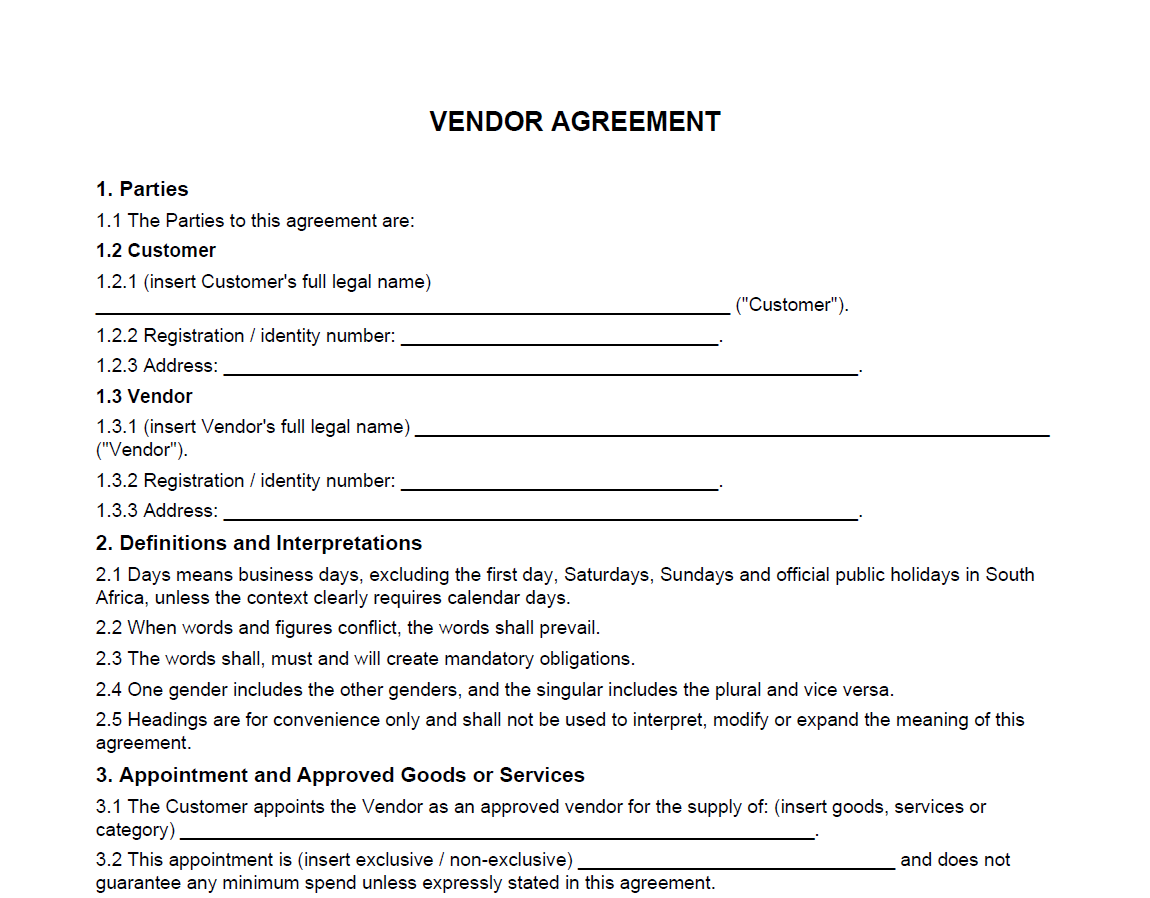
Below is a sample vendor contract template. Copy it, replace the placeholders, and review with both parties before signing.
VENDOR AGREEMENT
This Vendor Agreement (the "Agreement") is made on [Effective Date] by and between:
[Client Name], with a business address of [Client Address] ("Client"), and
[Vendor Name], with a business address of [Vendor Address] ("Vendor").
1. PROVISION OF SERVICES. Vendor shall provide the following goods or services: [Detailed Description of Work].
2. PAYMENT. Client agrees to pay Vendor [Amount] for the completion of the work. Payments shall be made within [Number] days of receiving an invoice.
3. TERM. This Agreement begins on [Start Date] and ends on [End Date], unless terminated earlier by either party.
4. TERMINATION. Either party may terminate this Agreement by providing [Number] days written notice to the other party.
5. INDEPENDENT CONTRACTOR. Vendor is an independent contractor. This Agreement does not create a partnership or employment relationship.
6. CONFIDENTIALITY. Vendor will not share any proprietary business information belonging to the Client with any third party.
7. OWNERSHIP. All work produced by the Vendor under this Agreement shall belong exclusively to the Client once payment is made.
8. LIABILITY. Vendor's total liability under this Agreement shall not exceed the total amount paid by Client to Vendor.
9. INDEMNIFICATION. Vendor shall defend and hold Client harmless from any claims arising from the Vendor's performance or negligence.
10. FORCE MAJEURE. Neither party is responsible for delays caused by natural disasters or other events beyond their control.
11. GOVERNING LAW. This Agreement shall be governed by the laws of the State of [State Name].
12. ENTIRE AGREEMENT. This document constitutes the entire agreement between the parties and replaces all prior discussions.
SIGNATURES:
__________________________
Client Signature
__________________________
Vendor Signature
This template is provided as a starting point and is not legal advice.
How to Use This Vendor Contract Template
- Copy the text: Save the content above into a new word processing document.
- Identify parties: Enter the full legal names of the companies, not just the names of individuals.
- Define the work: Be very specific in the first section about what you are buying.
- Fill in the money: Enter the exact dollar amounts and describe the hourly or flat rates.
- Check the dates: Ensure the start and end dates match your project timeline.
- Add state laws: Write in your home state to ensure local courts can handle the file.
- Send for review: Email the draft to the vendor so they can suggest changes.
- Finalize and sign: Use a digital signature tool or print and sign two physical copies.
- Store the copy: Save the final signed PDF in a secure cloud storage folder.
- Set reminders: Add the contract end date to your calendar two weeks early so you can renew it.
10 Critical Considerations When Reviewing a Vendor Contract
1. Are the legal entity names exact? Check that you used "Inc." or "LLC" where necessary to protect your personal assets. Incorrect names can make a contract hard to enforce in court.
2. Do the dates match the verbal deal? Verify that the start date allows enough time for the vendor to prepare. If the timeline is too tight, you might face delays immediately.
3. Is the scope of work unambiguous? Look for vague words like "reasonable" or "periodic" and replace them with numbers. For example, change "periodic updates" to "weekly status reports."
4. Are payment triggers explicit? Ensure the vendor only gets paid after hitting specific milestones. This keeps the vendor motivated to finish the work correctly.
5. Is the termination clause balanced? Check if you can leave the deal if the vendor does a poor job. You should not be trapped in a long-term deal with a bad partner.
6. Are liability caps reasonable? Make sure the vendor's insurance covers their maximum liability amount. If the cap is too low, you might lose money on a big mistake.
7. Is the governing law appropriate? Verify that you do not have to travel out of state for a legal dispute. This saves you thousands in travel and out-of-state legal fees.
8. Are IP rights clearly assigned? Ensure the contract says "work for hire" so you own the final product. You do not want to pay for work and then not own it.
9. Are renewal periods workable? Watch out for "auto-renew" clauses that might charge your credit card without notice. Always require written notice before a contract renews.
10. Are all exhibits attached? Confirm that if the contract mentions "Exhibit A," that page is actually included. Missing attachments can lead to missing details during a dispute.
What to Avoid When Using This Template
- Leaving placeholder text: Forgetting to remove brackets like [Vendor Name] makes you look unprofessional. It also makes the contract legally weak.
- Skipping the signature date: Always ensure both parties date their signatures. This helps determine when the obligations actually begin.
- Vague delivery locations: If you do not list an address, the vendor might drop goods at the wrong warehouse. Always specify a loading dock or office suite.
- Oral modifications: Never change the deal through a simple text message. Instead, write an amendment and have both sides sign it.
- Ignoring insurance: Do not assume the vendor has insurance. Always ask for a certificate of insurance before they start working on your property.
Legal Considerations and Compliance
A vendor contract must follow the laws of the jurisdiction where you do business. In the United States, the Uniform Commercial Code (UCC) often governs the sale of goods. This code sets standard rules for how buyers and sellers must behave. However, if you are buying services, state common law usually applies. Therefore, you must ensure your template aligns with local requirements.
Furthermore, if you handle personal data, you may need to follow data privacy laws like GDPR. These rules require special clauses about how the vendor stores your information. If you are a healthcare business, HIPAA rules might also apply to your vendors. Always remember that a generic contract template is a starting point, not a final legal solution.
Finally, a lawyer should review any high-value or high-risk agreements. Small business owners can often use a simple business contract sample for minor deals. However, for a million-dollar partnership, expert eyes are necessary. They can spot regional variations that might change how a court interprets your signature.
Frequently Asked Questions
Is this vendor contract legally binding?
Yes, once both parties sign it, the document is a legal contract. It creates a "meeting of the minds" that courts recognize. As long as it involves a legal exchange of value, it is enforceable.
Do I need a lawyer for every vendor agreement?
You do not always need a lawyer for simple, low-cost services. However, a lawyer should review any deal that could significantly hurt your business if it fails. Use your best judgment based on the cost involved.
Can I sign this contract electronically?
Absolutely. Most regions recognize digital signatures as just as valid as ink. Tools like Contract Corridor make it easy to collect these signatures securely from anywhere in the world.
What happens if a vendor breaches the contract?
If a vendor fails to perform, you can usually seek "damages" or a refund. You should first send a formal notice of breach. If that fails, you can use the agreement as evidence in court.
How is this different from a Purchase Order (PO)?
A purchase order is usually for a one-time buy of specific items. A vendor contract is a larger agreement that covers the whole relationship. Often, the PO sits under the contract as a specific order.
Manage Your Vendor Contract with Contract Corridor
Tracking dozens of vendor contract agreement samples across your company can become messy. If you rely on email and spreadsheets, you will eventually miss a renewal date. This can lead to service interruptions or price hikes you did not expect. Version control also becomes a nightmare when multiple people edit the same document. You need a better way to organize your legal life.
Contract Corridor offers a central place for every vendor contract you sign. Our software lets you store documents, track deadlines, and collect e-signatures in one workflow. You can use our AI tools to flag risky clauses or set automated reminders for expiration. Moreover, our platform provides a clean business contracts sample library for your team. Start your trial today and take the stress out of your vendor management.

About the Author: Melissa Jooste
Melissa Jooste is the Head of Marketing at Contract Corridor, where she shapes the voice, narrative, and market positioning of a leading contract lifecycle management platform. Recognized for her expertise in contract lifecycle management content, Melissa is known for producing insightful, high-impact thought leadership that challenges conventional approaches to contract management. Her work goes beyond surface-level marketing, offering clear, strategic perspectives on how organizations can unlock value, reduce risk, and gain control through more effective contract lifecycle practices. Her writing is widely valued for its clarity, depth, and relevance, bridging complex legal, financial, and operational concepts into content that is both accessible and commercially meaningful. By combining strong storytelling with data-driven insight, she consistently delivers content that resonates with senior business leaders, legal professionals, and operational teams alike. Through her work, Melissa plays a key role in establishing Contract Corridor as a leading voice in the contract lifecycle management space, shaping how organizations think about contracts, not as static documents, but as dynamic drivers of business performance.
Connect on LinkedIn
About the reviewer: Jenna Kretzmer
Jenna Kretzmer, CA(SA) is an Executive at Contract Corridor, where she plays a key role in shaping the strategic direction and market positioning of a leading contract lifecycle management platform. A global executive with over a decade of experience, Jenna has led large-scale, international operations and driven growth, transformation, and market expansion across multiple regions. She is recognized for her ability to operate at the intersection of strategy, execution, and commercial performance. Jenna is a leading voice in the contract lifecycle management space, known for her perspectives on contract governance, revenue optimization, and operational efficiency. Her work challenges traditional approaches to contract management, advocating for a shift toward greater visibility, accountability, and value realization across the entire contract lifecycle. She is driving Contract Corridor to enable organizations to move beyond static contract storage toward proactive, value-led contract management, where contracts are treated not as legal documents, but as dynamic instruments that drive measurable business outcomes.
Connect on LinkedInVendor Agreement
The templates and resources available through Contract Corridor are provided for general informational purposes only. They do not constitute legal advice, and their use does not create an attorney-client relationship between you and Contract Corridor or any of its affiliates.
While every effort has been made to ensure that the templates are up to date and relevant, Contract Corridor makes no representations or warranties, express or implied, regarding their accuracy, completeness, adequacy, legality, or suitability for any specific purpose. The templates may not reflect current legal developments or the laws applicable in your jurisdiction.
You are solely responsible for reviewing, customising, and validating any template before use, to ensure that any document meets your specific needs and complies with applicable laws and regulations.
To the fullest extent permitted by law, Contract Corridor, its owners, employees, and affiliates disclaim all liability for any loss, damage, or consequence arising directly or indirectly from the use of, or reliance upon, any template, resource, or related material provided on or through this platform.
By accessing, downloading, or using any template, you acknowledge and agree that such use is entirely at your own risk.
Contract Corridor Contract Templates