
What Is A Procurement Contract
Maximizing Value and Reducing Risk in Your Supply Chain
Introduction
Imagine your company needs a massive shipment of raw materials to finish a project. You send the payment, but the goods never arrive. Without a solid agreement, your business could lose thousands of dollars instantly. This scenario highlights why every business needs a clear procurement contract to protect its interests. These documents serve as the backbone of every trade and purchase your organization makes.
Consequently, understanding these legal tools helps you secure better deals and avoid lawsuits. In this guide, you will learn the exact steps to manage these agreements effectively. Contract Corridor simplifies the confusing world of legal tech for teams just like yours. We help you turn messy piles of paperwork into organized, digital assets that drive growth.
Quick Answer Summary
A procurement contract is a legally binding agreement between a buyer and a seller for goods or services. It defines the price, delivery dates, and quality standards for everything a company buys. These documents ensure both parties meet their promises and provide a legal path if something goes wrong. Using these agreements correctly protects your budget and keeps your operations running smoothly.
What Is A Procurement Contract?
The procurement meaning focuses on the act of obtaining goods or services for business purposes. Therefore, an agreement in this space acts as the formal rulebook for those transactions. It explains exactly what a vendor must provide and what the buyer must pay. You might also hear people use the term purchasing contract to describe the same concept.
Historically, businesses used handshakes to seal deals. However, modern contracts and procurement require much more detail to satisfy legal and tax requirements. These documents fit into the broader landscape of supply chain management. They ensure that the procurement of supplies happens on time and stays within the approved budget.
In many industries, users ask what is contracting and procurement in a professional setting. Simply put, it is the strategic process of finding vendors and signing them to legal terms. This process reduces uncertainty for both the buyer and the procurement contractor. It creates a record of what are procurement contracts supposed to achieve for the firm.
Why It Matters
Mistakes in your contract and procurement steps can lead to huge financial losses. For example, a missing delivery date could pause your entire production line. Furthermore, poor terms might allow a vendor to raise prices without warning. You must treat procurement and contracts as the shield that protects your cash flow.
Impact by the Numbers:
- Poor management can increase supply costs by up to 15% annually.
- Legal disputes over vague terms cost mid-sized firms over $50,000 per case.
- Automated tracking improves delivery speed by nearly 25%.
Strong contracting and procurement habits also help with audits. Tax officials and investors want to see where your money goes. As a result, having a clear procurement contract management process makes your business look professional. It shows that you value contract and procurement management as a core business strength.
Key Components & Elements
Every procurement contract sample should include specific sections to be valid. Therefore, you should check for these items before any contract purchaser signs on the dotted line. Here are the essential elements of contracting procurement agreements:
- Scope of Work: A detailed list of the specific goods or tasks the seller must deliver.
- Payment Terms: This section explains how much the buyer pays and the exact due dates.
- Termination Clause: This tells you how either party can end the deal if things go wrong.
- Confidentiality: Both parties agree to keep private business secrets safe from competitors.
- Indemnification: This protects the buyer if the seller’s product causes legal trouble or harm.
- Delivery Schedule: A clear timeline that states when the procurement of supplies must arrive.
Types & Categories
Different procurement contract types serve different business goals. For instance, some focus on low prices, while others focus on high quality. You must choose the right contract types in procurement to match your specific needs.
| Type | Description | Best For | Key Consideration |
|---|---|---|---|
| Fixed-Price | The price stays the same regardless of costs. | Standard goods. | Seller takes the risk. |
| Cost-Reimbursable | Buyer pays for actual costs plus a fee. | Research projects. | Buyer takes the risk. |
| Time & Materials | Payment based on hourly rates and parts. | Emergency repairs. | Needs close monitoring. |
| Master Service Agreement | Sets general terms for many future orders. | Long-term vendors. | Speeds up later deals. |
In federal work, you might encounter far 12 vs far 15 regulations. These define how the government buys commercial versus non-commercial items. Additionally, a&as contracts often cover advisory and assistance services for specialized projects. Understanding different types of procurement helps you pick the safest path for your money.
Step-by-Step Implementation Guide
Setting up a contract management procurement process does not have to be hard. Follow these steps to ensure your procurements stay organized and safe.
- Identify the Need: Determine exactly what the company must buy and why. Tip: Talk to the department heads to find their specific pain points first.
- Select a Vendor: Use a contract procurement method like bidding to find the best partner. Tip: Look for vendors with high ratings and stable financial backgrounds.
- Draft the Agreement: Create a procurement contract example that includes all the legal protections mentioned earlier. Tip: Use a template to ensure you do not miss standard clauses.
- Negotiate Terms: Work with the procurement contractor to find a fair price and timeline. Tip: Always prepare a "walk-away" price before the meeting starts.
- Sign and Store: Execute the purchasing agreements and save them in a central location. Tip: Digital storage makes it much easier to find documents later.
- Monitor Performance: Check if the vendor meets the term procurement goals regularly. Tip: Set alerts for expiring terms so you can renew early.
Common Mistakes & How to Avoid Them
Many people make errors during procurement contracting because they rush the work. Moreover, missing a single word can change the pocurement meaning of a whole page. Below are common pitfalls in the contract procurement process.
| Mistake | Why It Happens | How to Fix It |
|---|---|---|
| Vague Descriptions | Teams want to finish the draft quickly. | Use specific numbers and dates for every task. |
| Ignoring Deadlines | Lack of a tracking system for purchasing contracts. | Use software to send automatic email reminders. |
| Missing Signatures | People forget to track down the final version. | Switch to e-signatures for faster approvals. |
| Poor Pricing Data | Relying on old procurement definiton standards. | Research current market rates before every deal. |
Always read the "fine print" regarding price increases. If a vendor can raise prices without your permission, your budget will eventually break.
Industry Examples & Use Cases
The procurement software world touches every part of our lives. Specifically, here is how procuring contracts works in the real world across different sectors.
Technology: A software firm needs cloud storage. They sign a procurement & contracts deal with a data center. This ensures their app stays online 99% of the time for their customers. As a result, the firm grows quickly without worrying about hardware crashes.
Construction: A builder signs a purchasing contract for high-quality steel. The agreement states that the steel must arrive every Monday morning. Because they have a procurement contract, the builder can sue if the delivery is late and hits their bottom line.
Healthcare: A hospital uses procurement and contracting to buy life-saving medicine. They need strict quality controls in the document. This negotiated contract buying procurement process ensures the medicine is safe and legally compliant.
Frequently Asked Questions
What is the definition of procurement in simple terms?
The definition of procurement is the process of finding and buying the goods your business needs to operate. It involves choosing vendors, negotiating prices, and signing legal agreements.
How does a procurement contract differ from a regular bill?
A bill is just a request for payment after a purchase. However, procurement contracts examples show that a contract is a legal promise made before the purchase happens.
What is CC in procurement settings?
In procurement contracting, "CC" usually stands for "Carbon Copy" on emails or "Contract Category" in some systems. Always check your specific company handbook for the what is cc in procurement meaning at your firm.
Can I use a procurement contract sample for any deal?
You can use a procurement contract sample as a starting point. However, you should always customize it to fit the specific risks of your current deal.
What does procurement services meaning actually cover?
The procurement services meaning refers to third-party experts who handle the buying process for you. They help find vendors and manage contracting in procurement tasks to save you time.
How Contract Corridor Helps
Managing procurement and contracts should not be a full-time headache for your team. Fortunately, Contract Corridor offers powerful tools that make contracting procurement easy for everyone. We help you stay organized so you never miss a deadline again.
First, our platform stores all your purcurement documents in one secure place. This means you can find any procurment contracts in seconds using a simple search. No more digging through dusty filing cabinets or messy email folders. Second, our automated reminders track term procurement dates for you. You will receive an alert before a deal expires or a payment is due.
Finally, our system helps you standardize your types of procurement across the entire company. This ensures that every department uses the best legal terms every time. Are you ready to master the procurement contract management process once and for all? Sign up for a demo of Contract Corridor today and take control of your business agreements.

About the Author: Melissa Jooste
Melissa Jooste is the Head of Marketing at Contract Corridor, where she shapes the voice, narrative, and market positioning of a leading contract lifecycle management platform. Recognized for her expertise in contract lifecycle management content, Melissa is known for producing insightful, high-impact thought leadership that challenges conventional approaches to contract management. Her work goes beyond surface-level marketing, offering clear, strategic perspectives on how organizations can unlock value, reduce risk, and gain control through more effective contract lifecycle practices. Her writing is widely valued for its clarity, depth, and relevance, bridging complex legal, financial, and operational concepts into content that is both accessible and commercially meaningful. By combining strong storytelling with data-driven insight, she consistently delivers content that resonates with senior business leaders, legal professionals, and operational teams alike. Through her work, Melissa plays a key role in establishing Contract Corridor as a leading voice in the contract lifecycle management space, shaping how organizations think about contracts, not as static documents, but as dynamic drivers of business performance.
Connect on LinkedIn
About the reviewer: Jenna Kretzmer
Jenna Kretzmer, CA(SA) is an Executive at Contract Corridor, where she plays a key role in shaping the strategic direction and market positioning of a leading contract lifecycle management platform. A global executive with over a decade of experience, Jenna has led large-scale, international operations and driven growth, transformation, and market expansion across multiple regions. She is recognized for her ability to operate at the intersection of strategy, execution, and commercial performance. Jenna is a leading voice in the contract lifecycle management space, known for her perspectives on contract governance, revenue optimization, and operational efficiency. Her work challenges traditional approaches to contract management, advocating for a shift toward greater visibility, accountability, and value realization across the entire contract lifecycle. She is driving Contract Corridor to enable organizations to move beyond static contract storage toward proactive, value-led contract management, where contracts are treated not as legal documents, but as dynamic instruments that drive measurable business outcomes.
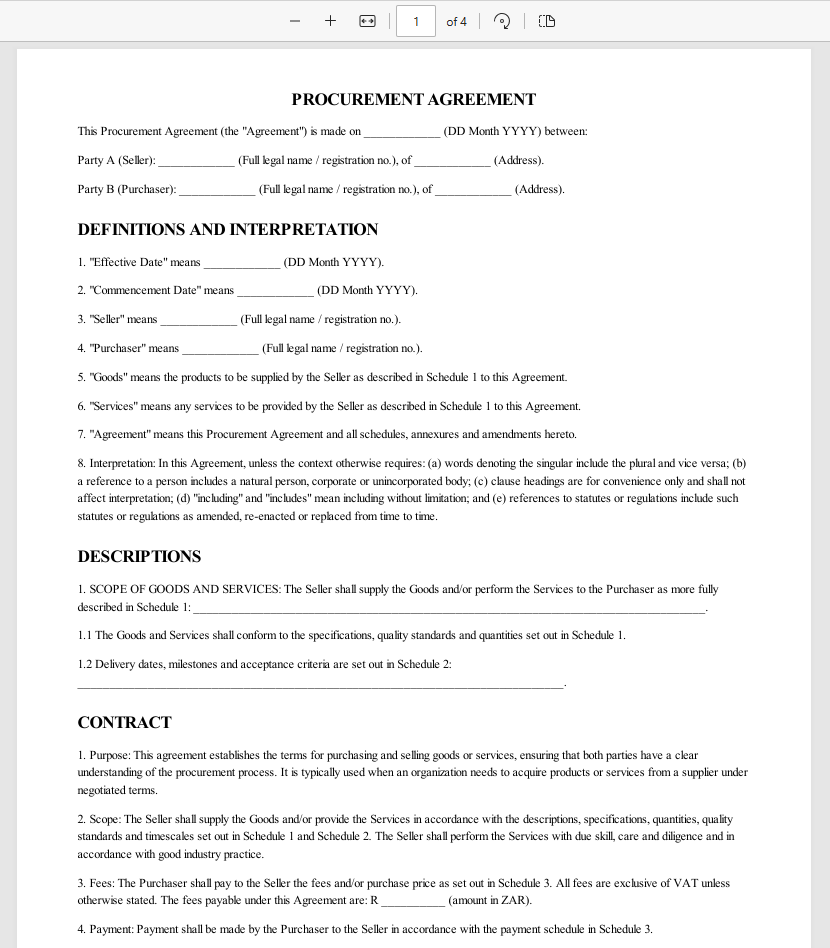
Connect on LinkedInProcurement Agreement
The templates and resources available through Contract Corridor are provided for general informational purposes only. They do not constitute legal advice, and their use does not create an attorney-client relationship between you and Contract Corridor or any of its affiliates.
While every effort has been made to ensure that the templates are up to date and relevant, Contract Corridor makes no representations or warranties, express or implied, regarding their accuracy, completeness, adequacy, legality, or suitability for any specific purpose. The templates may not reflect current legal developments or the laws applicable in your jurisdiction.
You are solely responsible for reviewing, customising, and validating any template before use, to ensure that any document meets your specific needs and complies with applicable laws and regulations.
To the fullest extent permitted by law, Contract Corridor, its owners, employees, and affiliates disclaim all liability for any loss, damage, or consequence arising directly or indirectly from the use of, or reliance upon, any template, resource, or related material provided on or through this platform.
By accessing, downloading, or using any template, you acknowledge and agree that such use is entirely at your own risk.
Contract Corridor Contract Templates