
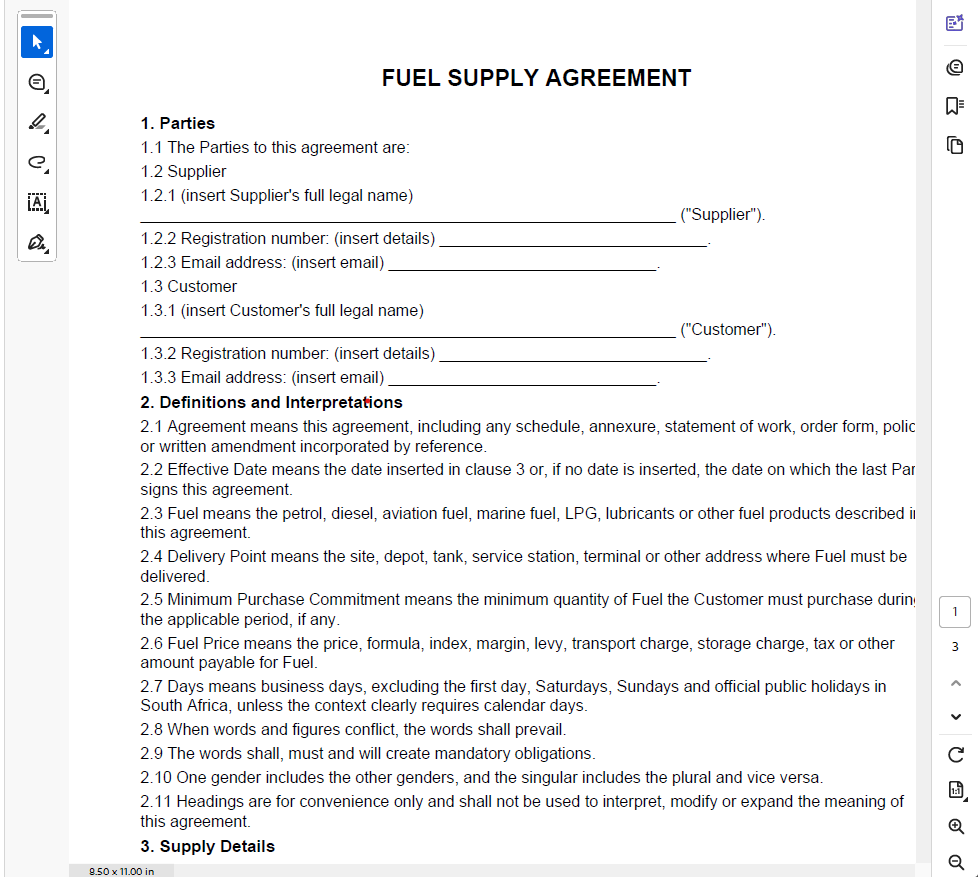
Fuel Supply Agreement
Essential Strategies for Securing Energy Resources
Introduction
Running a business requires steady energy sources. For many companies, this means buying large amounts of oil, gas, or electricity. Therefore, teams must secure these resources through formal legal deals. These deals keep operations running without interruptions. Contract Corridor helps managers organize these vital documents in one safe place.
Every major industry relies on energy to move goods or power machines. Consequently, a strong fuel supply agreement protects both the buyer and the seller. This document sets clear rules for prices and delivery times. Without it, price swings in the energy market could hurt your profits. Moreover, clear terms prevent messy legal fights later on.
Definition
Understanding the fuel supply agreement meaning is the first step for any procurement team. Essentially, this is a legal contract between a fuel provider and a customer. The provider agrees to deliver a specific type of energy resource. Meanwhile, the customer agrees to pay a set price over a certain period. This document outlines exactly how and when the transfer happens.
In fact, these contracts serve as a roadmap for the business relationship. They define the quality of the fuel and the location of delivery. Additionally, they specify what happens if the seller fails to provide the resource. By using this tool, companies ensure they always have the power they need to work.
Key Terms and Clauses
First, you must define the product specifications. For instance, different engines require specific grades of diesel or gasoline. You should list these technical details clearly in the contract. This prevents the supplier from sending low-quality products that might damage your equipment.
Second, the pricing mechanism remains the most important part of the deal. Some companies choose fixed prices to stay within a budget. Others prefer floating prices that change with the market. Regardless of your choice, you must explain the math behind the price in writing.
- Volume requirements and minimum purchase amounts
- Delivery schedules and specific drop-off locations
- Payment terms and late fee structures
- Fuel quality testing and inspection rights
- Force majeure clauses for natural disasters
Third, include a clear termination clause. Sometimes, a partnership does not work out as planned. Therefore, you need a legal way to end the relationship early. Specifically, name the behaviors that allow a party to cancel the deal. This protects your business from being stuck with a bad partner.
Types of Agreements
Companies choose different contract styles based on their goals. For example, a "Fixed Quantity" contract requires the buyer to take a exact amount. This helps the supplier plan their inventory levels. Conversely, it might limit the buyer if their needs change suddenly.
Another option is the "Requirements Contract." In this setup, the supplier provides as much fuel as the buyer actually needs. This offers great flexibility for growing businesses. However, the supplier may charge a higher price for this convenience. Both parties must agree on the expected range of fuel use.
Quick Stat: Nearly 70% of logistics companies favor long-term contracts to avoid daily market price changes. This helps them set predictable shipping rates for their own customers.
When to Use
You should sign a fuel supply agreement whenever your business depends on heavy machinery. For instance, trucking fleets need constant access to diesel. Similarly, manufacturing plants often need natural gas to run furnaces. If an energy shortage would stop your work, you need a formal contract.
Additionally, use these deals when you want to lock in a specific price. Market prices for oil can change every single hour. Therefore, a contract provides financial safety during times of global conflict. It allows your finance team to create accurate budgets for the coming year.
Benefits
Reliability stands out as the biggest advantage. When you have a signed deal, the supplier prioritizes your deliveries. Even during a shortage, the contract legally binds them to serve you first. Consequently, your business stays active while competitors might struggle to find fuel.
Furthermore, these contracts lead to better communication. Both parties know exactly what to expect every month. This clarity reduces stress for warehouse managers and drivers. Also, buying in bulk through a long-term deal usually lowers the overall cost per gallon.
Common Risks
Market volatility poses a major risk to both parties. If the market price drops significantly, the buyer might pay more than the current rate. In contrast, if prices skyrocket, the seller might lose money on every delivery. To mitigate this, teams often include "price caps" or "collars" in the document.
Another risk involves fuel quality. Contaminated fuel can destroy expensive truck engines or factory tools. To prevent this, include a clause that allows for independent testing. Similarly, require the supplier to carry heavy insurance for environmental spills or engine damage.
Pro Tip: Always include a "take-or-pay" clause carefully. This requires you to pay for fuel even if you do not use it. Make sure the minimum volume matches your lowest possible needs.
Comparison
Many people confuse these deals with "Spot Market" purchases. However, they are very different in practice. In the spot market, you buy fuel at the current daily price. You have no long-term relationship with the seller. This works well for small, one-time needs but offers no protection against shortages.
| Feature | Supply Agreement | Spot Market |
|---|---|---|
| Price Stability | High (Fixed or Formula) | Low (Changes Daily) |
| Delivery Priority | Guaranteed | First Come, First Served |
| Relationship | Long-Term Partner | Transaction Only |
| Administration | Complex Contract | Simple Receipt |
Examples in Different Industries
In the construction industry, developers use these deals for heavy equipment. For example, a large site might need thousands of gallons of diesel for cranes. A contract ensures that a fuel truck arrives every Monday morning. This keeps the project on schedule and avoids costly idle time.
Healthcare facilities also rely on these legal protections. Hospitals must keep backup generators ready at all times. Specifically, they sign deals to keep their on-site tanks full. If the power grid fails, the contract ensures they have enough energy to save lives. This is a matter of safety, not just business profit.
In the aviation world, airlines sign a fuel supply agreement to manage high costs. Fuel represents the largest expense for most flight companies. By securing millions of gallons in advance, they can sell tickets months ahead of time. This stability allows the travel industry to function smoothly.
Managing with Contract Corridor
Contract Corridor makes handling complex energy deals much easier. Our software provides powerful template management tools for your legal team. Instead of starting from scratch, you can use proven forms to build your next deal. This saves time and ensures you do not miss vital legal points.
Moreover, the platform offers automated tracking for expiration dates. You never want a fuel deal to end unexpectedly during a busy season. Therefore, our system sends alerts long before a contract expires. This gives your team plenty of time to negotiate better terms for the future.
- Upload your existing fuel contracts into the secure cloud.
- Set custom alerts for price adjustment dates and renewals.
- Collaborate with suppliers using built-in messaging tools.
- Monitor compliance to ensure every delivery matches contract terms.
Finally, Contract Corridor assists with compliance monitoring. You can store fuel quality reports and delivery receipts right next to the contract. This central hub makes it easy to prove that the supplier met their duties. In conclusion, using our software turns a complex fuel supply agreement into a simple, manageable asset for your company.
Frequently Asked Questions
What is a fuel supply agreement?
It is a legally binding contract where a supplier provides fuel to a buyer over a set time for an agreed price.
Can I change the price mid-contract?
Yes, if you include a price adjustment clause that links the cost to a market index or an inflation rate.
What happens if the fuel is poor quality?
The contract should include a quality clause. This allows you to reject the shipment and demand a refund or replacement.

About the Author: Melissa Jooste
Melissa Jooste is the Head of Marketing at Contract Corridor, where she shapes the voice, narrative, and market positioning of a leading contract lifecycle management platform. Recognized for her expertise in contract lifecycle management content, Melissa is known for producing insightful, high-impact thought leadership that challenges conventional approaches to contract management. Her work goes beyond surface-level marketing, offering clear, strategic perspectives on how organizations can unlock value, reduce risk, and gain control through more effective contract lifecycle practices. Her writing is widely valued for its clarity, depth, and relevance, bridging complex legal, financial, and operational concepts into content that is both accessible and commercially meaningful. By combining strong storytelling with data-driven insight, she consistently delivers content that resonates with senior business leaders, legal professionals, and operational teams alike. Through her work, Melissa plays a key role in establishing Contract Corridor as a leading voice in the contract lifecycle management space, shaping how organizations think about contracts, not as static documents, but as dynamic drivers of business performance.
Connect on LinkedIn
About the reviewer: Jenna Kretzmer
Jenna Kretzmer, CA(SA) is an Executive at Contract Corridor, where she plays a key role in shaping the strategic direction and market positioning of a leading contract lifecycle management platform. A global executive with over a decade of experience, Jenna has led large-scale, international operations and driven growth, transformation, and market expansion across multiple regions. She is recognized for her ability to operate at the intersection of strategy, execution, and commercial performance. Jenna is a leading voice in the contract lifecycle management space, known for her perspectives on contract governance, revenue optimization, and operational efficiency. Her work challenges traditional approaches to contract management, advocating for a shift toward greater visibility, accountability, and value realization across the entire contract lifecycle. She is driving Contract Corridor to enable organizations to move beyond static contract storage toward proactive, value-led contract management, where contracts are treated not as legal documents, but as dynamic instruments that drive measurable business outcomes.
Connect on LinkedInFuel Supply Agreement
The templates and resources available through Contract Corridor are provided for general informational purposes only. They do not constitute legal advice, and their use does not create an attorney-client relationship between you and Contract Corridor or any of its affiliates.
While every effort has been made to ensure that the templates are up to date and relevant, Contract Corridor makes no representations or warranties, express or implied, regarding their accuracy, completeness, adequacy, legality, or suitability for any specific purpose. The templates may not reflect current legal developments or the laws applicable in your jurisdiction.
You are solely responsible for reviewing, customising, and validating any template before use, to ensure that any document meets your specific needs and complies with applicable laws and regulations.
To the fullest extent permitted by law, Contract Corridor, its owners, employees, and affiliates disclaim all liability for any loss, damage, or consequence arising directly or indirectly from the use of, or reliance upon, any template, resource, or related material provided on or through this platform.
By accessing, downloading, or using any template, you acknowledge and agree that such use is entirely at your own risk.
Contract Corridor Contract Templates