
Operational Level Agreement
Aligning Internal Teams for Peak Performance
Table of Contents
What Is an Operational Level Agreement?
Step-by-Step Implementation Guide
Common Mistakes and How to Avoid Them
Introduction
Imagine a customer waiting for a technical fix. The support team promises a solution in two hours. However, the server team thinks they have two days to respond. This disconnect creates a massive service failure. Specific studies show that misaligned internal goals cause 80 percent of project delays. You must ensure every department works toward the same deadline. This article teaches you how to bridge those internal gaps effectively. Contract Corridor helps businesses streamline these vital internal documents. In this guide, you will learn the definition, benefits, and components of an operational level agreement. Soon, your teams will collaborate with total clarity and speed.Quick Answer Summary
What Is an Operational Level Agreement?
An operational level agreement acts as a blueprint for internal cooperation. It outlines exactly what one department provides to another department. For instance, the IT team might promise the HR team a new laptop within 24 hours. This document differs from a standard customer contract. Most contracts focus on the relationship between a buyer and a seller. In contrast, this internal deal focuses on the hand-offs between coworkers. An operational level agreement is a formal document that describes the specific technical or support services one internal group provides to another. Within the contract management landscape, these agreements serve as the foundation for the Service Level Agreement (SLA). If your internal teams fail to meet their own goals, you will likely break your promise to the customer. Therefore, these documents keep the entire organization accountable.Why It Matters
Without clear rules, teams often blame each other for mistakes. This finger-pointing drains company morale and slows down every process. Specifically, clear internal rules increase productivity and lower costs. Financial impacts are often hidden but very real. For example, slow internal hand-offs can lead to customer refunds or lost renewals. Furthermore, legal exposure grows when internal delays cause a breach of a major external contract.- Companies with aligned internal teams see 15 percent higher profit margins.
- Poor internal communication costs large firms an average of 62 million dollars annually.
- Clear internal goals improve employee retention by nearly 40 percent.
Key Components and Elements
A strong agreement needs detail to work correctly. You should include specific sections to prevent any confusion between the involved teams.- Service Scope: Define exactly what tasks the support team will perform.
- Response Times: Set a strict limit on how fast a team must acknowledge a request.
- Resolution Times: Determine how long the team has to finish the actual work.
- Operating Hours: State clearly when the team is available to help.
- Contact Methods: List the specific channels, like email or Slack, for sending requests.
- KPIs and Metrics: Identify how you will measure success or failure.
- Escalation Paths: Describe who to call if a deadline is missed.
Types and Categories
Internal deals vary depending on the departments involved. A tech team has different needs than a legal or marketing team. You can use the framework below to choose the right fit for your needs.| Type | Description | Best For | Key Consideration |
|---|---|---|---|
| IT Support | Technical fixes and hardware setup. | Server and Helpdesk teams. | Uptime and bug fix speed. |
| Human Resources | Hiring and onboarding workflows. | Recruiting and Management. | Security of personal data. |
| Legal/Compliance | Contract reviews and risk checks. | Sales and Legal departments. | Accuracy over raw speed. |
| Facilities | Building maintenance and logistics. | Office Ops and Employees. | Physical safety protocols. |
Step-by-Step Implementation Guide
Creating an operational-level agreement requires a collaborative spirit. You cannot force one team to follow rules they did not help write. Follow these steps to build a lasting document.- Identify the Departments: Select the two groups that need a better workflow.
Why: Clear boundaries prevent "scope creep" later on.
Pro Tip: Keep the group small to speed up the drafting process. - Audit Current Performance: Look at how long tasks currently take.
Why: You need a realistic baseline before setting new targets.
Pro Tip: Use data from the last three months for accuracy. - Draft the Terms: Write down the response times and duties.
Why: This puts everyone on the same page.
Pro Tip: Use simple language to avoid future legal arguments. - Review and Sign: Get both department heads to approve the draft.
Why: Management buy-in ensures the team takes the rules seriously.
Pro Tip: Use a digital signature to save time. - Monitor and Adjust: Check the metrics every month.
Why: Business needs change, and the agreement must evolve too.
Pro Tip: Treat the first 90 days as a pilot program.
Common Mistakes and How to Avoid Them
Many leaders rush the drafting process. This leads to documents that look good but do not work. Avoid these common pitfalls to keep your teams running smoothly.| Mistake | Why It Happens | How to Fix It |
|---|---|---|
| Unrealistic Deadlines | Teams want to look faster than they are. | Set targets based on historical data. |
| Vague Language | Writers use jargon to sound professional. | Use plain English and define all terms. |
| Ignoring the Customer | Internal teams forget the external SLA. | Ensure internal goals support the client's deal. |
| No Review Date | The document gathers dust in a folder. | Schedule a formal review every six months. |
Always remember that an internal agreement is a partnership, not a weapon to use against coworkers.
Industry Examples and Use Cases
Different sectors use these tools in unique ways. Seeing them in action helps you visualize how they apply to your business. Example 1: Software Development The QA team and the Developer team create an operational service level agreement. The developers promise to fix "critical" bugs within four hours. In return, the QA team promises to provide detailed logs for every error. Consequently, the product ships on time with fewer errors. Example 2: Healthcare A hospital lab and the emergency room set clear rules for blood tests. The lab commits to returning results within 30 minutes for urgent cases. Because of this agreement, doctors make faster decisions. As a result, patient safety increases significantly. Example 3: Finance A bank's sales team needs the compliance team to vet new clients. They agree that compliance will finish most checks within two business days. This transparency allows the sales team to give customers accurate start dates.Frequently Asked Questions
How is this different from an SLA?
An SLA is a promise between a company and an outside customer. This internal deal focuses only on how departments inside the company help each other. It supports the SLA from behind the scenes.
Who should write these documents?
Managers from both departments should draft the terms together. This ensures that the goals are realistic for the people doing the work. Usually, a contract manager oversees the process to maintain standards.
Are these agreements legally binding?
Generally, these are not legally binding in a court of law since they are internal. However, they are binding within the company's HR and management policies. Teams must follow them to meet their performance reviews.
Can I use one for small teams?
Yes, even small teams benefit from clear expectations. It prevents confusion as the company grows. Small companies often find these documents essential for scaling operations quickly.
How Contract Corridor Helps
Managing internal documents can feel overwhelming without the right tools. Contract Corridor simplifies the entire lifecycle of your agreements. You can store everything in one central location for easy access. Our platform offers automated reminders for review dates. This means you never have to worry about an outdated operational level agreement. Furthermore, our collaboration tools allow departments to edit terms in real-time. Finally, our dashboard tracks how well teams meet their goals. You can see bottlenecks before they become major problems. If you want to improve your internal operations, start organizing your agreements today.
About the Author: Melissa Jooste
Melissa Jooste is the Head of Marketing at Contract Corridor, where she shapes the voice, narrative, and market positioning of a leading contract lifecycle management platform. Recognized for her expertise in contract lifecycle management content, Melissa is known for producing insightful, high-impact thought leadership that challenges conventional approaches to contract management. Her work goes beyond surface-level marketing, offering clear, strategic perspectives on how organizations can unlock value, reduce risk, and gain control through more effective contract lifecycle practices. Her writing is widely valued for its clarity, depth, and relevance, bridging complex legal, financial, and operational concepts into content that is both accessible and commercially meaningful. By combining strong storytelling with data-driven insight, she consistently delivers content that resonates with senior business leaders, legal professionals, and operational teams alike. Through her work, Melissa plays a key role in establishing Contract Corridor as a leading voice in the contract lifecycle management space, shaping how organizations think about contracts, not as static documents, but as dynamic drivers of business performance.
Connect on LinkedIn
About the reviewer: Jenna Kretzmer
Jenna Kretzmer, CA(SA) is an Executive at Contract Corridor, where she plays a key role in shaping the strategic direction and market positioning of a leading contract lifecycle management platform. A global executive with over a decade of experience, Jenna has led large-scale, international operations and driven growth, transformation, and market expansion across multiple regions. She is recognized for her ability to operate at the intersection of strategy, execution, and commercial performance. Jenna is a leading voice in the contract lifecycle management space, known for her perspectives on contract governance, revenue optimization, and operational efficiency. Her work challenges traditional approaches to contract management, advocating for a shift toward greater visibility, accountability, and value realization across the entire contract lifecycle. She is driving Contract Corridor to enable organizations to move beyond static contract storage toward proactive, value-led contract management, where contracts are treated not as legal documents, but as dynamic instruments that drive measurable business outcomes.
Connect on LinkedInOperational Level Agreement
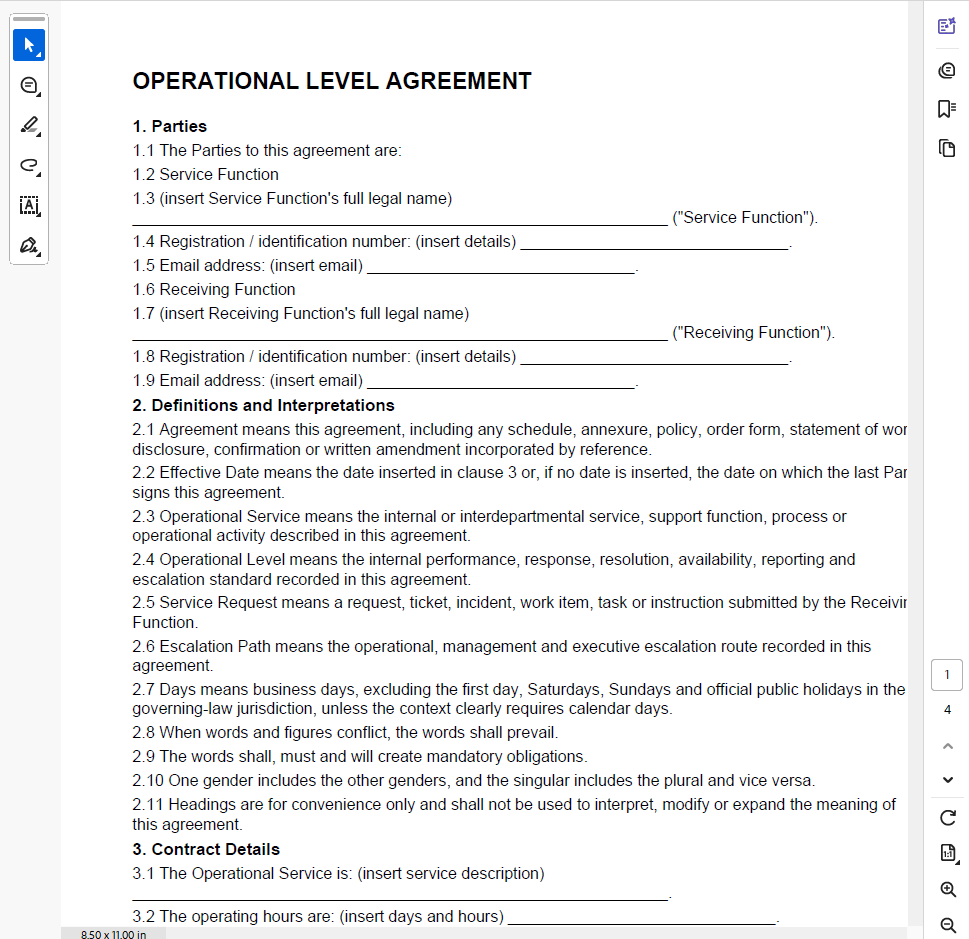
The templates and resources available through Contract Corridor are provided for general informational purposes only. They do not constitute legal advice, and their use does not create an attorney-client relationship between you and Contract Corridor or any of its affiliates.
While every effort has been made to ensure that the templates are up to date and relevant, Contract Corridor makes no representations or warranties, express or implied, regarding their accuracy, completeness, adequacy, legality, or suitability for any specific purpose. The templates may not reflect current legal developments or the laws applicable in your jurisdiction.
You are solely responsible for reviewing, customising, and validating any template before use, to ensure that any document meets your specific needs and complies with applicable laws and regulations.
To the fullest extent permitted by law, Contract Corridor, its owners, employees, and affiliates disclaim all liability for any loss, damage, or consequence arising directly or indirectly from the use of, or reliance upon, any template, resource, or related material provided on or through this platform.
By accessing, downloading, or using any template, you acknowledge and agree that such use is entirely at your own risk.
Contract Corridor Contract Templates