
Construction Contract
A Practical Breakdown for Modern Teams
Introduction
Imagine starting a million-dollar building project on just a handshake. Sadly, nearly 30% of construction firms report disputes over verbal agreements every year. You need a solid construction contract to protect your business and your budget. Without one, a small misunderstanding can turn into a legal nightmare.
Therefore, managing these documents correctly is the secret to a successful build. In this article, you will learn the exact steps to draft and manage these vital papers. Contract Corridor helps teams stay organized by storing every building agreement template in a safe, central location. Let us dive into the details of professional construction agreements.
Quick Answer Summary
A construction contract is a legally binding document between a client and a builder. It defines the work schedule, total costs, and specific materials for a building project. By using a standard construction contract agreement, both parties reduce risks and ensure clear communication. These documents turn vague ideas into a clear, enforceable plan for everyone involved.
What Is a Construction Contract?
In simple terms, it is an agreement that outlines the rules for building or fixing a structure. The term comes from the Latin "com-" meaning together and "struere" meaning to pile up. A construction contract is a legal promise where one party provides labor and materials while the other provides payment.
Moreover, these documents sit at the heart of the legal technology world. They act as the "source of truth" for architects, engineers, and owners. Often, companies start with a construction agreement template free of charge from the internet. However, professionals usually customize these files to fit their specific needs. Using a basic building contract ensures that everyone knows their role before the first shovel hits the ground.
Why It Matters
Getting your paperwork right saves money and time. If you use a weak contract for construction services, you might face huge delays. For instance, builders often lose money because they did not define "extra work" clearly. A strong format for construction contract prevents these issues from escalating.
The Cost of Poor Contracts
- Financial Impact: Poorly managed contracts can lead to a 15% increase in total project costs.
- Legal Exposure: Over 40% of construction lawsuits stem from unclear scope of work clauses.
- Efficiency: Teams using a project contract template finish their planning stages 25% faster.
Additionally, clear terms help maintain a good relationship between the owner and the builder. When you use a residential building contract template, you protect your home and your savings. In contrast, working without a blank contractor contract leaves you vulnerable to mechanics' liens and poor workmanship.
Key Components & Elements
Every successful project requires a few core pieces of information. You should check your building contractor agreement template for these items. If they are missing, your project is at risk.
- Scope of Work: This section describes exactly what the builder will do. It lists the tasks, materials, and specific goals of the project.
- Payment Schedule: It tells the owner when and how to pay the contractor. This usually follows a timeline based on completed milestones.
- Timeline and Completion Dates: This sets a firm deadline for finishing the work. Usually, it includes a start date and a move-in date.
- Change Order Process: This explains how to handle changes to the original plan. It prevents surprise costs from appearing later.
- Insurance and Licensing: This proves the contractor has the right to work. It ensures the builder covers any accidents on the job site.
- Dispute Resolution: This tells both parties how to fix disagreements. Usually, it suggests mediation or arbitration before going to court.
Types & Categories
Not every project uses the same rules. You must choose the right template of construction contract for your specific needs. Use the table below to compare the most common options.
| Type | Description | Best For | Key Consideration |
|---|---|---|---|
| Lump Sum | A fixed price for the entire project. | Simple builds with clear plans. | The builder takes on more risk. |
| Cost-Plus | The owner pays for costs plus a fee. | Unclear or complex projects. | Costs can rise quickly. |
| Time and Materials | Payment based on hourly rates and used items. | Small repairs or maintenance. | Requires strict tracking. |
| Unit Price | Prices set per unit of work (like per yard). | Public works or road building. | Quantities might change. |
Step-by-Step Implementation Guide
Ready to start your project? Follow these steps to ensure your legal paperwork is perfect. Use these instructions to build a strong foundation for your work.
- Define the Scope: List every single task the builder must complete. This prevents "scope creep" where the project grows too large. Pro Tip: Use a construction work contract sample to see how professionals describe their tasks.
- Choose a Template: Select a construction job contract template that fits your project type. For example, use a home remodeling contract template for kitchen upgrades. Pro Tip: Always look for a reputable source for your building contracts template.
- Negotiate the Price: Discuss the total cost and the payment milestones. Write these down in the house construction contract. Pro Tip: Never pay 100% of the money upfront.
- Review and Edit: Read every line of the construction contractor contract template. Make sure the dates and names are all correct. Pro Tip: Ask a legal expert to review your construction agreement template.
- Sign and Store: Both parties must sign the document. Then, save a copy in a secure digital system like Contract Corridor. Pro Tip: Keep a construction contract agreement sample for your records.
Common Mistakes & How to Avoid Them
Many people rush through their paperwork. This leads to expensive errors. Use the table below to avoid the most common traps in the industry.
| Mistake | Why It Happens | How to Fix It |
|---|---|---|
| Vague Work Descriptions | People assume the builder knows what to do. | Use a detailed construction work contract template. |
| Missing Deadlines | Parties forget to set a firm end date. | Include a specific schedule in your contract for building. |
| Oral Agreements | Trusting a person's word over a written document. | Always use a printable construction contract. |
| Ignoring Insurance | Assuming the contractor is covered. | Verify certificates before signing a brick-and-mortar builder contract. |
The single most important rule is this: if it is not in writing, it does not exist in the eyes of the law.
Industry Examples & Use Cases
Construction papers look different depending on the situation. Here are three ways teams use these documents in the real world.
Scenario 1: Residential Remodeling
A homeowner wants to fix their kitchen. They use a remodeling contract template to set a budget of $30,000. Because they defined the materials, the builder could not charge extra for expensive tiles later. The project finished on time and at the agreed price.
Scenario 2: Commercial Office Build
A tech company needs a new office. They hire a manager using a construction project manager contract template. This document ensures the manager tracks all subcontractors. Specifically, it helped the company save 10% by catching double-billing errors early.
Scenario 3: New Home Build
A family uses a new home construction contract template to build their dream house. The contract included a late penalty clause. When the builder fell two months behind, the family received a credit. This protected their budget during a stressful delay.
Frequently Asked Questions
What is a construction contract exactly?
It is a legally binding document between an owner and a contractor. It outlines the work, costs, and timeline for a building project to prevent legal disputes.
Can I use a free construction contract template?
Yes, you can use a free construction contract template for basic projects. However, you should always customize it to match your local laws and specific project needs.
How do I write a construction contract?
Start by identifying the parties and describing the work in detail. Then, add payment terms, site rules, and signatures to make it official and legal.
What is the difference between a contractor and a subcontractor?
The general contractor works directly for the owner. Subcontractors work for the general contractor to handle specific tasks like plumbing or electrical work.
Where can I find construction forms for contractors?
You can find them on legal websites or through software platforms. Contract Corridor provides a central place to store and manage all your building agreement files.
How Contract Corridor Helps
Managing a pile of paper is hard. Contract Corridor makes it easy to handle your construction contract from start to finish. Our platform helps you organize every building agreement template in one dashboard. Therefore, you never have to search through old emails to find a signature again.
First, our software tracks deadlines and payment milestones for you. This means you will always know when the next payment is due. Second, we offer a secure place to store your construction contractor contract sample. Your team can access the latest version from any device. Finally, our reminder system ensures you never miss a contract renewal or an insurance expiration date.
Stop worrying about lost files and unclear terms. Use Contract Corridor to simplify your legal workflow today. Your projects deserve the protection of professional contract management. Contact us now to see how we can streamline your building process.

About the Author: Melissa Jooste
Melissa Jooste is the Head of Marketing at Contract Corridor, where she shapes the voice, narrative, and market positioning of a leading contract lifecycle management platform. Recognized for her expertise in contract lifecycle management content, Melissa is known for producing insightful, high-impact thought leadership that challenges conventional approaches to contract management. Her work goes beyond surface-level marketing, offering clear, strategic perspectives on how organizations can unlock value, reduce risk, and gain control through more effective contract lifecycle practices. Her writing is widely valued for its clarity, depth, and relevance, bridging complex legal, financial, and operational concepts into content that is both accessible and commercially meaningful. By combining strong storytelling with data-driven insight, she consistently delivers content that resonates with senior business leaders, legal professionals, and operational teams alike. Through her work, Melissa plays a key role in establishing Contract Corridor as a leading voice in the contract lifecycle management space, shaping how organizations think about contracts, not as static documents, but as dynamic drivers of business performance.
Connect on LinkedIn
About the reviewer: Jenna Kretzmer
Jenna Kretzmer, CA(SA) is an Executive at Contract Corridor, where she plays a key role in shaping the strategic direction and market positioning of a leading contract lifecycle management platform. A global executive with over a decade of experience, Jenna has led large-scale, international operations and driven growth, transformation, and market expansion across multiple regions. She is recognized for her ability to operate at the intersection of strategy, execution, and commercial performance. Jenna is a leading voice in the contract lifecycle management space, known for her perspectives on contract governance, revenue optimization, and operational efficiency. Her work challenges traditional approaches to contract management, advocating for a shift toward greater visibility, accountability, and value realization across the entire contract lifecycle. She is driving Contract Corridor to enable organizations to move beyond static contract storage toward proactive, value-led contract management, where contracts are treated not as legal documents, but as dynamic instruments that drive measurable business outcomes.
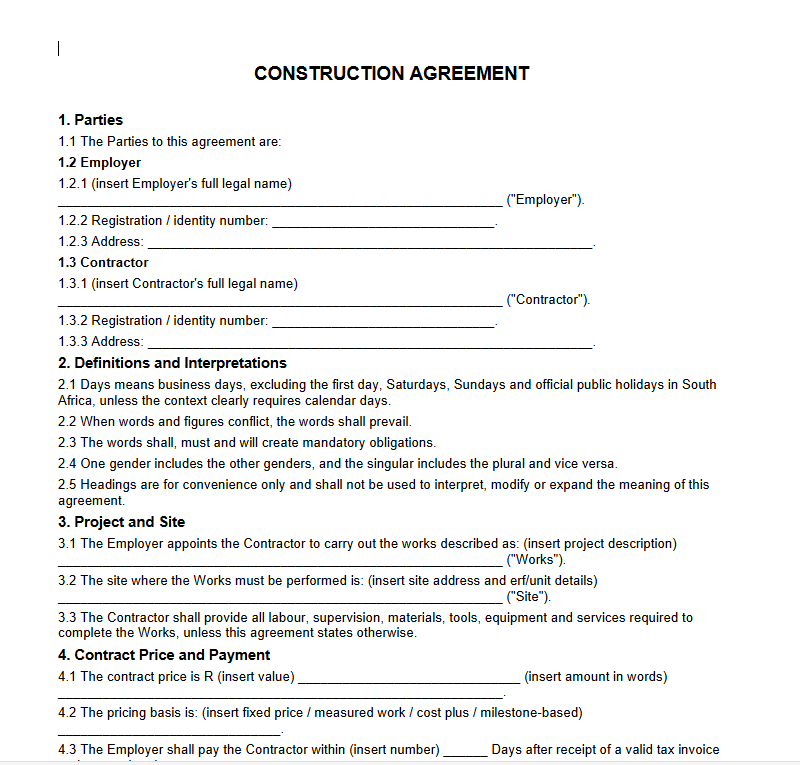
Connect on LinkedInConstruction Agreement
The templates and resources available through Contract Corridor are provided for general informational purposes only. They do not constitute legal advice, and their use does not create an attorney-client relationship between you and Contract Corridor or any of its affiliates.
While every effort has been made to ensure that the templates are up to date and relevant, Contract Corridor makes no representations or warranties, express or implied, regarding their accuracy, completeness, adequacy, legality, or suitability for any specific purpose. The templates may not reflect current legal developments or the laws applicable in your jurisdiction.
You are solely responsible for reviewing, customising, and validating any template before use, to ensure that any document meets your specific needs and complies with applicable laws and regulations.
To the fullest extent permitted by law, Contract Corridor, its owners, employees, and affiliates disclaim all liability for any loss, damage, or consequence arising directly or indirectly from the use of, or reliance upon, any template, resource, or related material provided on or through this platform.
By accessing, downloading, or using any template, you acknowledge and agree that such use is entirely at your own risk.
Contract Corridor Contract Templates