
Framework Agreement
A Practical Guide to Long-Term Business Success
Table of Contents
What Is a Framework Agreement?
Step-by-Step Implementation Guide
Introduction
Imagine your company needs to buy supplies every single month. Instead of writing a new contract every time, you could set the rules once. Many businesses waste hundreds of hours on repetitive paperwork because they lack a proper framework of agreement between partners. This simple document can cut your procurement time by half. Every modern manager should understand how these tools work to save money and stress. In this article, you will learn how to set up these arrangements correctly. Contract Corridor helps teams navigate these complex legal documents with ease. By the end, you will know how to protect your interests while building strong relationships.
Quick Answer Summary
A framework agreement is a broad document that sets terms for future transactions between parties. It does not usually force a specific purchase but establishes prices, quality standards, and delivery rules for later orders. This method allows buyers and sellers to work together quickly without renegotiating every small detail. Businesses use them to save time, reduce costs, and ensure a steady supply of goods or services.
What Is a Framework Agreement?
In the world of business, efficiency is the most important goal. A framework agreement is a long-term arrangement that sets the standard terms for any future contracts during a specific period. It acts like an umbrella for many smaller transactions. When you sign one, you agree on how you will work together. However, you do not usually commit to a specific volume of work yet. Instead, you create a menu of prices and rules.
The origin of this concept comes from public sector buying. Government agencies needed a way to hire builders or suppliers without starting from zero every week. Within the contract management landscape, this document sits above the individual purchase order. It provides the foundation for the entire business relationship. Consequently, people often call it a master agreement or a standing offer. Many teams use it to build trust with their best suppliers over several years.
Why It Matters
Getting this document right saves your legal team from constant headaches. For example, if you miss a price clause, your costs might skyrocket next year. On the other hand, a good document ensures quality never drops. You gain a competitive edge because you can move faster than your rivals. They are still writing contracts while you are already receiving goods.
Research shows the impact of using framework agreements effectively:
- Cost Savings: Companies often reduce procurement costs by 15 percent through these deals.
- Time Efficiency: Administrative time drops by up to 50 percent for repeat purchases.
- Risk Reduction: Standardized terms lower the chance of legal disputes by nearly 30 percent.
Operational efficiency improves when everyone knows the rules. For instance, your accounts payable team already knows the payment terms. Your warehouse knows exactly how items should arrive. If you get it wrong, you face high legal exposure. A single mistake in the liability clause could cost millions. Therefore, you must pay attention to every detail in the initial draft.
Key Components & Elements
A strong document must cover all possible future scenarios. You should include specific details to prevent any confusion later. Most successful framework agreements share several core elements.
- Duration: This tells you exactly how long the relationship will last, such as three or five years.
- Pricing Structure: You should define if prices are fixed or if they can change with the market.
- Scope of Work: This identifies the specific goods or services the supplier will provide.
- Call-off Process: You must explain exactly how the buyer will place a specific order under the main deal.
- Quality Standards: This part sets the bar for what counts as acceptable work or materials.
- Termination Clauses: You need a clear way to end the deal if a partner performs poorly.
- Dispute Resolution: This section dictates how you will handle disagreements without going to court immediately.
Types & Categories
Not every business relationship is the same. Thus, you must choose the right type of structure for your needs. The table below compares the most common options.
| Type | Description | Best For | Key Consideration |
|---|---|---|---|
| Single-Supplier | One company provides all the goods or services. | Specialized niche parts. | Higher risk if the supplier fails. |
| Multi-Supplier | A panel of companies competes for individual orders. | General construction or IT. | Harder to manage many partners. |
| Open Framework | New suppliers can join the deal late. | Rapidly changing tech markets. | Rules for joining must be clear. |
| Closed Framework | Only original signers can participate. | Low-risk office supplies. | Provides more stability for prices. |
Step-by-Step Implementation Guide
Setting up a new deal takes careful planning. You should follow these steps to ensure a smooth process. This approach helps you avoid common legal traps.
- Define Your Needs: List every product or service you might need over the next few years. This saves time because you won't have to add things later. Pro Tip: Ask your department heads what they struggle to buy currently.
- Select Your Partners: Vet several suppliers to find the best fit for your company culture. Finding a reliable partner is more important than finding the cheapest one. Pro Tip: Check their financial health before signing anything long-term.
- Draft the Umbrella Terms: Focus on the big picture like liability, insurance, and intellectual property. These rules protect your business from major losses. Pro Tip: Use plain language so everyone understands their obligations.
- Set the Pricing Rules: Decide how you will handle inflation or market changes over the coming years. This prevents suppliers from raising prices unfairly later. Pro Tip: Include a cap on how much prices can rise each year.
- Finalize the Call-off Method: Design a simple form or email process for placing new orders. Easy systems ensure your staff actually uses the agreement. Pro Tip: Make this digital to track your spending automatically.
Common Mistakes & How to Avoid Them
Even experts make mistakes when drafting these documents. However, you can learn from their errors. The following table highlights what to avoid.
| Mistake | Why It Happens | How to Fix It |
|---|---|---|
| Vague Pricing | Teams assume prices stay the same. | Index prices to a market standard. |
| No Exit Strategy | Partners expect a lifelong bond. | Add a "no-fault" termination clause. |
| Ignoring KPIs | Managers focus only on the price. | Define clear metrics for performance. |
| Over-commitment | Buyers promise volumes they cannot meet. | Only promise "good faith" efforts. |
Always remember that a framework should remain flexible. Markets change quickly, so your contracts must allow for adjustments over time.
Industry Examples & Use Cases
Frameworks work in many different sectors. Each industry uses them to solve specific problems. Here are three common scenarios.
Construction: A city council wants to build ten schools over five years. Instead of bidding each school separately, they sign an agreement with three builders. When a school project starts, the council asks the three builders for a quick quote. This saves months of advertising and interviewing.
Healthcare: A large hospital needs a steady supply of surgical gloves. They sign a long-term deal with a medical supplier. This ensures the gloves always meet safety standards. It also keeps the price steady even if global demand for rubber increases.
Technology: A bank needs several software developers for various short projects. They create a list of approved agencies. When a new app needs building, they hire someone from the list immediately. The hourly rates and security rules are already agreed upon.
Frequently Asked Questions
How long does a framework agreement usually last?
Most of these deals last between three and five years. However, you can make them shorter or longer based on your specific business needs.
Does this document force me to buy goods?
Usually, it does not create a legal obligation to purchase. It simply sets the rules for when you do decide to place an order.
Can I have multiple suppliers on one agreement?
Yes, many companies use multi-supplier panels to encourage competition. This helps you get better prices and prevents a single supplier from failing you.
What is a call-off contract?
A call-off contract is the specific order you place under the main framework. It inherits all the rules from the larger agreement but adds specific details like dates.
How Contract Corridor Helps
Managing many different partners requires the right tools. Contract Corridor provides the platform you need to keep everything organized. Our system simplifies the way you handle framework agreements. First, we provide central storage so you never lose an important deadline. You can see every expiration date at a glance. Second, our automation features help you manage the call-off process. This ensures every individual order follows the main legal rules. Third, we offer tracking for performance metrics. You can see which suppliers truly deliver on their promises. Consequently, you make better decisions for your business future. Contact us today to see how we can streamline your contract lifecycle.

About the Author: Melissa Jooste
Melissa Jooste is the Head of Marketing at Contract Corridor, where she shapes the voice, narrative, and market positioning of a leading contract lifecycle management platform. Recognized for her expertise in contract lifecycle management content, Melissa is known for producing insightful, high-impact thought leadership that challenges conventional approaches to contract management. Her work goes beyond surface-level marketing, offering clear, strategic perspectives on how organizations can unlock value, reduce risk, and gain control through more effective contract lifecycle practices. Her writing is widely valued for its clarity, depth, and relevance, bridging complex legal, financial, and operational concepts into content that is both accessible and commercially meaningful. By combining strong storytelling with data-driven insight, she consistently delivers content that resonates with senior business leaders, legal professionals, and operational teams alike. Through her work, Melissa plays a key role in establishing Contract Corridor as a leading voice in the contract lifecycle management space, shaping how organizations think about contracts, not as static documents, but as dynamic drivers of business performance.
Connect on LinkedIn
About the reviewer: Jenna Kretzmer
Jenna Kretzmer, CA(SA) is an Executive at Contract Corridor, where she plays a key role in shaping the strategic direction and market positioning of a leading contract lifecycle management platform. A global executive with over a decade of experience, Jenna has led large-scale, international operations and driven growth, transformation, and market expansion across multiple regions. She is recognized for her ability to operate at the intersection of strategy, execution, and commercial performance. Jenna is a leading voice in the contract lifecycle management space, known for her perspectives on contract governance, revenue optimization, and operational efficiency. Her work challenges traditional approaches to contract management, advocating for a shift toward greater visibility, accountability, and value realization across the entire contract lifecycle. She is driving Contract Corridor to enable organizations to move beyond static contract storage toward proactive, value-led contract management, where contracts are treated not as legal documents, but as dynamic instruments that drive measurable business outcomes.
Connect on LinkedInFramework Agreement
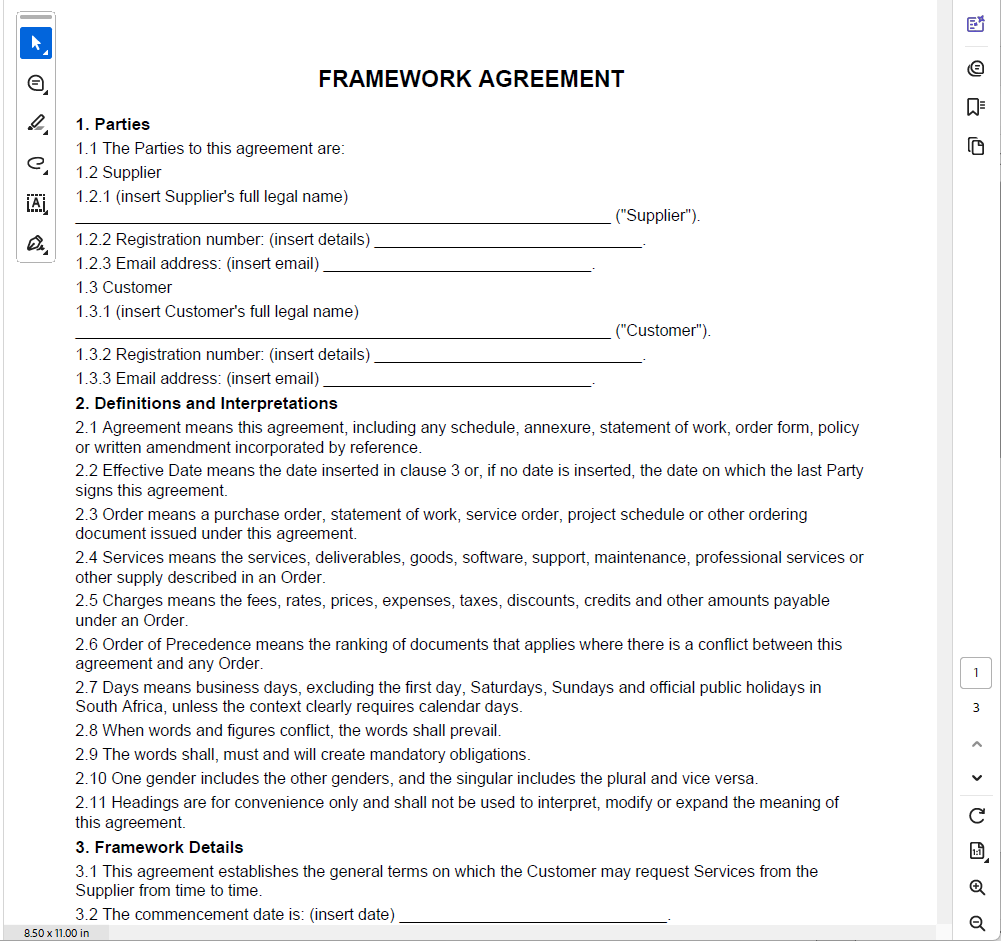
The templates and resources available through Contract Corridor are provided for general informational purposes only. They do not constitute legal advice, and their use does not create an attorney-client relationship between you and Contract Corridor or any of its affiliates.
While every effort has been made to ensure that the templates are up to date and relevant, Contract Corridor makes no representations or warranties, express or implied, regarding their accuracy, completeness, adequacy, legality, or suitability for any specific purpose. The templates may not reflect current legal developments or the laws applicable in your jurisdiction.
You are solely responsible for reviewing, customising, and validating any template before use, to ensure that any document meets your specific needs and complies with applicable laws and regulations.
To the fullest extent permitted by law, Contract Corridor, its owners, employees, and affiliates disclaim all liability for any loss, damage, or consequence arising directly or indirectly from the use of, or reliance upon, any template, resource, or related material provided on or through this platform.
By accessing, downloading, or using any template, you acknowledge and agree that such use is entirely at your own risk.
Contract Corridor Contract Templates