
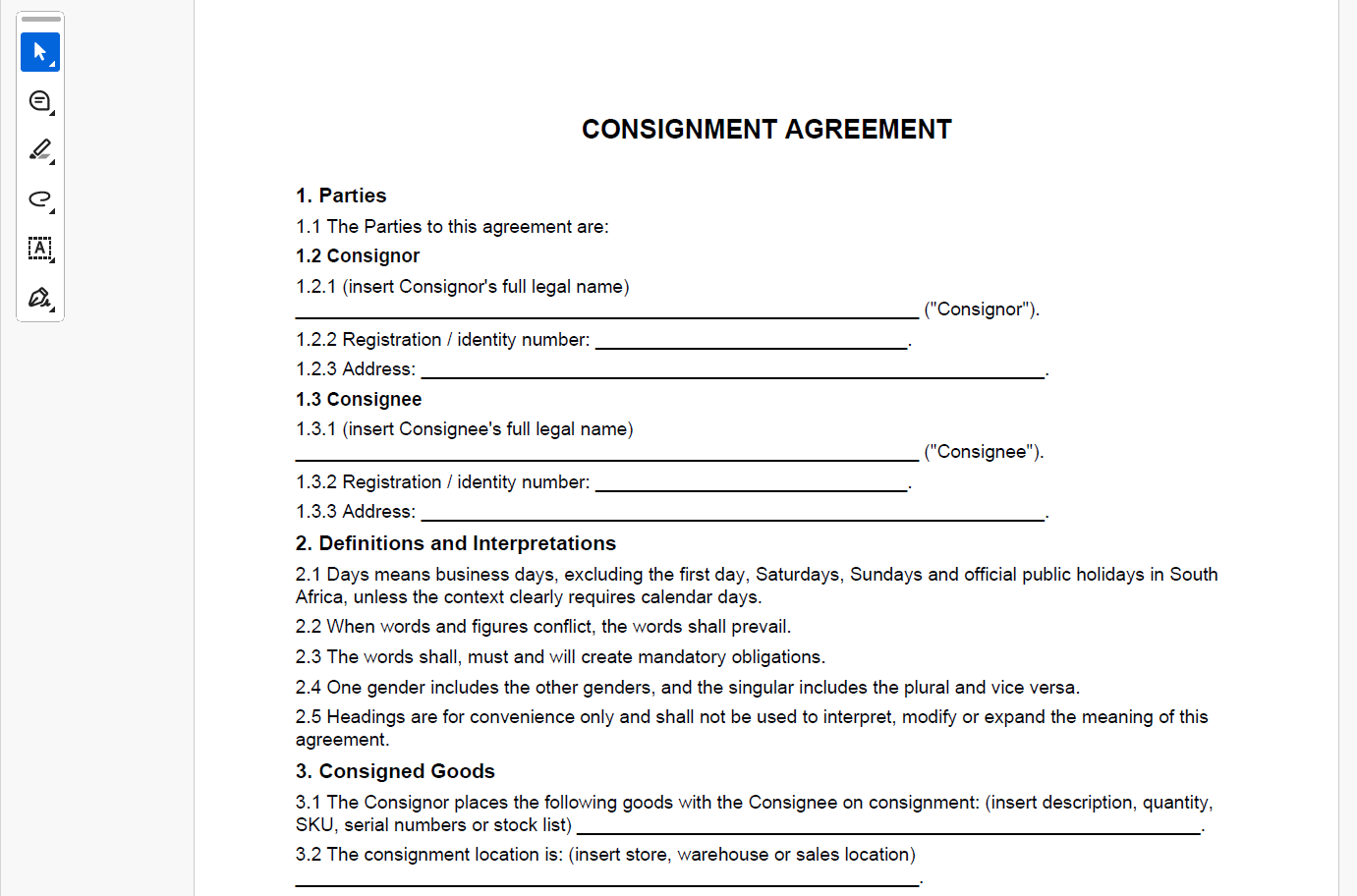
Consignment Agreement
Practical Strategies for Efficient Inventory Management
Introduction
Imagine you own a small boutique. You want to sell luxury watches but cannot afford to buy them in bulk. Conversely, a watchmaker has inventory but no storefront. This is where a deal comes into play. You will learn how these contracts protect both parties and keep goods moving. In fact, inventory costs can sink a growing business. Contract Corridor helps teams navigate these complex partnerships with ease. Our platform ensures your language stays clear and your risks stay low. This article explains how to build a solid legal foundation for your retail or wholesale partnerships.Quick Answer Summary
What Is a Consignment Agreement?
The word consignment comes from the French word "consigner," meaning to deliver or hand over. In the modern business world, this refers to a specific inventory strategy. A consignment agreement is a formal contract between a supplier and a seller that allows the seller to stock goods without paying for them upfront. Specifically, this falls under the umbrella of supply chain management. The consignor provides the goods while the consignee provides the sales floor. Because the consignor retains the title, they can take back the items if they do not sell. Consequently, the seller avoids the burden of debt for unsold stock.Why It Matters
This legal tool creates a win-win scenario for many businesses. First, it lowers the barrier to entry for small retailers. Second, it allows manufacturers to reach new markets without opening their own shops. However, without a clear consignment contract agreement, both sides face significant financial threats.The Impact of Inventory Management
- Loss Prevention: Studies show that clear contracts reduce inventory disputes by over 40 percent.
- Cash Flow: Retailers can increase their product variety by 30 percent without spending extra capital.
- Legal Safety: Properly filed security interests protect owners if a seller goes bankrupt.
Key Components & Elements
To build a strong document, you must include several specific sections. You can start with a simple consignment agreement template and customize it for your needs.- Property Description: A detailed list of the items, including serial numbers and condition reports.
- Pricing and Commission: The exact dollar amount or percentage the seller keeps from every sale.
- Duration of Agreement: The timeframe the seller has to move the inventory before returning it.
- Insurance and Liability: A clause stating who covers the cost if items are stolen or damaged.
- Payment Terms: How quickly the consignee must pay the consignor after a sale happens.
- Return Policy: The process for the consignor to reclaim unsold items at the end of the term.
Types & Categories
Different industries require different types of consignment contracts. Use the table below to see which format fits your specific business model.| Type | Description | Best For | Key Consideration |
|---|---|---|---|
| Retail Inventory | Selling small goods like clothing or art. | Boutiques and Galleries | High volume of small items. |
| Vehicle/Auto | Dealer sells a car for a private owner. | Car Dealerships | Clear title transfer rules. |
| Wholesale Stock | Suppliers place bulk stock in a warehouse. | Manufacturers | Vast storage requirements. |
| Electronic/High-Value | Specialized items with high price tags. | Tech Resellers | Extra security and insurance. |
Step-by-Step Implementation Guide
Follow these steps to set up a successful partnership. Whether you use a consignment form template free of charge or build one from scratch, these steps remain the same.- Evaluate the Partner: Check the seller's reputation and financial health. This ensures they can actually sell your goods. Pro tip: Ask for references from other suppliers.
- Draft the Document: Use a consignment agreement sample to outline the terms. This saves time and ensures you do not miss legal basics. Pro tip: Always specify who pays for shipping.
- Inspect the Goods: Create a consignment form that lists the condition of every item. This prevents later arguments about damage. Pro tip: Take high-resolution photos of every item.
- File a UCC-1 Form: In many regions, you must file a public notice to show you still own the goods. This protects you from the seller’s creditors. Pro tip: Do this before delivering any items.
- Monitor Sales Regularly: Set a schedule for inventory counts and payments. This helps identify "shrinkage" or theft early. Pro tip: Use software to track these dates.
Common Mistakes & How to Avoid Them
Many businesses rush into a consignment deal without thinking about the risks. Avoid these common pitfalls to protect your profit margins.| Mistake | Why It Happens | How to Fix It | |
|---|---|---|---|
| Vague Pricing | Parties assume they agree on the "market price." | Set a specific minimum sales price in writing. | |
| Missing Insurance | The seller thinks the owner's policy covers it. | Require the seller to provide proof of insurance. | |
| No End Date | People forget to set a timeline for sales. | Include an automatic return clause after 90 days. | |
| Poor Record Keeping | Teams rely on verbal tallies instead of forms. | Use a standard consignment form template for every batch. |
The most important thing to remember is that title remains with the consignor. If you lose track of where your items are, you lose your legal protection.
Industry Examples & Use Cases
A consignment agreement example looks different depending on the products involved. Here are 3 common scenarios. 1. The Art Gallery An artist provides five paintings to a local gallery. They use a consignment agreement form to set the split at 60/40. The gallery hosts a show and sells three pieces. Because of the contract, the artist receives their payment within ten days. 2. The Used Car Lot A private owner wants to sell their truck. They sign an auto consignment contract with a local dealer. The dealer handles the test drives and paperwork. In exchange, the dealer keeps 10 percent of the final sale price. 3. The Luxury Boutique A designer sends 50 dresses to a high-end shop using a clothing consignment contract template. The shop displays the items for the spring season. At the end of May, the shop returns the unsold dresses. The designer then ships them to a different region for a summer sale.Frequently Asked Questions
Does the consignee own the goods?
No, the consignee only holds the goods to sell them. The consignor maintains legal ownership until a customer pays for the item.
Who pays for damaged items?
This depends on your contract. Usually, the consignee is responsible for damage that happens while the goods are in their store.
How is this different from a standard sale?
In a standard sale, the retailer pays for the items immediately. In consignment, the retailer only pays after they sell the item to a third party.
Can a consignor take back their items early?
Yes, most agreements allow the owner to demand the return of their property. You should include a notice period, like 48 hours, in your document.
How Contract Corridor Helps
Managing many different consignment agreements can become overwhelming. Contract Corridor simplifies this process so you can focus on selling. Our platform offers three key advantages for your business. First, our automated alerts track every consignment stock agreement. You will never miss a payment deadline or a contract expiration date again. Second, our secure library stores every consignment form sample in one place. Your team can find the right document in seconds. Finally, our electronic signature tools make it easy to sign a printable retail consignment agreement from anywhere. Ready to protect your inventory and grow your sales? Start using Contract Corridor today to manage your next consignment deal with total confidence.
About the Author: Melissa Jooste
Melissa Jooste is the Head of Marketing at Contract Corridor, where she shapes the voice, narrative, and market positioning of a leading contract lifecycle management platform. Recognized for her expertise in contract lifecycle management content, Melissa is known for producing insightful, high-impact thought leadership that challenges conventional approaches to contract management. Her work goes beyond surface-level marketing, offering clear, strategic perspectives on how organizations can unlock value, reduce risk, and gain control through more effective contract lifecycle practices. Her writing is widely valued for its clarity, depth, and relevance, bridging complex legal, financial, and operational concepts into content that is both accessible and commercially meaningful. By combining strong storytelling with data-driven insight, she consistently delivers content that resonates with senior business leaders, legal professionals, and operational teams alike. Through her work, Melissa plays a key role in establishing Contract Corridor as a leading voice in the contract lifecycle management space, shaping how organizations think about contracts, not as static documents, but as dynamic drivers of business performance.
Connect on LinkedIn
About the reviewer: Jenna Kretzmer
Jenna Kretzmer, CA(SA) is an Executive at Contract Corridor, where she plays a key role in shaping the strategic direction and market positioning of a leading contract lifecycle management platform. A global executive with over a decade of experience, Jenna has led large-scale, international operations and driven growth, transformation, and market expansion across multiple regions. She is recognized for her ability to operate at the intersection of strategy, execution, and commercial performance. Jenna is a leading voice in the contract lifecycle management space, known for her perspectives on contract governance, revenue optimization, and operational efficiency. Her work challenges traditional approaches to contract management, advocating for a shift toward greater visibility, accountability, and value realization across the entire contract lifecycle. She is driving Contract Corridor to enable organizations to move beyond static contract storage toward proactive, value-led contract management, where contracts are treated not as legal documents, but as dynamic instruments that drive measurable business outcomes.
Connect on LinkedInConsignment Agreement
The templates and resources available through Contract Corridor are provided for general informational purposes only. They do not constitute legal advice, and their use does not create an attorney-client relationship between you and Contract Corridor or any of its affiliates.
While every effort has been made to ensure that the templates are up to date and relevant, Contract Corridor makes no representations or warranties, express or implied, regarding their accuracy, completeness, adequacy, legality, or suitability for any specific purpose. The templates may not reflect current legal developments or the laws applicable in your jurisdiction.
You are solely responsible for reviewing, customising, and validating any template before use, to ensure that any document meets your specific needs and complies with applicable laws and regulations.
To the fullest extent permitted by law, Contract Corridor, its owners, employees, and affiliates disclaim all liability for any loss, damage, or consequence arising directly or indirectly from the use of, or reliance upon, any template, resource, or related material provided on or through this platform.
By accessing, downloading, or using any template, you acknowledge and agree that such use is entirely at your own risk.
Contract Corridor Contract Templates