
Commercial Agreement
Essential Strategies for Business Stability and Growth
Introduction
Imagine your business delivers a massive shipment of goods, but the buyer refuses to pay the full price. Without a clear commercial agreement, you might spend years in court fighting for your money. Reliable records protect your revenue and your company reputation. In this guide, you will learn how to draft, manage, and enforce legal deals effectively. Contract Corridor simplifies these tasks so you can focus on building your brand. We explain the legal basics and provide practical tips for every business stage. By the end, you will understand how to secure your business interests with every signature.
Quick Answer Summary
A commercial agreement is a legally binding document between two or more parties regarding business activities. It outlines the specific obligations, rights, and payment details for a legal transaction. These documents ensure that all participants understand their roles and provide a clear path for resolving disputes. Businesses use them to protect assets and establish long-term professional relationships.
What Is a Commercial Agreement?
A commercial agreement is a formal arrangement where parties commit to specific business terms. In simple terms, what is a commercial agreement? It is a contract that governs the exchange of goods, services, or information for value. The term comes from the Latin word "commercium," which refers to trade or exchange. In the modern business world, these documents form the foundation of every professional interaction. Specifically, the commercial agreement meaning covers any legally enforceable deal related to trade, sales, or business partnerships.
Every commercial contract helps a business manage its risk. Furthermore, it defines the parameters of a project or sale. When you enter a commercial contract agreement, you are setting rules for how companies interact. These rules fall under the umbrella of commercial agreements contract law. This branch of law ensures that parties keep their promises. Therefore, every contraxt you sign has the power of the legal system behind it. Whether you call it a deal or a commercial term, the goal remains the same. You want to make sure everyone delivers what they promised on time.
Why It Matters
Many owners wonder, why do you need a commercial contract anyway? The answer lies in safety and clarity. Without a written commercial term, you rely on memory and handshakes. These often fail during high-stress situations or missed deadlines. For instance, a clear commercial term prevents confusion about delivery dates. Also, a strong commercial agreement sample can show you how to structure your payment schedules. This protects your cash flow and keeps your operations running smoothly.
Impact of Using Contract Standards:
1. Legal costs decrease by 30% when businesses use standardized templates.
2. Companies lose roughly 9% of their annual revenue due to poor tracking of contract management terms.
3. Over 60% of business disputes arise from vague or missing terms in the original deal.
Poorly written documents lead to legal exposure and financial loss. Conversely, well-drafted deals improve operational efficiency. If you understand what are commercial terms in a contract, you can negotiate better deals. Additionally, these documents prove your company is professional. Investors and banks often review your commercial contracts examples before they offer funding. Consequently, maintaining a clean library of industry-specific contracts increases your business value.
Key Components & Elements
A solid document needs specific details to be effective. For example, a trec commercial contract often includes detailed property descriptions. Most commercial contracts follow a similar pattern. Use this checklist to review your next commercial agreement law document.
- Party Identification: List the full legal names and addresses of everyone involved in the deal.
- Scope of Work: Describe exactly what services or products the seller will provide.
- Payment Terms: Define the price, the due dates, and the methods for sending money.
- Term and Termination: State how long the deal lasts and how someone can end it early.
- Confidentiality: Protect your trade secrets and private business data from being shared.
- Dispute Resolution: Choose a method for solving fights, such as mediation or court.
- Force Majeure: Explain what happens if an act of God, like a flood, stops the work.
Types & Categories
Different situations require different types of commercial contracts. Each one focuses on a specific business need. Below is a breakdown of common commercial agreements examples you might see in the market.
| Type | Description | Best For | Key Consideration |
|---|---|---|---|
| Sales Agreement | Transfer of ownership of goods | Retail and Manufacturing | Delivery deadlines and warranties |
| Service Level Agreement | Defining service quality and uptime | IT and Consulting | Specific performance metrics |
| Partnership Agreement | Rules for joint business ventures | Shared Startups | Profit sharing and liability |
| Distribution Agreement | Permission to sell someone's products | Logistics and Wholesale | Territory rights and exclusivity |
Step-by-Step Implementation Guide
Following a clear process helps you avoid errors. Creating a commercial agreement example for your team can serve as a guide. Follow these steps to handle your legal deals like a professional.
- Define the Goals: List what you want to achieve before you start writing. This ensures the document covers your actual needs. Pro Tip: Draft a simple bulleted list of deal points first.
- Select a Template: Choose a high-quality commercial agreement example or a commercial agreement sample. A good starting point saves time and covers standard legal bases. Pro Tip: Always use a template that matches your specific industry.
- Negotiate Terms: Discuss the commercial terms meaning with the other party. Compromise on small points to reach a final deal faster. Pro Tip: Keep a log of all changes made during the talking phase.
- Draft the Document: Put all agreed points into the formal deal. Ensure the language is simple and clear to avoid future confusion. Pro Tip: Ask a second person to read the draft for clarity.
- Review and Sign: Read the final version carefully before any signatures are added. Use electronic signatures to speed up the process. Pro Tip: Ensure the person signing has the legal power to bind the company.
- Store and Monitor: Save the signed document in a secure location. Set alerts for key dates like renewals or expirations. Pro Tip: Digital storage makes searching for specific clauses much easier later.
Common Mistakes & How to Avoid Them
Errors in a commercial contract definition can lead to expensive lawsuits. Avoiding these pitfalls keeps your business safe. Many people ignore small details and pay for it later.
| Mistake | Why It Happens | How to Fix It |
|---|---|---|
| Missing Deadlines | Vague delivery language | Use specific dates and times |
| Oral Promises | Trusting a person's word | Include an "Entire Agreement" clause |
| Wrong Party Names | Typographical errors or haste | Check official business registration records |
| Vague Payment Terms | Assuming the other side knows | List exact amounts and late fees |
The most important rule is to put every single promise in writing, no matter how small the detail seems.
Industry Examples & Use Cases
In the technology sector, a software company might use a commercial agreement to license its code. This document prevents the client from copying the software. As a result, the tech company protects its intellectual property and earns recurring revenue.
In the construction field, a contractor uses industry-specific contracts to define the building materials. For instance, the deal might list a specific grade of steel. If the supplier sends a lower grade, the contractor can use the document to demand a replacement.
Within healthcare, clinics use commercial agreements examples to hire visiting doctors. These documents outline the doctor's hours and the insurance coverage. Consequently, the clinic remains compliant with local health regulations while providing care.
Frequently Asked Questions
What is a commercial contract in simple words?
A commercial contract is a legal document between businesses. It explains what each company must do and how they will be paid for their work or products.
How is commercial contract law different from regular law?
Commercial contract law focuses specifically on business deals and trade. It uses rules that help companies operate smoothly and resolve professional disagreements in a structured way.
Can I write my own business deal without a lawyer?
Yes, you can draft your own deals using a commercial agreement sample. However, you should have a professional review important documents to ensure they follow local laws and protect your rights.
What happens if someone breaks a commercial term?
If a party breaches a term, the other party can usually sue for damages. The document will often explain if they should go to court or use a private mediator first.
How Contract Corridor Helps
Managing several deals at once is difficult without the right tools. Contract Corridor offers a centralized platform to organize every commercial agreement you own. Our software helps you track expiration dates so you never miss a renewal deadline. Furthermore, we provide a library of templates to help you understand what is a commercial contract for your specific niche. Our system streamlines your workflow by automating the repetitive parts of the negotiation process. This allows your team to focus on growing the business instead of getting buried in paperwork. Take control of your business future today. Use our tools to build a stronger, more organized company with legal confidence.

About the Author: Melissa Jooste
Melissa Jooste is the Head of Marketing at Contract Corridor, where she shapes the voice, narrative, and market positioning of a leading contract lifecycle management platform. Recognized for her expertise in contract lifecycle management content, Melissa is known for producing insightful, high-impact thought leadership that challenges conventional approaches to contract management. Her work goes beyond surface-level marketing, offering clear, strategic perspectives on how organizations can unlock value, reduce risk, and gain control through more effective contract lifecycle practices. Her writing is widely valued for its clarity, depth, and relevance, bridging complex legal, financial, and operational concepts into content that is both accessible and commercially meaningful. By combining strong storytelling with data-driven insight, she consistently delivers content that resonates with senior business leaders, legal professionals, and operational teams alike. Through her work, Melissa plays a key role in establishing Contract Corridor as a leading voice in the contract lifecycle management space, shaping how organizations think about contracts, not as static documents, but as dynamic drivers of business performance.
Connect on LinkedIn
About the reviewer: Jenna Kretzmer
Jenna Kretzmer, CA(SA) is an Executive at Contract Corridor, where she plays a key role in shaping the strategic direction and market positioning of a leading contract lifecycle management platform. A global executive with over a decade of experience, Jenna has led large-scale, international operations and driven growth, transformation, and market expansion across multiple regions. She is recognized for her ability to operate at the intersection of strategy, execution, and commercial performance. Jenna is a leading voice in the contract lifecycle management space, known for her perspectives on contract governance, revenue optimization, and operational efficiency. Her work challenges traditional approaches to contract management, advocating for a shift toward greater visibility, accountability, and value realization across the entire contract lifecycle. She is driving Contract Corridor to enable organizations to move beyond static contract storage toward proactive, value-led contract management, where contracts are treated not as legal documents, but as dynamic instruments that drive measurable business outcomes.
Connect on LinkedInCommercial Agreement
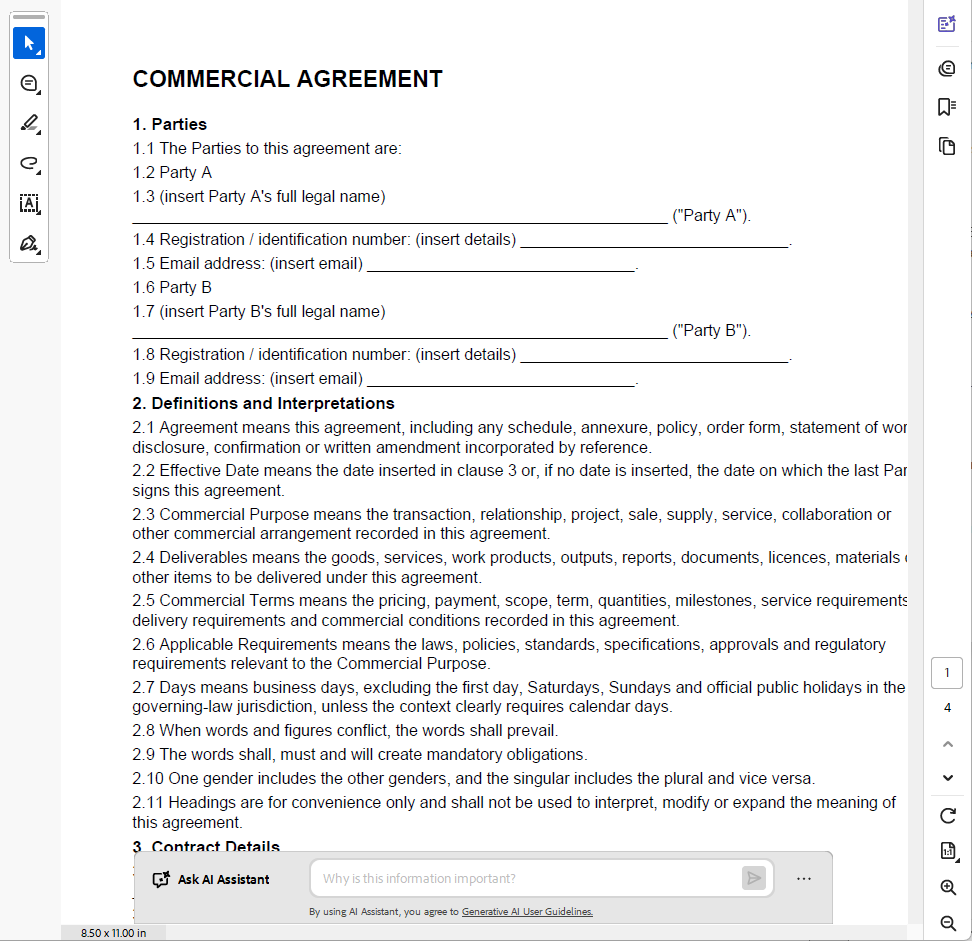
The templates and resources available through Contract Corridor are provided for general informational purposes only. They do not constitute legal advice, and their use does not create an attorney-client relationship between you and Contract Corridor or any of its affiliates.
While every effort has been made to ensure that the templates are up to date and relevant, Contract Corridor makes no representations or warranties, express or implied, regarding their accuracy, completeness, adequacy, legality, or suitability for any specific purpose. The templates may not reflect current legal developments or the laws applicable in your jurisdiction.
You are solely responsible for reviewing, customising, and validating any template before use, to ensure that any document meets your specific needs and complies with applicable laws and regulations.
To the fullest extent permitted by law, Contract Corridor, its owners, employees, and affiliates disclaim all liability for any loss, damage, or consequence arising directly or indirectly from the use of, or reliance upon, any template, resource, or related material provided on or through this platform.
By accessing, downloading, or using any template, you acknowledge and agree that such use is entirely at your own risk.
Contract Corridor Contract Templates