
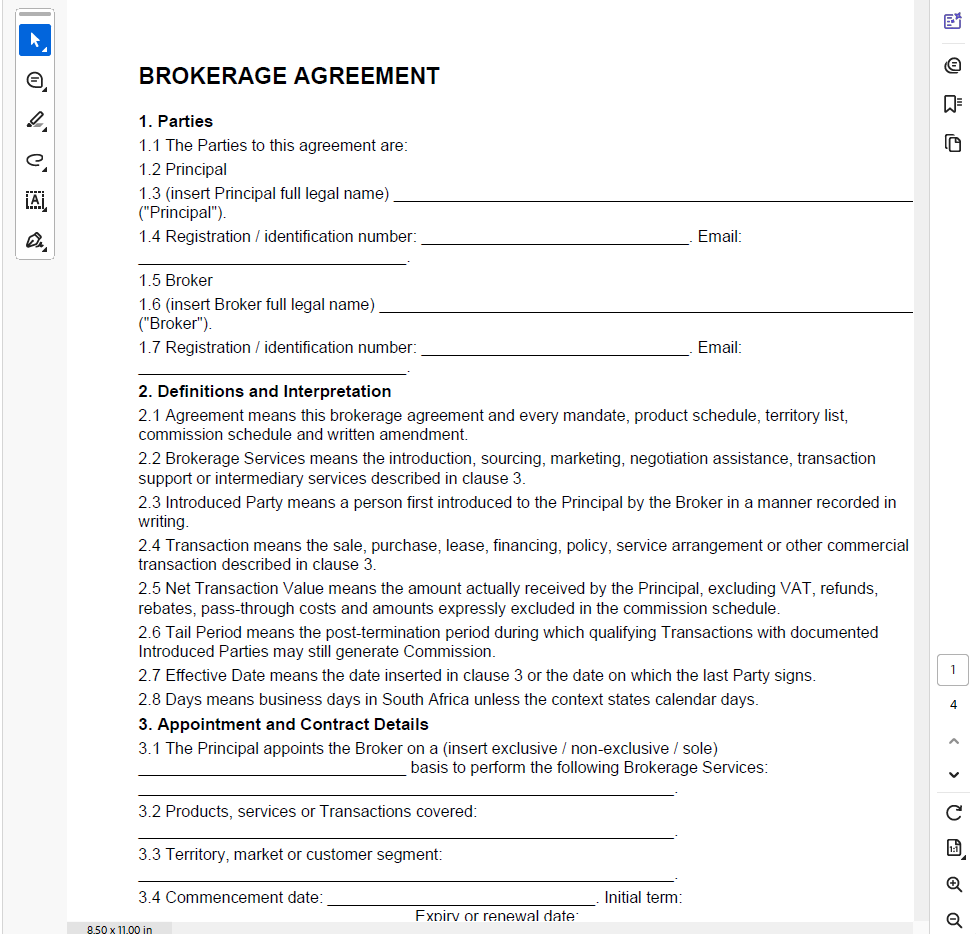
Brokerage Agreement
A Practical Framework for Managing Third-Party Partnerships
Introduction
Imagine finding the perfect buyer for your multi-million dollar company. However, a simple misunderstanding about commissions ruins the entire deal. This scenario happens more often than you might think.
Every successful connection between a buyer and a seller starts with clear rules. These rules protect your money and your time. In this guide, you will learn how to structure a professional brokerage agreement to ensure total clarity.
At Contract Corridor, we help businesses simplify complex legal relationships. We believe that legal documents should empower your growth rather than slow you down. Today, you will discover the essential parts of a broker contract and how to implement one correctly.
Quick Answer Summary
A brokerage agreement is a legally binding contract where one party hires a broker to find a buyer or seller. This document defines the scope of work, the relationship duration, and how much the broker receives in payment. It provides security for the business owner while ensuring the agent gets paid for their services. Most importantly, it prevents legal disputes by setting clear expectations from the start.
What is a Brokerage Agreement?
A broker agreement acts as a foundation for a professional middleman relationship. In simple terms, it is a document that says one person will help another find a deal. The person providing the service is the broker. The person paying for the service is the principal.
A brokerage agreement is a formal contract that authorizes an intermediary to represent a client in a transaction to buy or sell assets or services.
Typically, these documents appear in real estate, finance, and logistics. However, they also play a vital role when entrepreneurs sell their companies. In that case, you would use a business broker contract to outline the sale process. The roots of these agreements date back centuries to early maritime trade. Merchants needed trusted locals to sell their goods in foreign ports. Today, these contracts adapt to our digital world, but the core goal remains the safety of all parties.
Why It Matters
Entering a deal without a written plan is risky properly. Verbal promises often lead to confusion or expensive court battles. Therefore, a solid contract creates a shield for your business operations. It ensures that everyone knows their specific duties and limits.
Recent industry surveys highlight these critical trends:
- 85% of successful business sales involve a registered intermediary.
- Legal disputes over commissions drop by 60% when a written contract exists.
- Clear payout terms can speed up the closing process by nearly 20%.
Moreover, these documents help manage your cash flow. You can explicitly state when and how you pay the fees. This prevents unexpected bills from appearing after a deal closes. Also, it protects your trade secrets. Most of these forms include privacy rules to keep your business data safe from competitors.
Key Components & Elements
Writing a strong contract requires specific building blocks. If you miss one, the whole document might fail. You should check your broker agreement template for these essential items.
- Scope of Authority: You must list exactly what the broker can and cannot do on your behalf.
- Payment Terms: This defines the fee amount, whether it is a flat rate or a percentage.
- Exclusivity: You choose if the broker is the only one who can sell the item or if you can hire others.
- Duration and Termination: Every contract needs a start date and a clear way to end the relationship.
- Confidentiality: This clause stops the agent from sharing your private financial details with outsiders.
- Indemnification: These words protect you from legal trouble caused by the broker's mistakes.
- Dispute Resolution: You decide how to fix problems, such as using an arbitrator instead of a judge.
Types & Categories
Not all deals are the same. Consequently, different situations require different formats. Use this table to decide which broker contract template fits your specific needs.
| Type | Description | Best For | Key Consideration |
|---|---|---|---|
| Exclusive Right to Sell | The broker gets a fee regardless of who finds the buyer. | Complex business sales | High commitment required. |
| Open Listing | You can hire multiple brokers at the same time. | Fast-moving retail sales | Lower motivation for brokers. |
| Net Listing | The broker keeps everything above a set price. | High-risk assets | Often illegal in some states. |
| Exclusive Agency | The broker gets paid only if they find the buyer. | Independent owners | You can sell it yourself for free. |
Step-by-Step Implementation Guide
Setting up your contract does not have to be stressful. Follow these steps to create a secure environment for your next transaction.
- Identify Your Needs: Decide what goal you want to achieve. Specifically, determine if you need a buyer's agent or a seller's agent. Pro Tip: Define your ideal outcome before meeting any candidates.
- Select a Template: Find a high-quality brokerage agreement template that fits your industry. Why it matters: Starting with a proven structure saves hours of legal drafting. Pro Tip: Ensure the template follows the laws of your local state.
- Negotiate the Fee: Discuss the broker fee agreement terms clearly. You should decide if you will pay a retainer upfront or a commission at the end. Pro Tip: Ask for a tiered commission to reward higher sale prices.
- Define the Timeline: Set a realistic expiration date for the search. This prevents the contract from lasting forever if no progress happens. Pro Tip: Include a 30-day notice period for ending the agreement early.
- Review and Sign: Read every sentence carefully. Then, use a secure digital signature tool to finalize the paperwork. Pro Tip: Have a second person check the math on commission calculations.
Common Mistakes & How to Avoid Them
Even experienced managers make errors when signing a new brokerage contract. Knowing these pitfalls helps you stay ahead of potential issues.
| Mistake | Why It Happens | How to Fix It |
|---|---|---|
| Vague Payment Dates | Parties assume "at closing" is clear enough. | Define the specific event and time frame for payment. |
| Overlooking Expenses | Owners forget about marketing or travel costs. | List exactly which costs are reimbursable in the text. |
| No Tail Period | Brokers fear losing credit for leads after the end date. | Add a clause that protects leads found during the term. |
| Missing Termination Rights | People feel stuck in a bad relationship. | Include a simple "cancel for convenience" provision. |
Always make sure the person signing the document actually has the legal power to bind their company to the deal.
Industry Examples & Use Cases
Let us look at how these documents work in the real world. These scenarios show why a specific broker format matters for different sectors.
In the Technology Industry, a software founder wants to sell their startup. They sign a business broker agreement with a specialized firm. The firm uses its network to find three Silicon Valley buyers. Because the contract was clear, the founder pays a 5% fee and keeps their source code secret.
Meanwhile, in the Logistics Sector, a warehouse owner needs new tenants. They use a broker contract to hire a local agency. The agent finds a long-term tenant within two months. The owner pays a set fee per square foot, as agreed in the paperwork.
Finally, in Commercial Finance, a company needs a large loan. They sign a brokerage agreement sample with a debt advisor. The advisor finds a lender with low interest rates. The company pays the advisor a success fee only after the bank deposits the funds.
Frequently Asked Questions
What is a broker agreement in simple terms?
It is a written promise between a person who needs a deal and a person who finds deals. It explains what work the broker will do and how much they will earn from it.
How is a commission calculated in a broker contract?
Most payments are a percentage of the final sale price. Alternatively, some businesses prefer a flat fee for every successful introduction the agent makes.
Can I cancel a broker contract agreement before it ends?
Yes, you can usually cancel if the contract includes a termination clause. However, you might still owe fees if the broker already found a buyer before you canceled.
What is the difference between a broker and an agent?
Commonly, a broker has more training and can work independently. An agent often works under a broker and may have more limited legal powers in a transaction.
How Contract Corridor Helps
Managing multiple relationships requires precision and organization. Contract Corridor provides the tools you need to handle every broker contract agreement template with ease. Our platform ensures that you never miss a deadline or a payment milestone.
First, our smart storage keeps your documents organized by category. This means you can find your specific brokerage agreement in seconds during an audit. Second, we offer automated reminders for contract expiration dates. These alerts prevent you from being trapped in an auto-renewing deal you no longer want. Third, our collaboration tools allow you to negotiate terms directly with your partners in a secure space.
You deserve a contract process that works as hard as you do. Stop searching through messy folders and start using a streamlined system. Visit Contract Corridor today to take control of your business partnerships and protect your bottom line.

About the Author: Melissa Jooste
Melissa Jooste is the Head of Marketing at Contract Corridor, where she shapes the voice, narrative, and market positioning of a leading contract lifecycle management platform. Recognized for her expertise in contract lifecycle management content, Melissa is known for producing insightful, high-impact thought leadership that challenges conventional approaches to contract management. Her work goes beyond surface-level marketing, offering clear, strategic perspectives on how organizations can unlock value, reduce risk, and gain control through more effective contract lifecycle practices. Her writing is widely valued for its clarity, depth, and relevance, bridging complex legal, financial, and operational concepts into content that is both accessible and commercially meaningful. By combining strong storytelling with data-driven insight, she consistently delivers content that resonates with senior business leaders, legal professionals, and operational teams alike. Through her work, Melissa plays a key role in establishing Contract Corridor as a leading voice in the contract lifecycle management space, shaping how organizations think about contracts, not as static documents, but as dynamic drivers of business performance.
Connect on LinkedIn
About the reviewer: Jenna Kretzmer
Jenna Kretzmer, CA(SA) is an Executive at Contract Corridor, where she plays a key role in shaping the strategic direction and market positioning of a leading contract lifecycle management platform. A global executive with over a decade of experience, Jenna has led large-scale, international operations and driven growth, transformation, and market expansion across multiple regions. She is recognized for her ability to operate at the intersection of strategy, execution, and commercial performance. Jenna is a leading voice in the contract lifecycle management space, known for her perspectives on contract governance, revenue optimization, and operational efficiency. Her work challenges traditional approaches to contract management, advocating for a shift toward greater visibility, accountability, and value realization across the entire contract lifecycle. She is driving Contract Corridor to enable organizations to move beyond static contract storage toward proactive, value-led contract management, where contracts are treated not as legal documents, but as dynamic instruments that drive measurable business outcomes.
Connect on LinkedInBrokerage Agreement
The templates and resources available through Contract Corridor are provided for general informational purposes only. They do not constitute legal advice, and their use does not create an attorney-client relationship between you and Contract Corridor or any of its affiliates.
While every effort has been made to ensure that the templates are up to date and relevant, Contract Corridor makes no representations or warranties, express or implied, regarding their accuracy, completeness, adequacy, legality, or suitability for any specific purpose. The templates may not reflect current legal developments or the laws applicable in your jurisdiction.
You are solely responsible for reviewing, customising, and validating any template before use, to ensure that any document meets your specific needs and complies with applicable laws and regulations.
To the fullest extent permitted by law, Contract Corridor, its owners, employees, and affiliates disclaim all liability for any loss, damage, or consequence arising directly or indirectly from the use of, or reliance upon, any template, resource, or related material provided on or through this platform.
By accessing, downloading, or using any template, you acknowledge and agree that such use is entirely at your own risk.
Contract Corridor Contract Templates