
Affiliate Marketing Agreement
Essential Terms for Building Profitable Brand Partnerships
Introduction
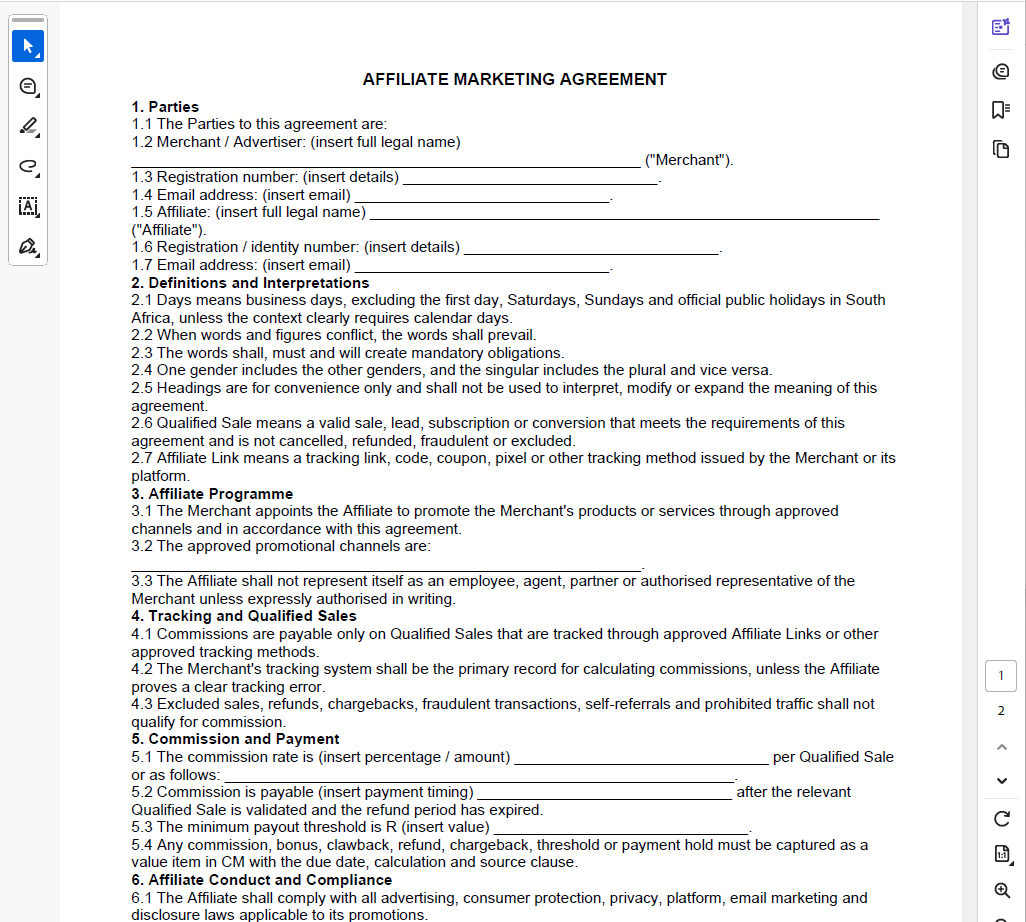
Imagine waking up to see your sales grew by 20 percent overnight without spending a dime on ads. This scenario happens every day for brands using smart partnerships. However, success requires more than just a handshake and a link. You need a solid affiliate marketing agreement to protect your brand and your revenue. This document sets the rules for how others promote your products. In this guide, you will learn how to build a strong legal foundation for your program. We also show how Contract Corridor makes managing these complex relationships simple and fast. Specifically, you will discover the exact clauses that prevent fraud and ensure compliance.Quick Answer Summary
What Is an Affiliate Marketing Agreement?
An affiliate marketing agreement is a formal contract where one party agrees to reward another for specific results. Most often, the reward is a commission for a sale. The document acts as the law for your partnership. It defines the relationship as an independent contractor status rather than employment. An affiliate marketing agreement governs the legal relationship between a merchant and an external partner who earns rewards for performance-based results. Historically, these deals were simple verbal agreements between local shops. Today, digital tracking makes these relationships global and complex. Within the contract management landscape, this specific marketing agreement contract template serves as a risk management tool. It controls how third parties use your trademarks and represent your voice online.Why It Matters
Getting this document right impacts your bottom line and your legal safety. Without a strong affiliate agreement, you might pay for fake traffic. For example, bad actors could use black-hat SEO tactics that hurt your brand ranking. Conversely, a good contract creates trust with high-quality partners.The Impact of Affiliate Partnerships
- Performance-based channels can account for up to 15% of all digital advertising revenue.
- Companies without clear terms face a 30% higher risk of affiliate tracking fraud.
- Proper affiliate contract monitoring can save brands thousands in disputed commission payouts annually.
Key Components & Elements
Every solid affiliate program agreement template needs specific building blocks. These sections ensure both parties understand their duties and rewards.- Commission Structure: Define exactly how much you pay and what triggers the payment. Use a marketing agreement sample to see common percentage ranges.
- Cookie Duration: State how long the tracking link stays active after a user clicks. This determines if a partner gets credit for a sale days later.
- Promotional Guidelines: List where and how partners can promote your brand. For instance, specify if they can use social media or email lists.
- Intellectual Property: Grant a limited license to use your logos. This section in your marketing contract sample prevents partners from misusing your brand.
- Termination Rights: Explain how either party can end the deal. This is vital for removing partners who violate your affiliate terms and conditions.
- Payment Schedule: Clarify when you send funds, such as "Net 30" or monthly. This keeps your cash flow predictable and your partners happy.
Types & Categories
Not every partnership looks the same. You should choose an affiliate marketing contract template that fits your specific business model.| Type | Description | Best For | Key Consideration |
|---|---|---|---|
| Unattached | Promoters have no connection to the product. | PPC Experts | Higher fraud risk. |
| Related | Partners have influence in the industry. | Bloggers & Media | Brand alignment matters. |
| Involved | Partners actually use and love the product. | Influencers | Highest conversion rates. |
Step-by-Step Implementation Guide
Follow these steps to launch your partnership program safely.- Select a Template: Start with a reliable affiliate agreement template. This saves time and ensures you cover basic legal protections.
- Customize Your Terms: Adjust the marketing contract template to match your specific goals. Pro tip: Always define "prohibited traffic" clearly to avoid paying for spam.
- Review with Counsel: Have your general counsel for affiliate marketing check the draft. This step prevents small wording errors from becoming big legal bills.
- Set Up Monitoring: Use tools for affiliate agreement monitoring. This helps you track which partners follow the rules and which ones do not.
- Onboard Partners: Send the website affiliate agreement to your new promoters. Make sure they sign before they receive their tracking links.
Common Mistakes & How to Avoid Them
Many managers rush the setup phase. This leads to disputes later on. Use this table to spot potential issues in your marketing agreement contract.| Mistake | Why It Happens | How to Fix It |
|---|---|---|
| Vague Payment Terms | Lack of clear math in the contract. | Use a sample marketing agreement template with exact formulas. | Thinking all partners are honest. | Add specific penalties for click-injection or masking. |
| Ignoring FTC Rules | Forgetting about consumer laws. | Mandate disclosure labels in your marketing contract example. |
| Poor Link Tracking | Using weak software. | Integrate affiliate contract sample data with your CRM. |
The most important part of any affiliate contract is the right to audit. Always keep the power to check a partner's traffic sources at any time.
Industry Examples & Use Cases
Different sectors use these contracts in unique ways. Here are three scenarios where an affiliate marketing agreement creates value. Software as a Service (SaaS): A cloud company wants to grow. They find a tech blogger to review their tool. They sign an affiliate contract template that pays 20% for every monthly subscription. Because the contract has a "lifetime" clause, the blogger keeps earning as long as the customer stays. Real Estate: A developer wants to find buyers for a new building. They create a marketing agreement contract template for local agents. This contract specifies that the fee only applies to closed escrow. This protects the developer from paying for leads that do not buy. E-commerce: A fashion brand uses a sample affiliate agreement with Instagram influencers. The contract forbids the use of "coupon sites" to steal attribution. Consequently, the brand only pays for new customers who found the shop through social media.Frequently Asked Questions
Do I need a lawyer for my affiliate contract?
While you can start with an affiliate marketing contract template, a lawyer should review it. Laws change often, and a professional ensures your document follows current regulations.
What is the difference between an affiliate and a referral program?
Affiliate programs usually involve professional marketers and higher volumes. Referral programs often reward existing customers with smaller credits or discounts for inviting friends.
Can I change my affiliate terms later?
Yes, but your affiliation contract agreement must explain how you will notify partners. Usually, you provide 30 days of notice before changing commission rates.
How do I prevent "trademark bidding" in my program?
Include a specific clause in your affiliate agreement contract. This clause forbids partners from buying ads on your brand name in Google or Bing.
How Contract Corridor Helps
Managing dozens of affiliate agreements can overwhelm your legal team. Contract Corridor simplifies this entire process. Our platform helps you organize and track every marketing agreement contract from one central hub. First, our library features a high-quality affiliate agreement template that you can customize in minutes. You no longer have to start from zero every time you hire a new partner. Second, we offer automated tools for affiliate contract monitoring. This ensures you never miss an expiration date or a renewal deadline. Third, our signature workflow makes getting an affiliate contract signed faster than ever. Digital signatures ensure your partners can start promoting your brand immediately. Stop chasing emails and start growing your revenue today. Are you ready to streamline your partnerships? Contact our team to see how we manage your affiliate agreements with ease.
About the Author: Melissa Jooste
Melissa Jooste is the Head of Marketing at Contract Corridor, where she shapes the voice, narrative, and market positioning of a leading contract lifecycle management platform. Recognized for her expertise in contract lifecycle management content, Melissa is known for producing insightful, high-impact thought leadership that challenges conventional approaches to contract management. Her work goes beyond surface-level marketing, offering clear, strategic perspectives on how organizations can unlock value, reduce risk, and gain control through more effective contract lifecycle practices. Her writing is widely valued for its clarity, depth, and relevance, bridging complex legal, financial, and operational concepts into content that is both accessible and commercially meaningful. By combining strong storytelling with data-driven insight, she consistently delivers content that resonates with senior business leaders, legal professionals, and operational teams alike. Through her work, Melissa plays a key role in establishing Contract Corridor as a leading voice in the contract lifecycle management space, shaping how organizations think about contracts, not as static documents, but as dynamic drivers of business performance.
Connect on LinkedIn
About the reviewer: Jenna Kretzmer
Jenna Kretzmer, CA(SA) is an Executive at Contract Corridor, where she plays a key role in shaping the strategic direction and market positioning of a leading contract lifecycle management platform. A global executive with over a decade of experience, Jenna has led large-scale, international operations and driven growth, transformation, and market expansion across multiple regions. She is recognized for her ability to operate at the intersection of strategy, execution, and commercial performance. Jenna is a leading voice in the contract lifecycle management space, known for her perspectives on contract governance, revenue optimization, and operational efficiency. Her work challenges traditional approaches to contract management, advocating for a shift toward greater visibility, accountability, and value realization across the entire contract lifecycle. She is driving Contract Corridor to enable organizations to move beyond static contract storage toward proactive, value-led contract management, where contracts are treated not as legal documents, but as dynamic instruments that drive measurable business outcomes.
Connect on LinkedInAffiliate Marketing Agreement
The templates and resources available through Contract Corridor are provided for general informational purposes only. They do not constitute legal advice, and their use does not create an attorney-client relationship between you and Contract Corridor or any of its affiliates.
While every effort has been made to ensure that the templates are up to date and relevant, Contract Corridor makes no representations or warranties, express or implied, regarding their accuracy, completeness, adequacy, legality, or suitability for any specific purpose. The templates may not reflect current legal developments or the laws applicable in your jurisdiction.
You are solely responsible for reviewing, customising, and validating any template before use, to ensure that any document meets your specific needs and complies with applicable laws and regulations.
To the fullest extent permitted by law, Contract Corridor, its owners, employees, and affiliates disclaim all liability for any loss, damage, or consequence arising directly or indirectly from the use of, or reliance upon, any template, resource, or related material provided on or through this platform.
By accessing, downloading, or using any template, you acknowledge and agree that such use is entirely at your own risk.
Contract Corridor Contract Templates