
Settlement Agreement
Practical Strategies to Resolve Legal Disputes Efficiently
Introduction
Many legal battles end before they ever reach a courtroom. In fact, research suggests that over 90% of civil cases result in an out-of-court resolution. This process allows businesses to save time and avoid massive legal fees. You will learn how to draft a clear settlement agreement in this article. We will cover the essential terms and common mistakes to avoid. Contract Corridor helps teams manage these sensitive documents with ease. Therefore, you can focus on growing your business instead of managing endless paperwork.Quick Answer Summary
What Is a Settlement Agreement?
A settlement agreement is a formal contract used to resolve a conflict. At its core, it is a peace treaty between businesses or individuals. The term "settle" comes from Old English, meaning to bring someone to rest or a permanent position. In a legal sense, the document puts a dispute to rest permanently. A settlement agreement is a voluntary, written contract where parties resolve a dispute to avoid or end a lawsuit. Within the contract management world, these files are unique. Most contracts create a new relationship between parties. However, this specific document usually ends a relationship or resolves a specific problem within one. It serves as a final record of the compromise. You can think of it as a bridge between a legal conflict and a clean slate.Why It Matters
Getting this document right is critical for business stability. If you draft a poor agreement, the other party might sue you again for the same issue. This leads to double the legal costs and double the stress.Impact by the Numbers
- Average cost of a minor business lawsuit: $50,000 - $100,000 in legal fees
- Time saved by settling vs. trial: 12 to 24 months of litigation
- Risk reduction: 100% certainty of the outcome compared to a jury trial
Key Components & Elements
Every effective settlement and release agreement needs specific parts to be valid. You must include these items to ensure the court can enforce the deal later.- Party Identification: List the full legal names of everyone involved in the dispute.
- Release of Claims: State clearly that the parties will not file future lawsuits regarding this specific issue.
- Payment Terms: Define the exact settlement agreement payment amount and the deadline for the wire transfer.
- Confidentiality: Restrict both sides from talking about the terms of the deal with the public.
- Non-Disparagement: Ensure neither party says negative things about the other in the future.
- Governing Law: Choose which state laws will apply if a new dispute arises from the contract.
- Signatures: Require authorized representatives from both sides to sign and date the document.
Types & Categories
Not every dispute is the same. Therefore, different situations require different formats. Use the table below to see which category fits your current needs.| Type | Description | Best For | Key Consideration |
|---|---|---|---|
| General Release | An agreement to settle all known and unknown claims. | General business breakups. | Extremely broad protection. |
| Employment Settlement | Resolves issues like wrongful termination or unpaid wages. | HR departments. | Must follow labor laws. |
| Debt Settlement | A debt settlement agreement format used to pay less than what is owed. | Credit and collections. | Tax implications on forgiven debt. |
| Property Settlement | A property settlement agreement example for land or asset disputes. | Real estate or divorce. | Requires clear asset lists. |
Step-by-Step Implementation Guide
Follow these steps to finish your deal. You can use a settlement agreement sample to guide your structure during the draft phase.- Send an initial offer: Use a settlement offer letter template to start negotiations. This shows you are serious about resolving the issue.
Pro Tip: Mark this letter "Without Prejudice" so it cannot be used against you in court. - Draft the contract: Use a settlement agreement template to outline the basic terms. This keeps the language professional and standard.
Pro Tip: Include a "Mutual Release" so both parties are protected, not just one. - Review with counsel: Ask a lawyer to check your lawyer settlement agreement draft. They check for local law compliance.
Pro Tip: Focus on the "scope" of the release to ensure it covers all potential issues. - Execute the document: Both parties sign the settlement document. Use digital signatures to speed up this step.
Pro Tip: Keep a secure digital copy in your contract management system. - Finalize payment: Send the funds as described in the settlement agreement letter. Keep the receipt for your records.
Pro Tip: Match the payment amount exactly to the settlement statement example provided in your contract.
Common Mistakes & How to Avoid Them
Many people rush this process. Consequently, they leave themselves open to risks. Avoid these common errors to stay safe.| Mistake | Why It Happens | How to Fix It |
|---|---|---|
| Vague Language | Parties try to finish too fast. | Use a clear settlement format with specific dates. |
| Missing Signatures | One party forgets to sign a page. | Use e-signature tools for tracking. |
| No Tax Plan | Forgetting that settlements can be taxable income. | Consult a tax expert before signing. |
| Too Narrow Scope | Only settling one part of a big problem. | Write a simple settlement agreement and release for all issues. |
Always ensure the person signing has the legal authority to bind the company. A signature from a low-level employee may not hold up in court.
Industry Examples & Use Cases
Different industries use these documents in unique ways. Here are three common scenarios. Construction Industry: A contractor completes a building but the windows leak. The owner threatens to sue. Instead, they use a contract settlement agreement template. The contractor pays half the repair costs, and the owner promises not to sue for future leaks. Technology Sector: Two software companies argue over a trademark settlement agreement. One company agrees to change its logo slightly. In return, the other company allows them to keep their current name. This avoids a multi-million dollar intellectual property battle. Finance and Debt: A borrower falls behind on a loan settlement agreement. The bank realizes a full lawsuit is too expensive. They use a loan settlement agreement to accept 70% of the original debt. The borrower pays immediately, and the bank closes the file.Frequently Asked Questions
What is a settlement agreement exactly?
It is a binding contract that ends a legal dispute. It usually involves one party paying money to avoid going to trial.
How do I write a settlement agreement effectively?
Start with a clear settlement template. Focus on the release of claims and the specific payment details to ensure clarity.
What is in a settlement agreement for employees?
It usually includes severance pay, a reference letter, and a promise to keep company secrets. It also prevents the employee from suing for wrongful dismissal.
Can I cancel the agreement after signing?
Generally, you cannot cancel it once both parties sign. It is a final legal contract unless you can prove fraud or extreme pressure.
Is a settlement agreement payment taxable?
Sometimes. Payments for physical injury are often tax-free, but payments for lost wages or emotional distress usually count as taxable income.
How Contract Corridor Helps
Managing a legal conflict is difficult. However, your software should be simple. Contract Corridor provides several tools to help you settle the contract correctly every time. First, our platform stores your settlement offer letter sample and other templates in one place. This makes it easy for your team to find the right settlement agreement sample when a dispute starts. You no longer have to search through old emails for the correct version. Second, we offer automated workflows for approvals. This ensures your legal team reviews every settlement agreement contract before it goes out. Specifically, you can set triggers that alert managers when a payment exceeds a certain amount. Finally, our secure repository helps you manage your settlement documents forever. You can easily prove the terms of a deal years later. Are you ready to streamline your legal resolutions? Start your journey with Contract Corridor today and protect your business with better contract management.
About the Author: Melissa Jooste
Melissa Jooste is the Head of Marketing at Contract Corridor, where she shapes the voice, narrative, and market positioning of a leading contract lifecycle management platform. Recognized for her expertise in contract lifecycle management content, Melissa is known for producing insightful, high-impact thought leadership that challenges conventional approaches to contract management. Her work goes beyond surface-level marketing, offering clear, strategic perspectives on how organizations can unlock value, reduce risk, and gain control through more effective contract lifecycle practices. Her writing is widely valued for its clarity, depth, and relevance, bridging complex legal, financial, and operational concepts into content that is both accessible and commercially meaningful. By combining strong storytelling with data-driven insight, she consistently delivers content that resonates with senior business leaders, legal professionals, and operational teams alike. Through her work, Melissa plays a key role in establishing Contract Corridor as a leading voice in the contract lifecycle management space, shaping how organizations think about contracts, not as static documents, but as dynamic drivers of business performance.
Connect on LinkedIn
About the reviewer: Jenna Kretzmer
Jenna Kretzmer, CA(SA) is an Executive at Contract Corridor, where she plays a key role in shaping the strategic direction and market positioning of a leading contract lifecycle management platform. A global executive with over a decade of experience, Jenna has led large-scale, international operations and driven growth, transformation, and market expansion across multiple regions. She is recognized for her ability to operate at the intersection of strategy, execution, and commercial performance. Jenna is a leading voice in the contract lifecycle management space, known for her perspectives on contract governance, revenue optimization, and operational efficiency. Her work challenges traditional approaches to contract management, advocating for a shift toward greater visibility, accountability, and value realization across the entire contract lifecycle. She is driving Contract Corridor to enable organizations to move beyond static contract storage toward proactive, value-led contract management, where contracts are treated not as legal documents, but as dynamic instruments that drive measurable business outcomes.
Connect on LinkedInSettlement Agreement
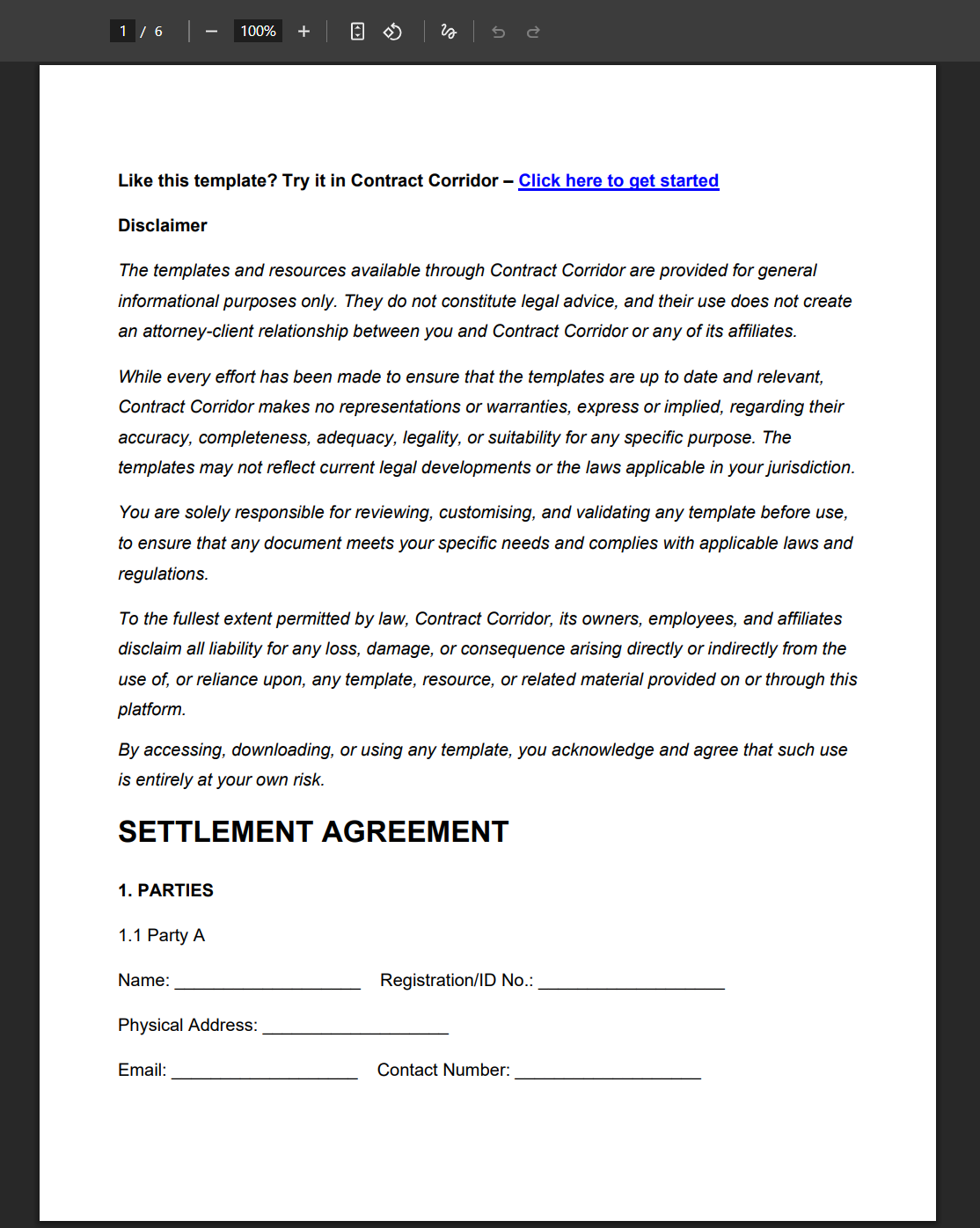
The templates and resources available through Contract Corridor are provided for general informational purposes only. They do not constitute legal advice, and their use does not create an attorney-client relationship between you and Contract Corridor or any of its affiliates.
While every effort has been made to ensure that the templates are up to date and relevant, Contract Corridor makes no representations or warranties, express or implied, regarding their accuracy, completeness, adequacy, legality, or suitability for any specific purpose. The templates may not reflect current legal developments or the laws applicable in your jurisdiction.
You are solely responsible for reviewing, customising, and validating any template before use, to ensure that any document meets your specific needs and complies with applicable laws and regulations.
To the fullest extent permitted by law, Contract Corridor, its owners, employees, and affiliates disclaim all liability for any loss, damage, or consequence arising directly or indirectly from the use of, or reliance upon, any template, resource, or related material provided on or through this platform.
By accessing, downloading, or using any template, you acknowledge and agree that such use is entirely at your own risk.
Contract Corridor Contract Templates