
Storage Rental Agreement
Essential Protections for Facility Owners and Tenants
Introduction
Imagine losing thousands of dollars because a leaky roof ruined a customer's antique furniture. Without a clear contract, you might face a massive lawsuit. Statistically, most legal disputes in the self-storage industry stem from vague terms. Therefore, you need a strong storage rental agreement to protect your local business.
Contract Corridor helps you organize these vital documents in one secure place. In this article, you will learn about essential clauses and legal protections. Specifically, we will cover how to draft a mini storage rental agreement that stays compliant. You will also find tips for managing your storage unit rental agreement with modern software tools.
Quick Answer Summary
A storage rental agreement is a legally binding contract between a facility owner and a tenant. It defines the rental price, payment terms, and rules for using the unit. Moreover, this storage rental contract outlines what happens if the tenant stops paying rent. A good storage agreement template protects the owner from liability while ensuring the tenant understands their rights.
What Is a Storage Rental Agreement?
This document is a specific type of lease for real estate. It allows a person or business to use a small space for their belongings. The storage rental lease agreement acts as the primary rulebook for the relationship between the landlord and the renter. Historically, these contracts evolved from traditional warehouse laws. However, modern laws now give storage owners unique rights, like the ability to sell abandoned goods.
A storage contract agreement differs from a home lease. For instance, you do not need a long court process to evict someone from a unit. Instead, the storage facility rental agreement usually follows state-specific lien laws. This means you can lock the unit if the tenant misses payments. Consequently, that makes the storage lease contract a powerful tool for debt collection.
In the world of contract management, these documents fall under recurring revenue agreements. You must track them carefully to ensure cash flow. Using a storage contract template helps you maintain consistency across hundreds of units. Thus, you save time and reduce errors in your daily operations.
Why It Matters
Getting your paperwork right prevents financial ruin. If a tenant claims you damaged their goods, the storage unit rental contract serves as your first line of defense. Without it, you are vulnerable to endless liability claims. Furthermore, clear terms help you maintain a professional reputation in your community.
Generic legal facts to consider:
- 80% of storage legal disputes involve late fees or lien sales.
- Clear liability limits can reduce insurance premiums by up to 15%.
- Consistent contract use increases the resale value of a facility.
Efficiency is another major factor. A storage rental agreement template allows you to onboard new customers in minutes. If you use a storage rental contract template, you ensure every tenant signs the same rules. As a result, your team spends less time arguing about fine print and more time growing the business.
Key Components and Elements
You must include certain details to make the document valid. Use this list to check your sample self storage rental agreement for completeness.
- Party Identification: List the full legal names and contact info for both the owner and the tenant.
- Unit Description: State the exact unit number and its physical dimensions clearly.
- Payment Terms: Define the monthly rent, due dates, and any late fees that apply.
- Use Restrictions: Explain that tenants cannot store hazardous materials, animals, or illegal goods.
- Termination Clause: Detail how much notice the tenant must give before they move out of the space.
- Insurance Requirement: Specify if the tenant must buy their own insurance or if you offer a protection plan.
- Lien Rights: Include the mandatory legal language that allows you to sell goods for unpaid rent.
Types and Categories
Not every rental situation is the same. Use the table below to see which storage space rental agreement template fits your specific needs.
| Type | Description | Best For | Key Consideration |
|---|---|---|---|
| Standard Unit | Basic indoor or outdoor space. | Household goods. | Security and access hours. |
| Climate Controlled | Units with temp and humidity rules. | Electronics and antiques. | Equipment failure liability. |
| Vehicle/Boat | Extra-large spaces or parking lots. | RV and boat owners. | Proof of registration and title. |
| Commercial | Spaces used for business inventory. | Local small businesses. | High-frequency access needs. |
Step-by-Step Implementation Guide
Follow these steps to set up your document system today. Using a storage unit rental agreement template makes this process much faster.
- Choose a Template: Select a storage space rental agreement that matches your state's specific laws. This ensures your lien process is legally valid.
- Customize Terms: Enter your facility name, address, and specific office hours. Pro Tip: Always include an emergency contact field for the tenant.
- Review Rules: Add a section for facility-specific rules like gate codes or trash disposal. This prevents confusion later on.
- Gather Signatures: Use digital signatures to speed up the process. This keeps your records organized and easy to search.
- Store Safely: Keep a digital copy of the storage rental agreements in a secure cloud platform. Consequently, you can find them instantly if a dispute arises.
Common Mistakes and How to Avoid Them
Mistakes in your sample storage rental agreement can lead to lost revenue. Avoid these common pitfalls to keep your business running smoothly.
| Mistake | Why It Happens | How to Fix It |
|---|---|---|
| Missing Dates | Rushing through the signing process. | Use digital forms with required fields. |
| Vague Fees | Failing to list exact dollar amounts. | List every fee clearly in a bold table. |
| Old Templates | Using a sample storage contract from 10 years ago. | Update your forms annually to match new laws. |
| No Signature | Forgetting to verify the tenant’s ID. | Always check a photo ID before signing. |
The most important thing to remember is that local laws change often. Always have a legal professional review your self storage rental agreement every year to stay safe.
Industry Examples and Use Cases
How does a simple storage contract work in the real world? Here are a few scenarios showing why these documents are so important.
Small Retailer Inventory: A boutique owner rents a 10x10 unit for seasonal clothing. They sign a storage agreement contract to ensure their goods stay dry. When the boutique owner forgets to pay, the facility uses the contract to contact them. Eventually, the owner pays the debt, and the contract keeps the business relationship strong.
Residential Moving: A family moves across the country and needs a month of storage. They use a self storage rental agreement template to sign up online. Because the terms were clear about the move-out date, the family avoids extra fees. Moreover, the facility manager knows exactly when that unit becomes available for the next customer.
Emergency Document Storage: A law firm stores old paper files in a climate-controlled unit. They use a storage unit contract that specifies strict access rules. One day, an unauthorized person tries to enter the unit. The facility staff check the contract, deny entry, and protect the firm's private data.
Frequently Asked Questions
Can I increase the rent in the middle of a storage unit lease?
Yes, most contracts allow for rent increases if you give proper notice. Usually, you must provide the tenant with 30 days of written warning before the new price starts.
What happens if a tenant loses their key or access code?
Your storage unit lease agreement should explain the replacement process. Often, you can charge a small fee to replace a lock or provide a new gate code to the tenant.
Do I need a printable simple storage agreement for walk-in customers?
It is helpful to have paper copies, but most facilities now prefer digital versions. Digital contracts are easier to store and harder for either party to lose or damage.
Who is responsible if items are stolen from a unit?
Typically, the storage space lease agreement states that the tenant stores goods at their own risk. Facility owners usually only face liability if they were extremely negligent regarding security.
Can I use a sample storage unit rental agreement found online?
You can use online samples as a starting point. However, you must customize them to match your local state laws regarding lien sales and late payment penalties.
How Contract Corridor Helps
Managing dozens of storage unit contracts can become overwhelming. Contract Corridor simplifies your workflow so you can focus on your property. Our platform allows you to store every storage rental agreement template free of clutter. You can set automated alerts for when a storage unit lease is about to expire.
Our software improves your organization by categorizing different types of storage unit lease agreement documents. You can see at a glance which tenants have signed their paperwork. Additionally, our search tools let you find a specific storage unit lease agreement template in seconds. This speed helps you resolve tenant questions immediately.
Stop struggling with messy filing cabinets and outdated folders. Use a modern system to manage your storage rental agreement pdf free from errors. Our secure cloud environment keeps your data safe and accessible from anywhere. Start your journey toward better document management today with Contract Corridor.
Ready to streamline your facility operations? Contact our team to see how we help storage owners succeed.

About the Author: Melissa Jooste
Melissa Jooste is the Head of Marketing at Contract Corridor, where she shapes the voice, narrative, and market positioning of a leading contract lifecycle management platform. Recognized for her expertise in contract lifecycle management content, Melissa is known for producing insightful, high-impact thought leadership that challenges conventional approaches to contract management. Her work goes beyond surface-level marketing, offering clear, strategic perspectives on how organizations can unlock value, reduce risk, and gain control through more effective contract lifecycle practices. Her writing is widely valued for its clarity, depth, and relevance, bridging complex legal, financial, and operational concepts into content that is both accessible and commercially meaningful. By combining strong storytelling with data-driven insight, she consistently delivers content that resonates with senior business leaders, legal professionals, and operational teams alike. Through her work, Melissa plays a key role in establishing Contract Corridor as a leading voice in the contract lifecycle management space, shaping how organizations think about contracts, not as static documents, but as dynamic drivers of business performance.
Connect on LinkedIn
About the reviewer: Jenna Kretzmer
Jenna Kretzmer, CA(SA) is an Executive at Contract Corridor, where she plays a key role in shaping the strategic direction and market positioning of a leading contract lifecycle management platform. A global executive with over a decade of experience, Jenna has led large-scale, international operations and driven growth, transformation, and market expansion across multiple regions. She is recognized for her ability to operate at the intersection of strategy, execution, and commercial performance. Jenna is a leading voice in the contract lifecycle management space, known for her perspectives on contract governance, revenue optimization, and operational efficiency. Her work challenges traditional approaches to contract management, advocating for a shift toward greater visibility, accountability, and value realization across the entire contract lifecycle. She is driving Contract Corridor to enable organizations to move beyond static contract storage toward proactive, value-led contract management, where contracts are treated not as legal documents, but as dynamic instruments that drive measurable business outcomes.
Connect on LinkedInStorage Rental Agreement
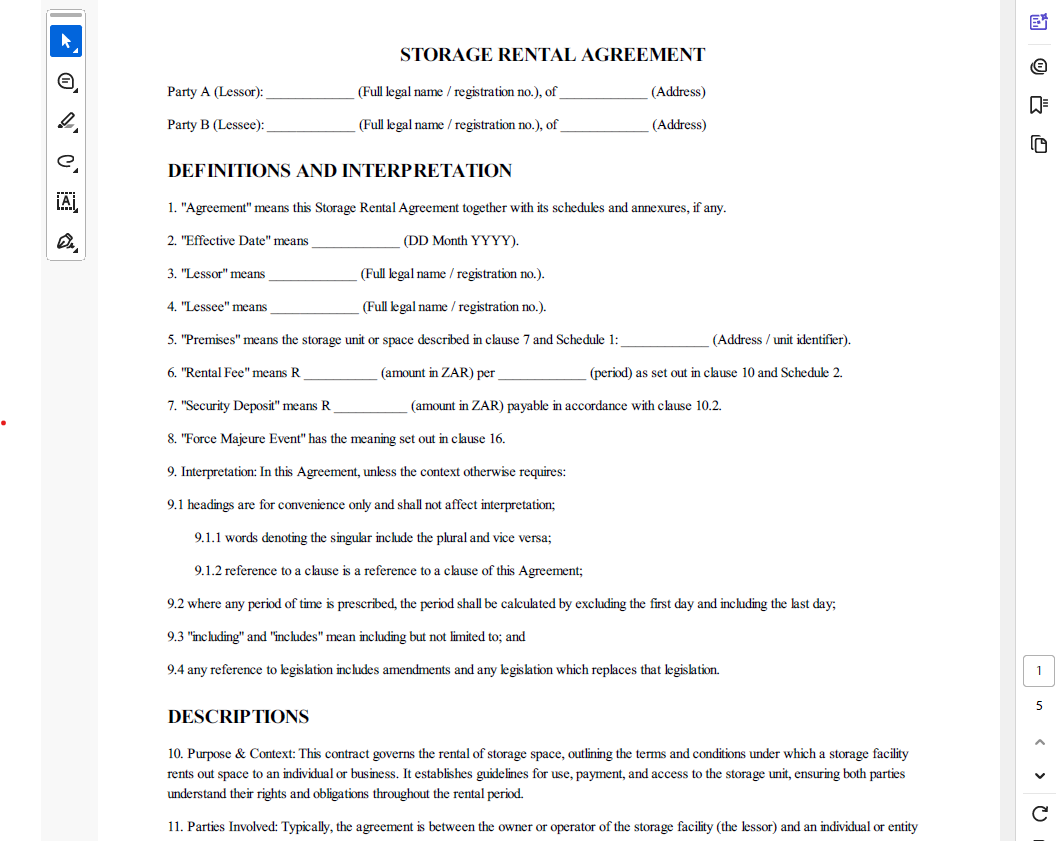
The templates and resources available through Contract Corridor are provided for general informational purposes only. They do not constitute legal advice, and their use does not create an attorney-client relationship between you and Contract Corridor or any of its affiliates.
While every effort has been made to ensure that the templates are up to date and relevant, Contract Corridor makes no representations or warranties, express or implied, regarding their accuracy, completeness, adequacy, legality, or suitability for any specific purpose. The templates may not reflect current legal developments or the laws applicable in your jurisdiction.
You are solely responsible for reviewing, customising, and validating any template before use, to ensure that any document meets your specific needs and complies with applicable laws and regulations.
To the fullest extent permitted by law, Contract Corridor, its owners, employees, and affiliates disclaim all liability for any loss, damage, or consequence arising directly or indirectly from the use of, or reliance upon, any template, resource, or related material provided on or through this platform.
By accessing, downloading, or using any template, you acknowledge and agree that such use is entirely at your own risk.
Contract Corridor Contract Templates