
Insurance Contract
A Comprehensive Guide to Risk Distribution and Legal Terms
Introduction
Many businesses lose thousands of dollars each year because they misunderstand a single clause in an insurance contract. These legal documents dictate how you recover funds after a disaster. Understanding the fine print can mean the difference between business survival and bankruptcy. Contract Corridor helps teams navigate these complex documents by simplifying the review process. In this article, you will learn about the essential parts of these agreements. You will also discover how to manage them effectively using modern tools. We will cover everything from basic definitions to advanced industry trends like machine learning in insurance industry applications.Quick Answer Summary
What Is an Insurance Contract?
A definition of an insurance contract focuses on the transfer of risk. One party agrees to compensate another party for a potential loss. This document specifies the terms of an insurance contract clearly. In legal terms, insurance contracts are known as aleatory contracts. This means the exchange of value is unequal. You might pay a small premium but receive a large payout if a loss occurs. The insurance agreement definition involves two main players. Who is the insurer in an insurance contract? The insurer is the company providing the coverage. The other party is the insured or the policyholder. Furthermore, the insurance agreement template usually follows standard state laws. Organizations like departments of insurance oversee these rules to protect consumers.Why It Matters
Getting these documents right is vital for financial health. An insurer has a contractual agreement to pay only for losses covered in the text. If you miss a detail, you might lose your coverage entirely. Additionally, insurance and asset management require strict record-keeping.The Cost of Poor Management
- Failing to track certificates of insurance best practices leads to 20% higher liability costs.
- Manual data entry causes errors in 1 out of 10 insurance agreements.
- Companies using data modernization in insurance reduce claim processing times by 30%.
Key Components & Elements
Every policy depends on specific building blocks. If one is missing, the contract might be void. These parts of an insurance contract ensure the deal is fair and legal.- Offer and Acceptance: One party proposes coverage and the other agrees to the terms.
- Consideration: The insured pays a premium while the insurer promises to pay claims.
- Insurable Interest: Which contract element is insurable interest a component of? It is part of the legal purpose, showing the policyholder would suffer a financial loss.
- Competent Parties: Both sides must be of legal age and sound mind to enter the insurance agreement.
- Insuring Agreement: What is an insuring agreement? It is the section where the insurer describes the risks they cover.
- Exclusions: These are items stipulated in the contract that the insurer will not pay for.
- Conditions: According to the entire contract provision a policy must contain all rules the insured must follow.
Types & Categories
Different risks require different types of contract insurance. The structure changes based on the asset or person protected.| Type | Description | Best For | Key Consideration |
|---|---|---|---|
| Personal Contract Insurance | Protects individuals from private risks. | Homeowners or drivers. | Focuses on personal liability. |
| Commercial Insurance | Covers business assets and operations. | Corporations and startups. | Includes complex liability limits. |
| Conditional Contract in Insurance | Payouts depend on specific events or actions. | Life and health policies. | Strict adherence to "if-then" rules. |
| Auto Insurance Methodology | Uses specific math to set rates for cars. | Fleet managers. | Requires frequent data modernization. |
Step-by-Step Implementation Guide
Managing the insurance lifecycle requires a clear plan. Follow these steps to ensure your coverage stays active and valid.- Identify Risks: Audit your business assets to see what needs protection. This prevents gaps in your contract of insurance.
- Compare Templates: Review an insurance agreement template from multiple providers. This helps you find the best insuring agreement definition for your needs.
- Verify Insurable Interest: Ensure you actually own or have a legal stake in the insured item. In an insurance contract the element that shows this interest is vital for legal standing.
- Adopt Technology: Implement insurance it systems to track expiration dates. Modern insurance automation saves time and reduces human error.
- Review Industry News: Read an insurance industry newsletter or financial times insurance sections. Staying updated helps you spot new insurance creativity in policy shifts.
Common Mistakes & How to Avoid Them
Avoid these pitfalls to keep your business safe. Many insurance operations executives at mid-to-large firms miss these small details.| Mistake | Why It Happens | How to Fix It | |
|---|---|---|---|
| Missing Deadlines | Lack of insurance contract management tools. | Use automated alerts for renewals. | |
| Undefined Terms | Ignoring the definition of insuring agreement. | Ask for a clear define insuring agreement written statement. | |
| Invalid Interest | Insuring assets you don't own. | Verify ownership before signing any insurance contracts. | |
| Ignoring Exclusions | Reading only the insuring agreement in insurance. | Read the entire policy contract including the fine print. |
Always verify that your policy includes the entire contract provision. This prevents the insurer from using outside documents to deny your claim later.
Industry Examples & Use Cases
Seeing these concepts in action makes them easier to understand. Here are three ways companies describe how insurance works in the real world. Construction Risk: A builder signs a contract for a new skyscraper. They must follow certificates of insurance best practices to prove they have coverage. Because they use insurance automation, they can share these proofs instantly with the city. Tech Firm Liability: A software company buys it services for insurance to protect their data. Their insuring agreement definition specifically covers cyber attacks. When a breach happens, the insurance agreement pays for the legal defense. Global Logistics: A shipping firm uses business intelligence in insurance industry tools to predict storm risks. They adjust their contracts insurance levels based on these forecasts. This proactive approach helps them in growing an insurance agency relationship that values data.Frequently Asked Questions
What are the elements of an insurance contract?
The elements of an insurance contract include offer, acceptance, consideration, and legal purpose. You also need competent parties and a clear insurable interest. These components of insurance policy work together to make the document legally binding.
How can I get contracts with insurance companies?
Learning how to get contracts with insurance companies usually involves proving your financial stability. You must submit an insurance initiative proposal or join an existing network. Most providers look for partners who understand managing insurance assets effectively.
What is data modernization in insurance?
Data modernization involves moving from old paper files to digital insurance it systems. It allows companies to use machine learning in insurance industry tasks. This technology helps insurers predict risks and set fairer prices for customers.
What is an insuring agreement?
An insuring agreement is the heart of the policy contract. It defines exactly what risks the company will cover. Usually, it lists the perils like fire, theft, or liability that trigger a payout.
How Contract Corridor Helps
Managing a complex insurance contract requires the right tools. Contract Corridor simplifies the insurance lifecycle by organizing all your legal papers in one place. First, our platform identifies key elements of an insurance contract automatically. This saves your team hours of manual reading. Second, you can track certificates of insurance best practices to ensure your vendors remain compliant. Furthermore, our system uses insurance graphics to show your coverage gaps clearly. You no longer have to guess if you are protected. Our tool acts like a business intelligence in insurance industry suite for your legal department. Join the many insurance operations executives at mid-to-large firms who trust us. Streamline your insurance agreement workflow and protect your bottom line today.
About the Author: Melissa Jooste
Melissa Jooste is the Head of Marketing at Contract Corridor, where she shapes the voice, narrative, and market positioning of a leading contract lifecycle management platform. Recognized for her expertise in contract lifecycle management content, Melissa is known for producing insightful, high-impact thought leadership that challenges conventional approaches to contract management. Her work goes beyond surface-level marketing, offering clear, strategic perspectives on how organizations can unlock value, reduce risk, and gain control through more effective contract lifecycle practices. Her writing is widely valued for its clarity, depth, and relevance, bridging complex legal, financial, and operational concepts into content that is both accessible and commercially meaningful. By combining strong storytelling with data-driven insight, she consistently delivers content that resonates with senior business leaders, legal professionals, and operational teams alike. Through her work, Melissa plays a key role in establishing Contract Corridor as a leading voice in the contract lifecycle management space, shaping how organizations think about contracts, not as static documents, but as dynamic drivers of business performance.
Connect on LinkedIn
About the reviewer: Jenna Kretzmer
Jenna Kretzmer, CA(SA) is an Executive at Contract Corridor, where she plays a key role in shaping the strategic direction and market positioning of a leading contract lifecycle management platform. A global executive with over a decade of experience, Jenna has led large-scale, international operations and driven growth, transformation, and market expansion across multiple regions. She is recognized for her ability to operate at the intersection of strategy, execution, and commercial performance. Jenna is a leading voice in the contract lifecycle management space, known for her perspectives on contract governance, revenue optimization, and operational efficiency. Her work challenges traditional approaches to contract management, advocating for a shift toward greater visibility, accountability, and value realization across the entire contract lifecycle. She is driving Contract Corridor to enable organizations to move beyond static contract storage toward proactive, value-led contract management, where contracts are treated not as legal documents, but as dynamic instruments that drive measurable business outcomes.
Connect on LinkedInInsurance Agreement
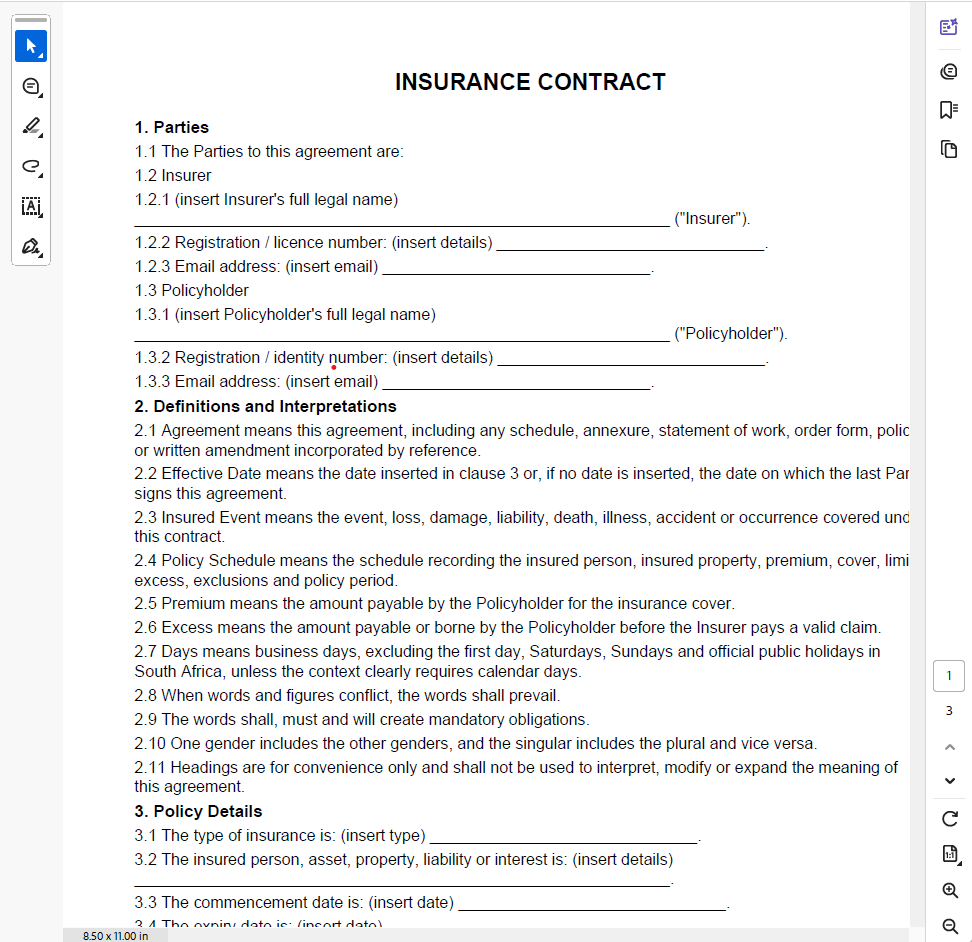
The templates and resources available through Contract Corridor are provided for general informational purposes only. They do not constitute legal advice, and their use does not create an attorney-client relationship between you and Contract Corridor or any of its affiliates.
While every effort has been made to ensure that the templates are up to date and relevant, Contract Corridor makes no representations or warranties, express or implied, regarding their accuracy, completeness, adequacy, legality, or suitability for any specific purpose. The templates may not reflect current legal developments or the laws applicable in your jurisdiction.
You are solely responsible for reviewing, customising, and validating any template before use, to ensure that any document meets your specific needs and complies with applicable laws and regulations.
To the fullest extent permitted by law, Contract Corridor, its owners, employees, and affiliates disclaim all liability for any loss, damage, or consequence arising directly or indirectly from the use of, or reliance upon, any template, resource, or related material provided on or through this platform.
By accessing, downloading, or using any template, you acknowledge and agree that such use is entirely at your own risk.
Contract Corridor Contract Templates