
Loan Agreement
A Practical Breakdown for Modern Teams
Introduction
Imagine lending a significant sum of money and realized you never put the terms in writing. This happens to business owners and individuals more often than you might think. In fact, many people skip documentation because they trust the other party. However, clear communication remains the best way to protect any relationship. This article explains how to build a solid loan agreement from scratch. You will learn about interest rates, repayment schedules, and legal protections. Additionally, we will show how Contract Corridor makes managing these documents simple for any team. Whether you need a simple loan agreement or a complex business contract, the right structure is key.Quick Answer Summary
What Is a Loan Agreement?
A loan agreement is a formal contract between two or more parties where one person or entity provides money to another. The borrower promises to pay back the funds according to a specific schedule. This document acts as the primary evidence of the debt. Without it, the lender may find it impossible to prove the debt in court. In the world of contract management, these documents serve as foundations for financial stability. They often connect to other papers like a simple note payable agreement or a broader lending contract agreement. Historically, these documents evolved from simple verbal promises to written lending note template formats. Today, modern businesses use digital tools to track these obligations and ensure compliance with local laws.Why It Matters
Having a written record prevents expensive legal battles. When people rely on memories, mistakes happen. For example, one person might remember the interest rate differently than the other. A basic loan agreement removes this confusion by laying out every detail clearly.Key Data Points
1. Experts suggest that over 40% of informal loans experience some form of repayment delay or dispute.
2. Businesses with written contracts recover debts 3 times faster than those with verbal agreements.
3. Proper documentation can reduce legal expenses by up to 60% during a conflict.
Key Components & Elements
Every effective contract requires specific parts to be valid. You should always include these items in your simple loan document template.- Party Identification: List the full legal names and addresses of both the lender and borrower.
- Principal Amount: State the exact amount of money the lender is providing.
- Interest Rate: Define whether the interest is fixed or variable and how often it calculates.
- Repayment Schedule: Specify if the borrower pays in installments or one lump sum.
- Default Terms: Explain what happens if the borrower fails to make a payment.
- Governing Law: Name the state or region whose laws will settle any legal disagreements.
- Signatures: Both parties must sign and date the document to make it legally binding.
Types & Categories
Different situations require different types of contracts. For instance, a loan to a child looks different than a loan for a car. Use this table to find the right fit for your needs.| Type | Description | Best For | Key Consideration |
|---|---|---|---|
| Personal Loan | Unsecured money for general use. | Friends and family. | High risk if no collateral is used. |
| Secured Loan | Backed by an asset like a car or home. | Large purchases. | The lender can seize the asset if payments stop. |
| Business Loan | Used for company operations or growth. | Startups and expansions. | Often requires financial statements. |
| Fixed Term | Specific date for full repayment. | Short-term needs. | Borrower must have total funds ready by the deadline. |
Simple Loan Agreements and Samples
Starting with a simple loan agreement document helps parties understand their basic obligations without dense legal jargon. A simple lending agreement clearly states who is borrowing the money and when they must pay it back. You can often find a simple loan agreement sample to use as a starting point for these straightforward transactions.
Using a simple loan contract example allows you to see how interest rates and payment schedules look in writing. Many people prefer a simple loan contract template because it covers the essentials while remaining easy to read. These simple loan agreements work well for short term arrangements where complex collateral is not required.
Step-by-Step Implementation Guide
Follow these steps to create your own lending contract.- Gather Information: Collect IDs and financial details from both sides. This ensures everyone is who they say they are. Pro Tip: Always verify the borrower's ability to pay before drafting.
- Draft the Terms: Use a simple loan agreement contract as a starting point. Write down the amount, interest, and dates. Pro Tip: Use plain language to avoid later confusion.
- Review Legal Compliance: Check local laws regarding interest rate caps. This prevents your contract from being declared illegal. Pro Tip: Some states have strict "usury" laws that limit interest.
- Execute the Document: Print the document and have both parties sign in front of a witness. This adds a layer of authenticity. Pro Tip: Use a notary public for large sums of money.
- Store Safely: Keep a digital and physical copy of the signed paper. This ensures you can find it if a problem arises years later. Pro Tip: Use a secure cloud platform for easy access.
Common Mistakes & How to Avoid Them
Avoid these pitfalls to keep your agreement strong.| Mistake | Why It Happens | How to Fix It |
|---|---|---|
| Vague Dates | Parties want to be "flexible." | Set specific calendar dates for every payment. | Lenders feel awkward discussing failure. | Clearly state late fees and legal consequences. |
| Verbal Changes | People make side deals over the phone. | Require all amendments to be in writing. |
| Skipping Signatures | Parties think an email is enough. | Always get a formal signature on the final draft. |
The most important thing to remember is that a contract is only as good as its clarity. If a stranger cannot understand your terms, a judge probably won't either.
Industry Examples & Use Cases
Here is how different groups use these documents. Real Estate: An investor uses a private mortgage loan agreement to fund a house flip. The contract specifies that the lender gets paid back when the house sells. This protects the investor's capital with the property itself. Tech Startups: A founder receives funds from an angel investor using a term loan contract. The agreement outlines how the loan might turn into company equity later. This allows the startup to grow without immediate cash pressure. Family & Friends: A person uses a simple personal loan agreement to help a friend buy a car. They include a small interest rate to cover inflation. This keeps the friendship professional and avoids hurt feelings. Retail: A store owner uses a cash loan contract to buy seasonal inventory. The lender agrees to take payments based on monthly sales numbers. This helps the owner manage cash flow during slow months.Frequently Asked Questions
How do I write a personal loan agreement?
Start with a simple loan contract sample to ensure you have the right structure. Include the loan amount, interest rate, and a clear repayment schedule. Make sure both parties sign the final document to make it enforceable.
Can I write a loan agreement between friends?
Yes, you should use a draft loan agreement between friends to protect the relationship. This document keeps expectations clear and prevents arguments about when the money is due. It also provides a legal path if the friend cannot pay you back.
Is a handwritten loan agreement legally binding?
Yes, a handwritten contract is usually legal if it contains all essential elements and signatures. However, using a professional loan agreement template is safer. It ensures you do not forget important clauses like interest or default terms.
What is the difference between a loan and a promissory note?
A loan agreement is a detailed contract that explains the responsibilities of both the lender and the borrower. A promissory note is a shorter document where the borrower simply promises to pay. For most business deals, the full agreement is a better choice.
How to draw up a loan contract?
To draw up a loan contract, you should start by identifying the lender and borrower with their full legal names and addresses. You must clearly state the principal amount being borrowed and the specific interest rate that will apply over time. Finally, define the repayment schedule and have both parties sign the document in front of a witness or notary to ensure it is legally binding.
How Contract Corridor Helps
Managing a loan of agreement manually leads to missed deadlines and lost paperwork. Contract Corridor offers a centralized platform to handle all your lending documents. Our software allows you to store a simple loan agreement format digitally for instant access. First, our platform provides a secure library for your money borrowing agreement files. You can stop digging through old emails to find a specific loan agreement sample. Instead, you can search and find any document in seconds. Second, we offer automated reminders for payment milestones. You will never have to manually track if a borrower is late on their lending contract obligations. The system sends alerts to both parties to keep things on track. Third, our version control ensures you always use the most current family loan agreement template. You can track changes during negotiations without losing the original draft. This keeps everyone on the same page and reduces legal risk. Ready to simplify your contract process? Start using Contract Corridor today to manage every simple loan agreement with confidence and ease.
About the Author: Melissa Jooste
Melissa Jooste is the Head of Marketing at Contract Corridor, where she shapes the voice, narrative, and market positioning of a leading contract lifecycle management platform. Recognized for her expertise in contract lifecycle management content, Melissa is known for producing insightful, high-impact thought leadership that challenges conventional approaches to contract management. Her work goes beyond surface-level marketing, offering clear, strategic perspectives on how organizations can unlock value, reduce risk, and gain control through more effective contract lifecycle practices. Her writing is widely valued for its clarity, depth, and relevance, bridging complex legal, financial, and operational concepts into content that is both accessible and commercially meaningful. By combining strong storytelling with data-driven insight, she consistently delivers content that resonates with senior business leaders, legal professionals, and operational teams alike. Through her work, Melissa plays a key role in establishing Contract Corridor as a leading voice in the contract lifecycle management space, shaping how organizations think about contracts, not as static documents, but as dynamic drivers of business performance.
Connect on LinkedIn
About the reviewer: Jenna Kretzmer
Jenna Kretzmer, CA(SA) is an Executive at Contract Corridor, where she plays a key role in shaping the strategic direction and market positioning of a leading contract lifecycle management platform. A global executive with over a decade of experience, Jenna has led large-scale, international operations and driven growth, transformation, and market expansion across multiple regions. She is recognized for her ability to operate at the intersection of strategy, execution, and commercial performance. Jenna is a leading voice in the contract lifecycle management space, known for her perspectives on contract governance, revenue optimization, and operational efficiency. Her work challenges traditional approaches to contract management, advocating for a shift toward greater visibility, accountability, and value realization across the entire contract lifecycle. She is driving Contract Corridor to enable organizations to move beyond static contract storage toward proactive, value-led contract management, where contracts are treated not as legal documents, but as dynamic instruments that drive measurable business outcomes.
Connect on LinkedInLoan Agreement
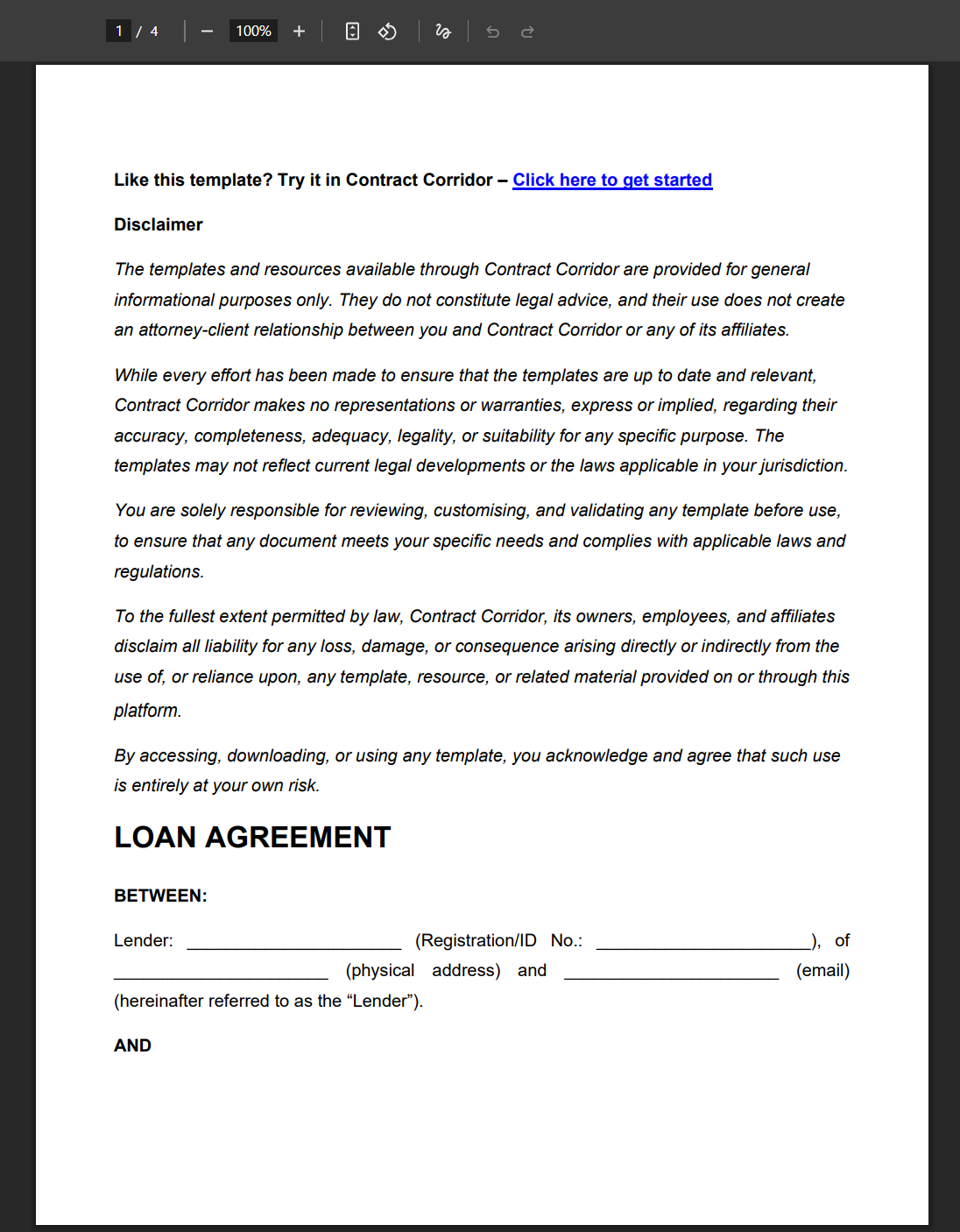
The templates and resources available through Contract Corridor are provided for general informational purposes only. They do not constitute legal advice, and their use does not create an attorney-client relationship between you and Contract Corridor or any of its affiliates.
While every effort has been made to ensure that the templates are up to date and relevant, Contract Corridor makes no representations or warranties, express or implied, regarding their accuracy, completeness, adequacy, legality, or suitability for any specific purpose. The templates may not reflect current legal developments or the laws applicable in your jurisdiction.
You are solely responsible for reviewing, customising, and validating any template before use, to ensure that any document meets your specific needs and complies with applicable laws and regulations.
To the fullest extent permitted by law, Contract Corridor, its owners, employees, and affiliates disclaim all liability for any loss, damage, or consequence arising directly or indirectly from the use of, or reliance upon, any template, resource, or related material provided on or through this platform.
By accessing, downloading, or using any template, you acknowledge and agree that such use is entirely at your own risk.
Contract Corridor Contract Templates