
Partnership Agreement
Essential Strategies for Building Strong Business Foundations
Introduction
Imagine starting a company with your best friend on a handshake. Statistics show that nearly 70 percent of business partnerships eventually fail. Most of these failures happen because the partners did not put their rules in writing. You must define your roles, money split, and exit plans early to survive.
Furthermore, Contract Corridor helps teams navigate these complex legal waters with ease. In this article, you will learn how a partnership agreement protects your assets. We will also cover the vital clauses every business owner needs to include. Finally, you will discover how to manage these documents throughout your company's life.
Quick Answer Summary
A partnership agreement is a legally binding document that dictates how two or more people run a business together. It covers profit sharing, decision-making powers, and dispute resolution methods. By signing this partnership agreement contract, owners prevent future legal battles and ensure everyone stays accountable. This document provides the essential roadmap for a company's daily operations and long-term growth.
What Is a Partnership Agreement?
When you start a business with others, you create a shared journey. However, you need a clear map to guide that journey. The partnership agreement meaning refers to a formal contract between two or more parties who manage a business together. This document outlines the specific rights and responsibilities of every person involved.
Historically, an agreement in partnership was often a simple verbal promise. Modern law now requires more detail to protect all parties. This legal partnership contract serves as the ultimate rulebook for the firm. It sits at the heart of the contract management landscape. In fact, it acts as the primary governing document before any other operational contracts enter the picture.
Additionally, the partnership agreement definition focuses on the relationship between owners. It is not just about ownership percentages. It also defines how people solve problems and share liabilities. Therefore, understanding the meaning of partnership agreement is vital for any new founder or seasoned investor.
Understanding the Partnership Contract Definition
A partnership contract definition refers to a legally binding document that outlines the relationship between two or more individuals or entities going into business together. This agreement of business partnership serves as the governing rulebook for daily operations. It transforms a verbal handshake into a legal partnership by clarifying rights, duties, and financial expectations.
When you define partnership agreement terms, you are essentially setting the parameters for contract partnerships. These partnership agreements definition concepts cover everything from how profits are split to who has the authority to sign a company partnership agreement. Establishing a clear partnership contract agreement early on helps prevent disputes that could otherwise dissolve the venture.
The Meaning and Definition of a Partnership Agreement
Understanding the partnership agreement meaning is the first step for any entrepreneur. A partnership agreement definition describes a legally binding document that outlines the relationship between two or more individuals who manage a business together. This partnership agreement contract serves as the rulebook for the venture, ensuring that every partner understands their role and the expectations placed upon them.
When you define partnership agreement terms, you are creating a framework for how the entity functions daily. An agreement of business partnership covers everything from financial contributions to decision-making powers. This legal partnership contract acts as a safeguard, preventing disputes by providing clear instructions on how to handle various business scenarios. It is more than just a piece of paper; it is the foundation of the entire company partner agreement.
Understanding General Partnerships and Legal Structures
In the world of business, general partnerships are a common structure where all members share equal responsibility for management and debts. The general partnership is characterized by the joint liability of all participants. A general partnership agreement contract is necessary to formalize this arrangement, as it dictates how profits are distributed and how losses are handled among the group. Without a specific general partnership contract, the business may default to state laws that do not fit the needs of the owners.
When looking at a general partnership agreement example, you will notice that it emphasizes the collective authority of the partners. This differs from other structures because every person involved can typically bind the business to contracts. Using a general partnership agreement template helps founders document these high-stakes responsibilities. Whether you use a simple general partnership agreement or a more complex version, the goal is to establish a clear act of partnership that governs the collective behavior of the firm.
Why It Matters
Without a written plan, state laws often dictate how your business operates. These "default" laws might not fit your specific needs. For example, a state might force you to split profits equally even if one person does all the work. A company partner agreement allows you to set your own rules instead.
Partnership Business Agreement Impact:
- 80% of legal disputes in small businesses stem from unclear verbal agreements.
- Companies with written owner contracts see 30% higher operational efficiency.
- Properly drafted partnerships contracts reduce legal fees during a breakup by over 50%.
Poorly managed business partnership agreements lead to expensive litigation. Furthermore, they can cause the total collapse of a profitable company. Consequently, entrepreneurs must treat the partnership business agreement as a high-priority asset. Correct documentation ensures everyone understands their financial impact and legal exposure from day one.
Why Partnership Contracts Are Essential
Utilizing partnership contracts protects the personal assets of the individuals involved. Without a formal business partner contract agreement, your personal liability might be higher than expected. By creating partner contract template documents, you can limit the scope of authority each person holds within the organization.
Moreover, contracts for business partners help define the exit strategy for the firm. If one person decides to leave, the business partnership contract example in your files will dictate how their share is bought out. Having a partnership agreement contract template ready ensures that even difficult transitions follow a pre-approved legal partnership agreement process.
Key Components and Elements
What is partnership contract content exactly? You should include specific details to cover all possible scenarios. Each part of the business contract partnership should be crystal clear. Use the following list to check your document.
- Capital Contributions: Explain how much cash, property, or service each person provides to the firm.
- Profit and Loss Distribution: Detail exactly how the business shares its earnings or absorbs its financial losses.
- Management and Voting: Define who makes the big decisions and how many votes every person gets during a conflict.
- Dispute Resolution: Choose a method, like mediation or arbitration, to settle active disagreements without going to court.
- Dissolution and Exit: Describe the process for closing the business or allowing a partner to leave or sell their share.
- Death or Disability: State what happens to a partner’s ownership share if they can no longer work or pass away.
List Five Details Commonly Found on a Partnership Agreement
Every effective partnership agreement format includes several critical data points to ensure clarity. First, it must list the name of the business and the specific purpose of the venture. Second, it needs to detail the capital contributions made by each partner, whether in cash, property, or services. Third, the document should clearly outline the profit and loss distribution ratios between all parties.
Fourth, a partnership agreement for business must define the management and voting powers of each participant. Finally, it should include a partnership procedure for resolving disputes or dissolving the company entirely. These five details form the core of a simple partnership agreement and provide a safety net for all involved.
Types and Categories
Not every business needs the same structure. You must choose the right business partnership contract for your goals. Below is a comparison of the most common frameworks used today.
| Type | Description | Best For | Key Consideration |
|---|---|---|---|
| General Partnership Agreement | All owners share equal management and unlimited liability. | Small, low-risk companies. | Partners are personally liable for debts. |
| Managing Partner Agreement | One person handles daily operations while others remain passive. | Investment groups or professional firms. | Defines clear boundaries for the manager. |
| Strategic Partnership Agreement | Two separate companies collaborate on a specific project. | Tech launches or marketing campaigns. | Usually a temporary arrangement. |
| Accountability Partnership Agreement | Focuses on meeting specific performance goals and benchmarks. | Service-based startups. | Heavily emphasizes metrics and results. |
General and LLC Partnership Agreements
A general partnership agreement example typically involves partners who share equal responsibility and liability for the business. This is common for smaller groups who want a simple general partnership agreement without complex corporate layers. A general partnership contract sample usually highlights the joint liability of all members for the debts of the business.
In contrast, a partnership agreement for llc is designed for entities that want to combine partnership flexibility with limited liability protection. An llc partnership agreement template will focus on members and managers rather than traditional partners. Whether you need a contract for llc partnership or an llc business partnership agreement, the focus remains on protecting the individual from the entity's debts.
Step-by-Step Implementation Guide
Creating a partnership agreement takes time and careful thought. You should not rush this process. Follow these steps to build a solid foundation for your venture.
- Discuss Core Values: Talk about your long-term goals and work styles. This makes writing the actual legal document much easier.
- Document Contributions: List every asset each person brings to the table. Pro tip: Always specify if a contribution is a loan or permanent equity.
- Draft the Document: Use a partnership template contract to get started. This helps you remember standard legal clauses you might otherwise miss.
- Review with Legal Counsel: Ask a lawyer to check your partnership agreement for small business needs. They ensure the text follows local and federal regulations.
- Sign and Secure: Every partner must sign the document in front of a notary. Afterward, upload the file to a secure system like Contract Corridor for easy access.
Starting with a Partnership Agreement Template
Most business owners begin by looking for a business partnership agreement template to save time and legal fees. A well drafted partnership agreement template pdf can provide a strong starting point for negotiations. You might search for a free business partnership agreement template, but it is important to customize it to fit your specific needs.
Using a template for business partnership agreement allows you to see common clauses used by other successful firms. Whether you choose a partnership contract template or a simple partnership agreement template, ensure that you review the document with all stakeholders. A partnership agreement templates approach is efficient, but the final business partner agreement form must reflect your unique business goals.
Creating a Partnership Agreement from Scratch
Creating a partnership agreement starts with open communication between all parties involved. You must decide on the partnership sharing ratios, which determine how money and workload are split. During the initial business partnership agreement draft phase, partners should discuss every possible outcome, including what happens if someone wants to leave. Using a template for business partnership agreement can help you organize these thoughts and ensure no critical details are missed.
The partnership agreement format usually follows a logical progression from naming the partners to detailing dissolution procedures. Many founders start by looking for a partnership agreement sample or a partnership contract sample to see how other successful businesses handle their internal rules. Once the partnership language is finalized, the business partner agreement form should be signed by all parties. This turns a simple discussion into a legal partnership agreement that holds everyone accountable to the agreed-upon standards.
Utilizing Partnership Agreement Templates and Samples
For those who need to move quickly, a partnership agreement template word or a partnership agreement template pdf provides a ready-made structure. You might find a free partnership agreement template online, but it is crucial to ensure it meets your local legal requirements. A partnership agreement contract template should be treated as a starting point that you customize to fit your unique situation. Whether you are looking for a business partnership agreement template or a basic partnership agreement, the quality of the content matters more than the price of the form.
Looking at a sample partnership agreement or an example of partnership agreement can provide clarity on how to phrase complex clauses. For instance, a partnership agreement contract sample might show you how to handle a 50 50 partnership contract, where power is perfectly balanced. If you are looking for a specific style, a partnership agreement sample pdf or a general partnership agreement sample can serve as a reference. By reviewing a variety of partnership agreement templates, you can pick the best elements to include in your own partnership business agreement.
Common Mistakes and How to Avoid Them
Many founders make the same errors when contracting with a partnership. These mistakes often remain hidden until a crisis occurs. Use this table to identify and fix these risks early.
| Mistake | Why It Happens | How to Fix It |
|---|---|---|
| Vague Voting Rules | Partners assume they will always agree. | Set specific voting weights for different topics. | Founders don't want to think about the end. | Include a "Buy-Sell" clause in the partner agreement. |
| Ignoring Tax Issues | Complexity scares small business owners. | Consult an accountant during the drafting phase. |
| Ignoring Personal Liability | Owners think the business entity protects them fully. | Clarify liability in the general partnership contract. |
Always update your partnership agreements every two years or after any major business shift.
Industry Examples and Use Cases
A sample of a business partnership agreement looks different depending on the industry. Specifically, certain sectors have unique risks. Here are three examples of how partnerships function in the real world.
Real Estate: A real estate team partnership agreement template focuses on commission splits. For instance, one partner might find the house while the other handles the sale. Their contract partnership example specifies that the finder gets 60% of the profit. This prevents arguments after the closing date.
Construction: A construction partnership agreement often deals with equipment and labor. One partner provides the heavy machinery. The other provides the skilled workforce. As a result, their partnership business contract defines who covers the cost of machine repairs on the job site.
Technology: Two coders decide to build a new app. Their business partner contract focuses on intellectual property. It states that if they split, the company keeps the code. This protects the product's future even if one creator leaves the team.
Industry Specific Partnership Samples and Forms
Different business types require different forms, such as a small business partnership agreement for a local shop. You can often find a small business partnership agreement pdf online to use as a guide. If you are forming a general partnership, you might need a general partnership contract template or a general partnership sample to get started.
For those in the corporate world, a company partnership agreement sample or a company partnership agreement template provides a more formal structure. Larger entities might use a model partnership agreement that follows international standards. Regardless of the form, like a partner form or business agreement template, the document must be clear about who is a partnership partner and what they contribute to the business contract between two parties.
Frequently Asked Questions
What is a partnership in law?
A partnership is a legal relationship where two or more parties agree to share the profits and losses of a shared business venture. It creates a fiduciary duty, meaning partners must act in the best interest of the group.
How do I structure a strategic partnership agreement?
You should focus on the specific project scope and the resources each company provides. Clearly state the start and end dates to ensure the collaboration stays on track and within budget.
Can I write a partner contract myself?
Yes, you can use a basic partnership agreement to start. However, you should always have a legal professional review the final version to ensure it follows local state laws.
What is the difference between a partnership and a corporation?
A partnership generally offers less liability protection than a corporation. In many general partnerships, the owners are personally responsible for the business's debts and legal obligations.
How do I write a partnership agreement?
To write a partnership agreement, start by discussing the roles, capital contributions, and profit-sharing ratios with your partners. Use a business partnership agreement template to ensure you cover essential legal sections like dispute resolution and dissolution. Once you have a draft, have all partners review the language before signing the partnership agreement contract to make it official.
What is a partnership agreement definition?
A partnership agreement definition is a legal document that governs the relationship between business partners by outlining their rights and responsibilities. It serves as a contract that details how the business will be managed, how profits are shared, and how disagreements are settled. This agreement is vital for preventing legal confusion and ensuring the partnership business operates smoothly.
What is a partnership in law?
In law, a partnership is a business relationship where two or more people carry on a trade or business with the goal of making a profit. Each partner typically contributes money, property, or labor and shares in both the profits and losses of the entity. A legal partnership involves shared liability, meaning the partners may be personally responsible for the business's debts and legal obligations.
How do I structure a strategic partnership agreement?
Structuring a strategic partnership agreement requires defining the specific objectives and the resources each party will contribute to the project. You should clearly outline the scope of the collaboration, how intellectual property will be handled, and the duration of the agreement. Using a business to business partnership agreement format helps ensure both companies remain independent while working toward a common goal.
How is responsibility shared in a partnership?
Responsibility in a partnership is shared based on the terms outlined in the partnership agreement contract, which usually divides tasks according to expertise. In a general partnership, all partners typically have an equal say in management and share full liability for the business's actions. However, a partner agreement can be customized to give certain individuals more or less control over daily operations and financial decisions.
What is a legal partnership?
A legal partnership is a recognized business entity formed by two or more people who agree to share profits and losses. It is governed by state laws and the specific terms found in the partnership business agreement created by the owners. This structure allows for shared resources and expertise but also involves shared legal and financial risks among the partners.
What is an example of a partnership?
An example of a partnership is a small accounting firm where two CPAs combine their clients and split the office expenses and profits. Another common general partnership example is a real estate investment group where multiple individuals pool their money to purchase and manage rental properties. These examples show how different people can work together under a single company partnership agreement to achieve greater success.
What is a partnership agreement definition?
A partnership agreement definition is the legal explanation of a document that binds two or more parties in a business venture. It establishes the rules for management, capital contributions, and how profits or losses are shared. This definition of partnership in economics focuses on how individuals collaborate to achieve a common financial goal.
What is a legal partnership?
A legal partnership is a business structure where two or more people share ownership and responsibility for a company's operations. It is officially recognized by the state once the partners sign an agreement of business partnership or file the necessary paperwork. This structure allows the business to operate as a separate entity while the partners remain personally involved in its success.
What is an example of a partnership?
What is an example of partnership can be seen in many everyday businesses, such as a local law firm or a small medical practice. Another example of a partnership is two friends opening a cafe together and sharing the startup costs and daily management duties. A partnership agreement example might also include a real estate investment group where several people pool their money to buy property.
How to write a partnership agreement?
To understand how to write a partnership agreement, you should start by identifying the roles and contributions of each person involved. Use a partnership agreement format to list important details like the business name, profit sharing ratios, and dispute resolution methods. Many people use a business partnership agreement templates search to find a draft, then customize it with specific partnership language.
How to write a business partnership contract?
If you are wondering how to write a business partnership contract or how to write a partnership contract, you must focus on the legal protections for each partner. You should clearly state the duration of the partnership and the process for adding or removing members. Consulting a business partnership agreement draft can help you ensure all necessary legal clauses are included for your specific industry.
How is responsibility shared in a partnership?
How is responsibility shared in a partnership depends entirely on the terms set in the business partner agreement form. In some cases, partners share all duties equally, while in others, a managing partner contract gives one person more authority. The partnership sharing of both work and rewards should be clearly documented in your partner agreements to avoid confusion as the business grows.
How Contract Corridor Helps
Managing a business partnership agreement requires more than just a signature and a file folder. You need to keep track of deadlines and renewals constantly. Contract Corridor provides a central hub for all your partnership business documents. Our platform simplifies the way you handle contracts for partnerships.
First, our automated reminders ensure you never miss a review date. For example, you can set alerts for annual profit-sharing audits. Second, our secure storage keeps your confidential general partnership agreement contract safe from unauthorized eyes. Only the people you choose can see the sensitive financial details.
Finally, Contract Corridor offers version control for when you need to update your rules. This helps you see how your partnership has evolved over time. Do not wait for a dispute to look for your paperwork. Use Contract Corridor to keep your business organized and protected. Start building a stronger future for your partnership today by streamlining your contract management process.

About the Author: Melissa Jooste
Melissa Jooste is the Head of Marketing at Contract Corridor, where she shapes the voice, narrative, and market positioning of a leading contract lifecycle management platform. Recognized for her expertise in contract lifecycle management content, Melissa is known for producing insightful, high-impact thought leadership that challenges conventional approaches to contract management. Her work goes beyond surface-level marketing, offering clear, strategic perspectives on how organizations can unlock value, reduce risk, and gain control through more effective contract lifecycle practices. Her writing is widely valued for its clarity, depth, and relevance, bridging complex legal, financial, and operational concepts into content that is both accessible and commercially meaningful. By combining strong storytelling with data-driven insight, she consistently delivers content that resonates with senior business leaders, legal professionals, and operational teams alike. Through her work, Melissa plays a key role in establishing Contract Corridor as a leading voice in the contract lifecycle management space, shaping how organizations think about contracts, not as static documents, but as dynamic drivers of business performance.
Connect on LinkedIn
About the reviewer: Jenna Kretzmer
Jenna Kretzmer, CA(SA) is an Executive at Contract Corridor, where she plays a key role in shaping the strategic direction and market positioning of a leading contract lifecycle management platform. A global executive with over a decade of experience, Jenna has led large-scale, international operations and driven growth, transformation, and market expansion across multiple regions. She is recognized for her ability to operate at the intersection of strategy, execution, and commercial performance. Jenna is a leading voice in the contract lifecycle management space, known for her perspectives on contract governance, revenue optimization, and operational efficiency. Her work challenges traditional approaches to contract management, advocating for a shift toward greater visibility, accountability, and value realization across the entire contract lifecycle. She is driving Contract Corridor to enable organizations to move beyond static contract storage toward proactive, value-led contract management, where contracts are treated not as legal documents, but as dynamic instruments that drive measurable business outcomes.
Connect on LinkedInPartnership Agreement
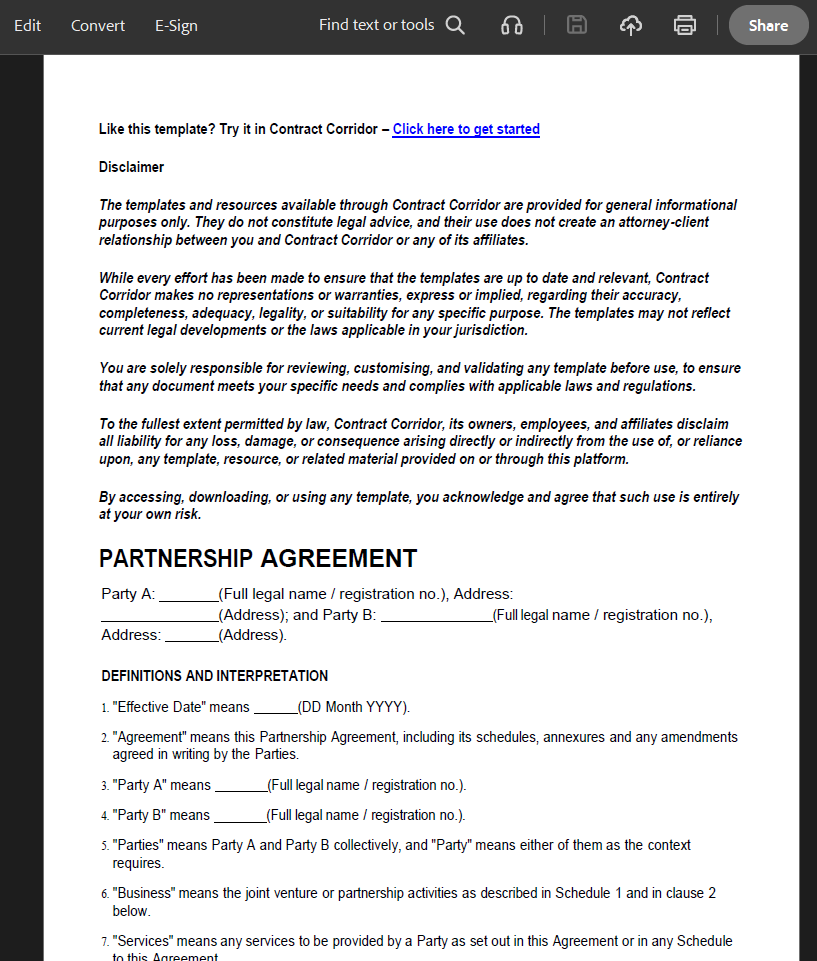
The templates and resources available through Contract Corridor are provided for general informational purposes only. They do not constitute legal advice, and their use does not create an attorney-client relationship between you and Contract Corridor or any of its affiliates.
While every effort has been made to ensure that the templates are up to date and relevant, Contract Corridor makes no representations or warranties, express or implied, regarding their accuracy, completeness, adequacy, legality, or suitability for any specific purpose. The templates may not reflect current legal developments or the laws applicable in your jurisdiction.
You are solely responsible for reviewing, customising, and validating any template before use, to ensure that any document meets your specific needs and complies with applicable laws and regulations.
To the fullest extent permitted by law, Contract Corridor, its owners, employees, and affiliates disclaim all liability for any loss, damage, or consequence arising directly or indirectly from the use of, or reliance upon, any template, resource, or related material provided on or through this platform.
By accessing, downloading, or using any template, you acknowledge and agree that such use is entirely at your own risk.
Contract Corridor Contract Templates
Using a Sample Partnership Agreement for Reference
Reviewing a sample partnership agreement can help you visualize how your own document should look. You can find a sample partnership agreement template for various industries, such as retail or consulting. For example, a partnership contract sample or a business partnership contract sample provides a practical look at how clauses work in the real world.
If you are looking for specific examples, a general partnership agreement sample or a business partnership agreement example can guide your drafting process. Some might even look for a maya solutions partnership agreement sample or a maya solutions partnership letter template to see how specific firms handle their outreach. A sample contract agreement between business partners is a valuable educational tool before you finalize your own deal.