
Equity Agreement
Essential Frameworks for Business Ownership and Investment
Introduction
Many startup founders lose their companies because they fail to define ownership early. In fact, research shows that nearly 40 percent of founding teams face disputes over shares within the first three years. An equity agreement prevents these messy legal battles by setting clear rules for every partner. Fortunately, Contract Corridor simplifies these complex legal papers for busy entrepreneurs. This article explains how to build a solid equity contract to protect your interests. You will learn about vesting schedules, transfer rights, and different investment structures. By the end, you will know how to manage your business shares with total confidence.Quick Answer Summary
What Is an Equity Agreement?
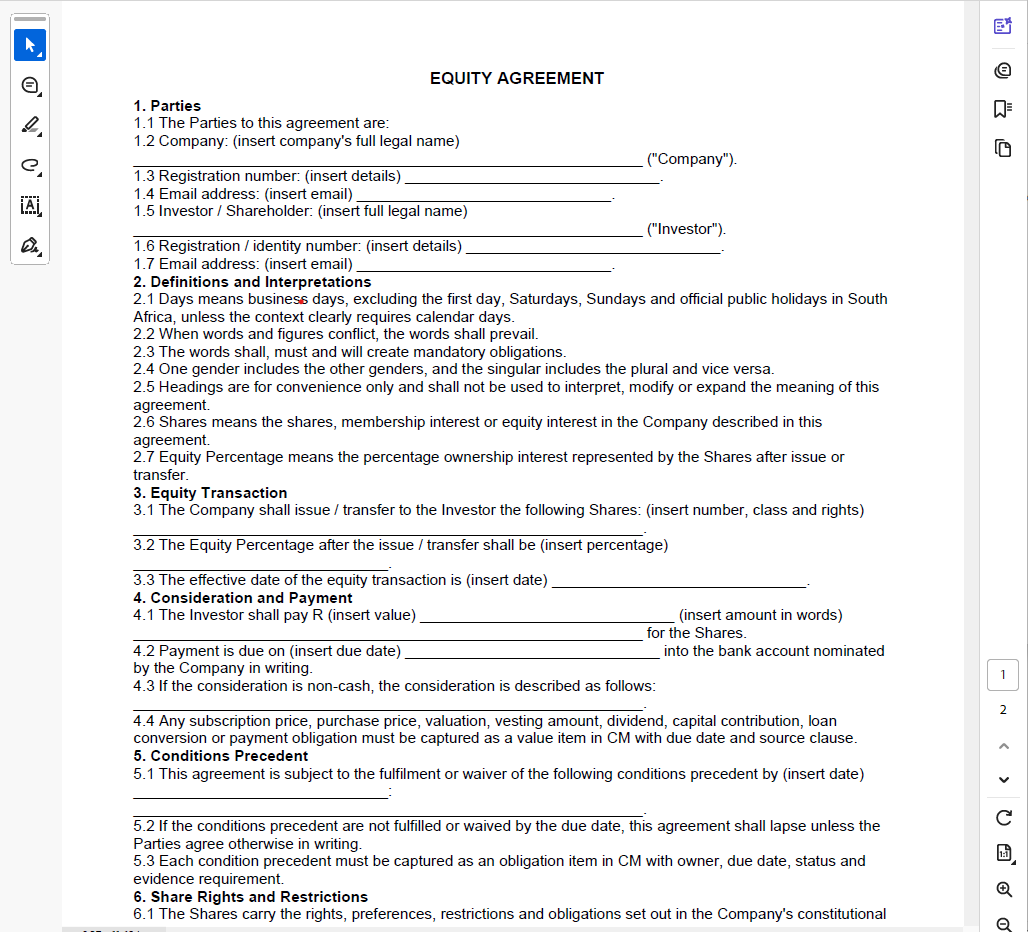
An equity agreement is a contract that governs the distribution of ownership in a company. Specifically, it details who owns what percentage of the business. It also explains what happens when someone wants to leave. Historically, the word equity comes from the Latin "aequitas," meaning fairness or equality. Within the contract management landscape, these documents serve as the foundation of the corporate structure. They bridge the gap between initial ideas and real financial value. An equity agreement acts as a legal roadmap that ensures fair treatment for all owners while protecting the long-term health of the organization. These documents often involve complex rules about how shares gain value over time. For example, a shared equity contract might require a partner to work for four years before they "own" their full portion.Why It Matters
Correctly drafting equity agreements is vital for any growing business. If you fail to define ownership, you invite expensive lawsuits that can bankrupt a young firm. Moreover, investors rarely fund companies that lack clear ownership records.The Impact of Equity Management
- 80% of venture capitalists require a formal equity ownership agreement before considering an investment.
- Companies with clear vesting schedules see 30% higher retention rates among key employees.
- Legal fees for resolving ownership disputes without a contract average $50,000 per case.
Key Components & Elements
Every equity ownership agreement template should include several core sections. These parts ensure the document is enforceable and clear.- Ownership Percentage: This identifies exactly how many shares each person receives at the start.
- Vesting Schedule: This rule forces individuals to "earn" their shares over months or years of service.
- Voting Rights: This section explains how much power each owner has over business decisions.
- Right of First Refusal: This prevents owners from selling their shares to outsiders without offering them to the company first.
- Transfer Restrictions: These clauses limit who can own shares to keep the circle of owners manageable.
- Buyback Provisions: This gives the company the right to buy shares back if someone leaves or gets fired.
- Confidentiality: This ensures that all owners keep trade secrets and financial data private.
Types & Categories
Not every equity contract looks the same. Different situations require different structures. For instance, an equity investment agreement template differs greatly from a home equity agreement template.| Type | Description | Best For | Key Consideration |
|---|---|---|---|
| Common Stock Agreement | Basic ownership shared by founders and employees. | Initial founding teams | High risk, potential high reward |
| Preferred Stock Investment | Shares with special rights, like priority payouts. | External investors | Includes liquidation preference |
| Sweat Equity Contract | Ownership given in exchange for labor instead of cash. | Early-stage advisors | Requires strict performance milestones |
| Phantom Equity | A promise of cash bonuses tied to share price increases. | Non-owner executives | Does not grant actual voting rights |
| Home Equity Sharing | An agreement where an investor provides cash for a stake in a house. | Homeowners needing cash | Does not require monthly payments |
Step-by-Step Implementation Guide
Follow these steps to create a working ownership structure. This process helps you avoid common legal traps.- Determine Share Allocation: Decide how much value each person brings. Professional teams use a sweat equity contract template to measure the value of work versus cash contributions. Pro tip: Always leave a pool of shares for future hires.
- Select Your Agreement Type: Match the contract to your goal. If you are raising money, use an equity investment contract to satisfy professional lenders.
- Draft the Vesting Terms: Set a "cliff" period. This means no one gets shares until they stay for a full year. This protects you if a partner quits early.
- Define Exit Strategies: Plan for the end at the beginning. Describe what happens if the company is sold. An equity distribution agreement should clearly state how money flows to each owner.
- Legal Review: Never sign a sample equity agreement without a lawyer. They ensure your specific terms follow local state laws.
- Digital Execution: Sign and store the document in a secure location. Many firms use a participation agreement template to track who has signed into the ownership pool.
Common Mistakes & How to Avoid Them
Many people rush their equity agreement startup paperwork. This leads to problems down the road.| Mistake | Why It Happens | How to Fix It |
|---|---|---|
| No Vesting Schedule | Founders trust each other too much early on. | Always include a 4-year vesting plan with a 1-year cliff. |
| Verbal Promises | Teams discuss percentages in casual meetings. | Put every promise into an equity agreement contract immediately. |
| Ignoring Taxes | Parties don't realize that receiving shares is taxable income. | Consult a tax expert and file an 83(b) election if needed. |
| Lack of Transfer Rules | Owners assume they will always get along. | Include clear equity transfer agreement clauses to control who joins the cap table. |
The single most important thing to remember: Paperwork is cheaper than a lawsuit. Never start a business without a signed equity ownership contract.
Industry Examples & Use Cases
Here is how different sectors use these legal instruments to grow.Technology Startup: A software team uses a startup equity agreement template to hire a lead developer. They cannot pay a high salary. Therefore, they offer 2% equity. The developer gets the shares over four years. This keeps the developer motivated to build a great product. Real Estate Investment: A homeowner needs money for renovations but cannot afford a loan. They use a home equity sharing agreement template with an investor. The investor provides $50,000 today. In exchange, the investor gets a portion of the home's value when it sells in ten years.
Company Executive Bonus: A large firm wants to reward a CEO without diluting existing shares. They use a phantom equity agreement sample. This pays the CEO a cash bonus if the company value doubles. It aligns the leader's goals with the owners' goals without changing the cap table.
Healthcare Partnership: Three doctors open a clinic together. They use an equity share agreement to split the profits. One doctor provides the building, while the other two provide the medical services. The contract balances these different types of value.
Frequently Asked Questions
What is the difference between equity and shares?
Equity refers to the total ownership value of a business. Shares represent the specific units of that ownership held by an individual.
Can I download an equity agreement template free online?
Yes, many sites offer free templates, but you should always customize them. Generic forms often miss specific state laws or protective clauses for your industry.
What happens to my equity if I am fired?
This depends on your equity contract. Usually, you keep what has already vested, but the company may have the right to buy it back at a fair price.
How does a sweat equity contract sample help a founder?
It provides a way to pay partners when the company has no cash. It converts hours worked into a measurable ownership stake in the business.
What is a home equity agreement example?
An example is when a homeowner gets a cash lump sum from a company like Unison. The homeowner pays nothing back until they sell the house years later.
How Contract Corridor Helps
Managing these complex documents requires the right tools. Contract Corridor provides a central hub for all your business ownership papers. Our platform ensures you never lose a signed equity agreement or miss a vesting milestone. First, our automated alerts track vesting schedules for you. You will know exactly when an employee earns their next batch of shares. Second, our secure vault stores every equity agreement template in one place. This makes it easy to show potential investors that your records are clean. Finally, our collaboration tools allow you to negotiate an equity agreement example with partners in real-time. You can track changes and see exactly who suggested each clause. Stop guessing about your company's ownership. Start managing your equity with Contract Corridor today.
About the Author: Melissa Jooste
Melissa Jooste is the Head of Marketing at Contract Corridor, where she shapes the voice, narrative, and market positioning of a leading contract lifecycle management platform. Recognized for her expertise in contract lifecycle management content, Melissa is known for producing insightful, high-impact thought leadership that challenges conventional approaches to contract management. Her work goes beyond surface-level marketing, offering clear, strategic perspectives on how organizations can unlock value, reduce risk, and gain control through more effective contract lifecycle practices. Her writing is widely valued for its clarity, depth, and relevance, bridging complex legal, financial, and operational concepts into content that is both accessible and commercially meaningful. By combining strong storytelling with data-driven insight, she consistently delivers content that resonates with senior business leaders, legal professionals, and operational teams alike. Through her work, Melissa plays a key role in establishing Contract Corridor as a leading voice in the contract lifecycle management space, shaping how organizations think about contracts, not as static documents, but as dynamic drivers of business performance.
Connect on LinkedIn
About the reviewer: Jenna Kretzmer
Jenna Kretzmer, CA(SA) is an Executive at Contract Corridor, where she plays a key role in shaping the strategic direction and market positioning of a leading contract lifecycle management platform. A global executive with over a decade of experience, Jenna has led large-scale, international operations and driven growth, transformation, and market expansion across multiple regions. She is recognized for her ability to operate at the intersection of strategy, execution, and commercial performance. Jenna is a leading voice in the contract lifecycle management space, known for her perspectives on contract governance, revenue optimization, and operational efficiency. Her work challenges traditional approaches to contract management, advocating for a shift toward greater visibility, accountability, and value realization across the entire contract lifecycle. She is driving Contract Corridor to enable organizations to move beyond static contract storage toward proactive, value-led contract management, where contracts are treated not as legal documents, but as dynamic instruments that drive measurable business outcomes.
Connect on LinkedInEquity Agreement
The templates and resources available through Contract Corridor are provided for general informational purposes only. They do not constitute legal advice, and their use does not create an attorney-client relationship between you and Contract Corridor or any of its affiliates.
While every effort has been made to ensure that the templates are up to date and relevant, Contract Corridor makes no representations or warranties, express or implied, regarding their accuracy, completeness, adequacy, legality, or suitability for any specific purpose. The templates may not reflect current legal developments or the laws applicable in your jurisdiction.
You are solely responsible for reviewing, customising, and validating any template before use, to ensure that any document meets your specific needs and complies with applicable laws and regulations.
To the fullest extent permitted by law, Contract Corridor, its owners, employees, and affiliates disclaim all liability for any loss, damage, or consequence arising directly or indirectly from the use of, or reliance upon, any template, resource, or related material provided on or through this platform.
By accessing, downloading, or using any template, you acknowledge and agree that such use is entirely at your own risk.
Contract Corridor Contract Templates