
Employee Confidentiality Agreement
Protecting Your Company Trade Secrets and Intellectual Property
Introduction
Imagine a top salesperson leaving your company today. Tomorrow, they start working for your biggest rival. Suddenly, your competitor knows your secret pricing, your lead lists, and your upcoming product designs. This nightmare happens to businesses every single day because they lack proper legal protection. In fact, trade secret theft costs global companies trillions of dollars annually.
Furthermore, you must act now to safeguard your hard work. This article explains how to create a strong employee confidentiality agreement to keep your data safe. You will learn about legal terms, essential clauses, and best practices for staff management. Contract Corridor helps teams build these protections quickly. Our tools ensure your business stays secure as you grow your workforce.
Quick Answer Summary
An employee confidentiality agreement is a legal contract that stops workers from sharing company secrets. It defines what information is private and explains the consequences of leaking that data. These documents protect your intellectual property, client lists, and internal processes from competitors. Companies use them to maintain a fair market advantage and ensure long-term security.
What Is an Employee Confidentiality Agreement?
An employee confidentiality agreement is a restrictive covenant that creates a legal duty for a worker to protect sensitive business information. Many people call it an employee nda or a secrecy agreement employee. In essence, it serves as a legal fence around your company’s "secret sauce." This could include code, formulas, customer data, or marketing plans.
Historically, businesses relied on basic trust. However, the modern digital world makes it easy to copy and move data. Therefore, the simple confidentiality agreement became a standard part of the hiring process. This document fits into the broader field of contract lifecycle management. It acts as the first line of defense during the onboarding stage.
Typically, the agreement starts when the worker joins the firm. Often, the protection continues even after the worker leaves. This ensures that a former staff member cannot hurt your business later. Specifically, you can find a confidentiality agreement employee version in almost every professional industry today.
Why It Matters
Running a business without these forms is like leaving your front door wide open. First, it leaves your brand's unique ideas vulnerable to theft. Second, it can lead to massive financial losses if a competitor steals your strategy. Without a signed employee nda agreement, you might struggle to win a court case against a dishonest worker.
Impact by the Numbers:
- Over 60% of employees admit to taking company data when they leave a job.
- Legal fees for trade secret litigation can exceed $500,000 for small businesses.
- Companies with strong IP protections see 20% higher valuations during exits.
Additionally, investors and partners look for these documents during audits. They want to see that you take security seriously. If you lack a clear employment confidentiality agreement, you might lose funding opportunities. Thus, these contracts protect both your daily operations and your future growth.
Key Components & Elements
Every effective contract needs specific building blocks. If you miss one, the whole document might fail in court. Use this list to check your current confidentiality statement template for gaps.
- Definition of Confidential Information: This section names exactly what "secret" means. It should cover data like client lists, software code, and financial records.
- Exclusions from Confidentiality: You cannot claim everything is a secret. Usually, information already known to the public does not count.
- Obligations of the Employee: This describes how the worker must handle data. For example, they might need to use password-protected devices.
- Time Period: Most agreements stay active for a set number of years. Some trade secrets, like recipes, might have infinite protection.
- Consequences of Breach: Clearly state what happens if the worker leaks data. This often includes firing the person or seeking a court injunction.
- Return of Property: This clause requires the worker to give back laptops, keys, and files when they quit.
Types & Categories
Not every role requires the same level of secrecy. For instance, an executive handles more data than a delivery driver. Therefore, you should choose the right employee non disclosure agreement template for the specific job.
| Type | Description | Best For | Key Consideration |
|---|---|---|---|
| Unilateral | Only the employee has a duty to keep secrets. | Standard hiring | Most common for new staff. |
| Mutual | Both parties share secrets and keep them safe. | Executive partnerships | Protects both side's IP. |
| Role-Specific | Custom terms for high-level technical roles. | Software engineers | Focuses on code and patents. |
| Short-Term | Covers a single project or task. | Contractors or interns | Easier to manage for stays. |
Step-by-Step Implementation Guide
Creating a safe culture starts with a clear process. Follow these steps to deploy your non disclosure agreement employee forms effectively.
- Identify Your Secrets: List every piece of data that gives you a competitive edge. This helps you customize your employee non disclosure agreement sample. Pro tip: Don't be too broad, or a judge might throw the contract out.
- Select a Template: Choose a high-quality employee nda agreement template that matches your state laws. Legal rules change depending on where your office is located. Pro tip: Always use a template from a trusted legal technology source.
- Present the Document Early: Offer the confidentiality agreement template pdf along with the job offer letter. This gives the candidate time to read it. Pro tip: Never wait until the first day of work to show them the legal terms.
- Discuss the Terms: Sit down with the new hire to explain the rules. Specifically, focus on the confidentiality clause in employment agreement text. Pro tip: Answering questions now prevents "accidental" leaks later.
- Store and Track: Save the signed copy in a secure digital contract repository. You should be able to find it in seconds. Pro tip: Set alerts for when the agreement period ends.
Common Mistakes & How to Avoid Them
Many managers make simple errors that ruin their legal defense. If your language is too vague, it becomes useless. Review this table to avoid common traps when creating a confidentiality agreement.
| Mistake | Why It Happens | How to Fix It |
|---|---|---|
| Being Too Broad | Managers try to protect "all info ever." | Only list specific, valuable data. |
| Using Old Forms | People download a random secrecy agreement template online. | Update your forms annually to match new laws. |
| Forgetting Signatures | HR gets busy and skips the paperwork. | Use digital signature tools for every new hire. |
| No Expiration Date | The contract tries to last forever. | Set a reasonable timeframe, like 2 to 5 years. |
The most important thing to remember is that you cannot stop a person from using their general skills. You can only stop them from using your specific secrets.
Industry Examples & Use Cases
How does this work in the real world? Here are three scenarios where these documents saved the day.
Scenario 1: The Tech Startup
A software company hires a developer to build a new AI tool. The developer signs an employee nda template. Later, the developer tries to sell the code to a rival. Because the company had a clear contract, they sued to stop the sale immediately. The court protected the code.
Scenario 2: The Dental Clinic
A receptionist at a clinic has access to a private patient list. The clinic uses a staff confidentiality agreement template to protect medical data. When the receptionist leaves to start their own business, they cannot take the phone numbers. This keeps the clinic in compliance with high privacy standards.
Scenario 3: The Private Executive
A high-wealth individual hires a personal assistant. They use a personal assistant confidentiality agreement to keep their home life private. This prevents the assistant from selling photos or stories to tabloids. Result: The executive's family stays safe and out of the headlines.
Frequently Asked Questions
Is my employment contract confidential?
Usually, the details of your salary and title are not secrets. However, the specific terms regarding company data within that contract are strictly confidential. You should check the language for any specific non-disclosure clauses.
Can I use a free confidentiality agreement template word from the internet?
You can use a free confidentiality agreement template word for basic needs. However, you should always have a legal professional check it. Generic forms often miss specific state laws that make the contract valid.
What is the difference between an NDA and a confidentiality agreement?
In most workplaces, these terms mean the exact same thing. Both an employee non disclosure agreement and a confidentiality agreement between employer and employee serve to protect private data. The choice of name usually depends on local preference.
Does an employee secrecy agreement hold up in court?
Yes, these contracts are very strong if they are reasonable. They must define secrets clearly and not stop the person from working entirely. Judges usually support companies that protect specific trade secrets.
Should I use separate confidentiality agreement forms for interns?
Yes, interns have the same access to data as full-time staff. Therefore, they should sign a sample employee confidentiality agreement before their first day. This protects your IP even during short-term projects.
How Contract Corridor Helps
Managing messy paperwork takes time away from your business. Contract Corridor simplifies the entire process of protecting your firm. Our platform offers several benefits for your legal workflow.
First, we provide a centralized library. You can store your employee confidentiality agreement template and other legal forms in one spot. This stops people from using outdated versions. Consequently, your whole team stays on the same page.
Next, our automated tracking keeps you organized. You can see which workers signed their documents and which are pending. We send reminders so no new hire slips through the cracks. This reduces your risk of a data breach.
Finally, we offer customizable workflows. You can build a sample employee non disclosure and confidentiality agreement that fits your unique brand. Our tools help you edit, sign, and store documents in minutes. Start protecting your business today with Contract Corridor.

About the Author: Melissa Jooste
Melissa Jooste is the Head of Marketing at Contract Corridor, where she shapes the voice, narrative, and market positioning of a leading contract lifecycle management platform. Recognized for her expertise in contract lifecycle management content, Melissa is known for producing insightful, high-impact thought leadership that challenges conventional approaches to contract management. Her work goes beyond surface-level marketing, offering clear, strategic perspectives on how organizations can unlock value, reduce risk, and gain control through more effective contract lifecycle practices. Her writing is widely valued for its clarity, depth, and relevance, bridging complex legal, financial, and operational concepts into content that is both accessible and commercially meaningful. By combining strong storytelling with data-driven insight, she consistently delivers content that resonates with senior business leaders, legal professionals, and operational teams alike. Through her work, Melissa plays a key role in establishing Contract Corridor as a leading voice in the contract lifecycle management space, shaping how organizations think about contracts, not as static documents, but as dynamic drivers of business performance.
Connect on LinkedIn
About the reviewer: Jenna Kretzmer
Jenna Kretzmer, CA(SA) is an Executive at Contract Corridor, where she plays a key role in shaping the strategic direction and market positioning of a leading contract lifecycle management platform. A global executive with over a decade of experience, Jenna has led large-scale, international operations and driven growth, transformation, and market expansion across multiple regions. She is recognized for her ability to operate at the intersection of strategy, execution, and commercial performance. Jenna is a leading voice in the contract lifecycle management space, known for her perspectives on contract governance, revenue optimization, and operational efficiency. Her work challenges traditional approaches to contract management, advocating for a shift toward greater visibility, accountability, and value realization across the entire contract lifecycle. She is driving Contract Corridor to enable organizations to move beyond static contract storage toward proactive, value-led contract management, where contracts are treated not as legal documents, but as dynamic instruments that drive measurable business outcomes.
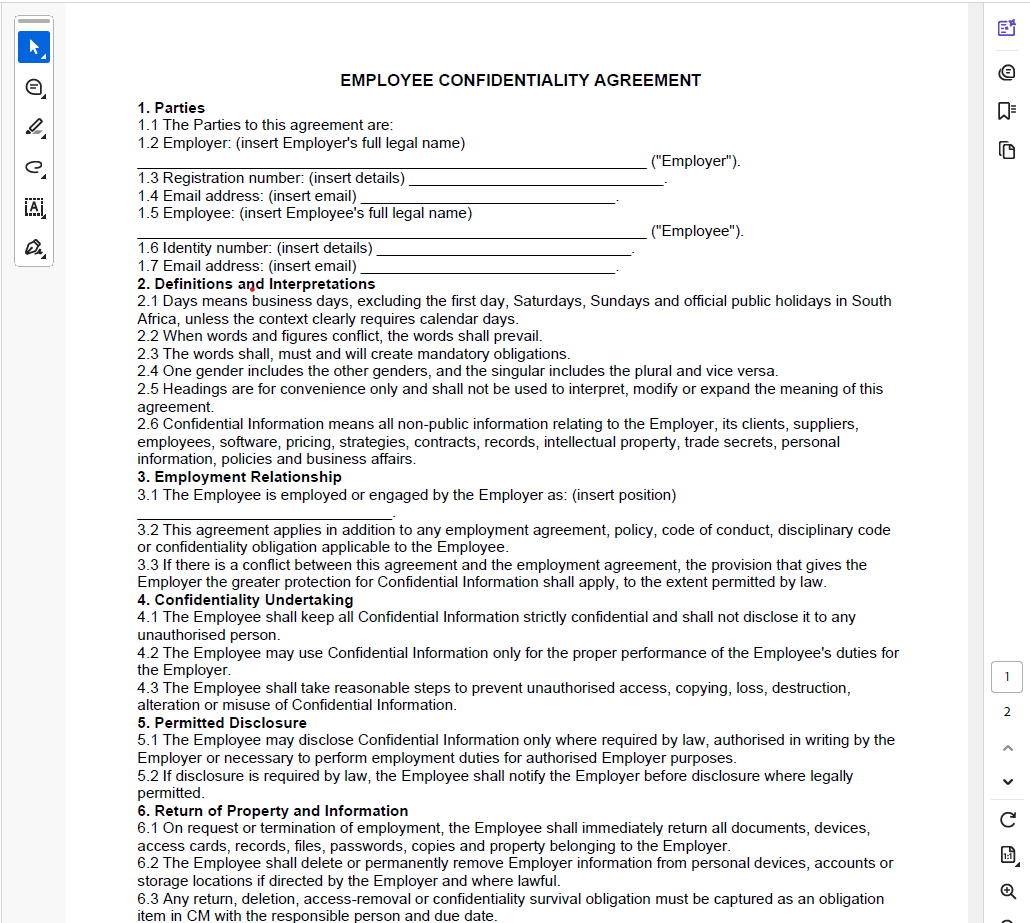
Connect on LinkedInEmployee Confidentiality Agreement
The templates and resources available through Contract Corridor are provided for general informational purposes only. They do not constitute legal advice, and their use does not create an attorney-client relationship between you and Contract Corridor or any of its affiliates.
While every effort has been made to ensure that the templates are up to date and relevant, Contract Corridor makes no representations or warranties, express or implied, regarding their accuracy, completeness, adequacy, legality, or suitability for any specific purpose. The templates may not reflect current legal developments or the laws applicable in your jurisdiction.
You are solely responsible for reviewing, customising, and validating any template before use, to ensure that any document meets your specific needs and complies with applicable laws and regulations.
To the fullest extent permitted by law, Contract Corridor, its owners, employees, and affiliates disclaim all liability for any loss, damage, or consequence arising directly or indirectly from the use of, or reliance upon, any template, resource, or related material provided on or through this platform.
By accessing, downloading, or using any template, you acknowledge and agree that such use is entirely at your own risk.
Contract Corridor Contract Templates