
Shareholders Agreement
How to Protect Long-Term Business Interests
Introduction
Starting a business with partners brings many challenges. Most founders focus on growth and sales first. However, legal structure stays equally important for success. A clear shareholders agreement forms the backbone of these partnerships. It prevents messy disputes before they even start.
Contract Corridor helps teams organize their most vital legal records. Our software streamlines the way you store and track your shareholders agreement over time. Without a central system, partners might lose track of their rights. This leads to confusion during big business moves or transitions.
Furthermore, early-stage companies often overlook formal contracts. They rely on verbal promises or simple emails. Unfortunately, these methods rarely hold up in court. Using a solid shareholders agreement ensures everyone stays on the same page. It defines who owns what and who makes the big decisions.
Definition
A shareholders agreement is a private contract between the owners of a company. It outlines how the business operates and protects the rights of each owner. Specifically, it regulates the relationship between majority and minority owners. It also sets rules for how people can sell or transfer their ownership stakes.
Additionally, this document sits alongside the official bylaws of the corporation. While bylaws are often public records, this contract usually stays confidential. It deals with sensitive details like profit sharing and board seats. In short, it acts as a roadmap for the company's internal governance.
Key Terms and Clauses
Every shareholders agreement contains specific rules to keep the peace. These clauses help managers handle difficult situations without fighting. First, consider the board composition rules. These dictate who can pick the leaders of the company.
Second, look for "Drag-Along" and "Tag-Along" rights. Drag-along rights allow a majority owner to force a sale of the whole company. Meanwhile, tag-along rights protect small owners by letting them join a sale on the same terms. These clauses ensure fair treatment during a merger or acquisition.
Third, many teams use a shareholder loan agreement template within their legal stack. This tracks money that owners lend to the business. It lists interest rates and repayment dates clearly. Likewise, a share subscription agreement template helps when new investors want to buy fresh shares.
Essential Clause Checklist
- Voting rights for major decisions
- Dividend policies and profit distribution
- Restrictions on transferring shares to outsiders
- Dispute resolution methods like mediation
- Non-compete and non-solicitation rules
Types of Agreements
Standard documents work for some, but many businesses need specific formats. For example, a shareholder agreement template uk might follow different tax laws than one in the US. You must choose a format that matches your local regulations and business type.
Small businesses often use an llc shareholder agreement template for their unique structure. These focus more on member roles and operating rules. In contrast, large corporations use a stockholders agreement to manage thousands of investors. Each type serves a different level of complexity.
Furthermore, some owners focus on debt instead of equity. They might use a shareholder loan agreement to provide working capital. This keeps the money separate from the actual ownership shares. It ensures the owner gets paid back before other distributions happen.
When to Use
You should create this contract the moment two or more people own a business. Waiting until a problem happens is a mistake. Similarly, you need a new shareholder contract whenever someone joins the founding team. High-growth startups should review their terms during every funding round.
Additionally, use a transfer of business ownership agreement sample when an owner retires. This helps the remaining partners buy out the departing person fairly. It prevents the shares from going to an unwanted third party. Clear rules make transitions much smoother for everyone involved.
Benefits
First, a shareholders agreement creates stability for the company. It gives banks and investors confidence that the business is stable. They want to see that the owners have a plan for disagreements. Secondly, it protects minority owners from being ignored by the majority.
Third, a shareholder agreement example often shows how to handle "deadlock" situations. A deadlock happens when owners cannot agree on a path forward. The contract provides a tie-breaking vote or a buyout trigger. This prevents the business from freezing up during a crisis.
Finally, having a share agreement contract keeps the company's shares within the original group. You can prevent owners from selling to competitors. This control is vital for maintaining the company's vision and brand over several years.
Common Risks
One major risk involves using a free shareholder agreement template without local legal review. Laws vary by state and country. A generic form might not protect you in your specific location. Always have a lawyer check a sample of shareholder agreement before you sign it.
Another risk is failing to update the shareholder contract as the company grows. Ten-year-old terms might not fit a company with fifty employees. Consequently, owners might find themselves stuck with outdated rules. This often leads to lawsuits when the business values change significantly.
Also, ignore a shareholder loan agreement template at your own peril. If you don't document loans, the tax office might call them income. This creates surprising tax bills for both the owner and the company. Proper documentation prevents these financial headaches.
Comparison
People often confuse the shareholders agreement with the Articles of Incorporation. While they seem similar, they serve different masters. The Articles are public and set the broad legal existence of the firm. The private contract handles the specific behavior of the owners.
| Feature | Shareholders Agreement | Articles of Incorporation |
|---|---|---|
| Privacy | Confidential | Public Record |
| Flexibility | High (Easy to change) | Low (Requires state filing) |
| Subject Matter | Owner relationships | Company existence |
| Parties | Signed by shareholders | Filed by company founders |
Examples in Different Industries
In the technology sector, a shares contract often includes intellectual property clauses. Founders must agree that their code belongs to the company, not themselves. This protects the company's value if a lead developer leaves the group. Investors look for these terms before funding any tech firm.
In healthcare, a shareholder agreement sample might focus on professional licensing. For instance, only licensed doctors can own shares in some medical practices. The contract must explain what happens if a doctor loses their license. It usually triggers an automatic buyout to keep the firm legal.
Construction firms often use a shareholder buyout agreement template for succession planning. Older partners might want to exit slowly over five years. The agreement sets a formula for the price of their equity. This ensures the company keeps enough cash to operate during the payout.
Finance companies prioritize voting power in their stockholders agreement template. They may create different classes of shares with different weights. This allows the original founders to keep control even as they bring on many new investors. It maintains the original investment strategy over time.
Managing with Contract Corridor
Managing a shareholders agreement requires perfect organization. Contract Corridor provides a secure hub for all your shares agreement contract versions. Our platform tracks who signed which document and when. You never have to hunt through old email chains again.
Additionally, our system offers shareholder agreement template word files for easy customization. You can update your terms and send them for digital signature in minutes. Our automated alerts remind you of key dates, like dividend payouts or loan maturity. This keeps your company compliant and your owners happy.
Furthermore, collaboration tools allow partners to comment on a sample of shareholders agreement inside the software. This transparency builds trust among the leadership team. When everyone sees the same data, disputes happen much less often. Contract Corridor makes legal management simple and effective.
Expert Tip: Always keep a stockholder agreement template ready for new hires who receive equity. Using a consistent document prevents "special deals" that might upset your original investors.
Frequently Asked Questions
Are these agreements legally binding?
Yes, this contract is a legally binding document. If someone breaks the rules, the other owners can sue for damages or specific performance. Usually, courts uphold these private contracts as long as they don't break public laws.
Where can I find a sample shareholders agreement?
You can find many examples online, but be careful with the quality. Most shareholder agreement format options provide a starting point. However, you should customize the shareholder contract sample to fit your specific business needs and local laws.
Can we change the agreement later?
Absolutely. Most shareholders agreement contract terms allow for amendments. Typically, you need a majority or a 75% vote to change the rules. You should record the changes in a new share agreement template free of errors.
What is an equity agreement template free of cost?
This is a basic document that outlines how ownership shares are distributed. While a free shareholders agreement template word file helps startups save money, it may lack complex protections. Use an equity agreement template free only for the very simplest business setups.
What happens if a shareholder dies?
A good shareholders agreement model includes a "buy-sell" provision. This usually allows the company or other owners to buy the shares from the deceased person's estate. It prevents family members who don't know the business from getting voting power.
In conclusion, a shareholders agreement is the most important document for any partner-led business. It protects your money, your hard work, and your professional relationships. By using Contract Corridor, you can manage these vital records with ease and confidence. Start building your legal foundation today to ensure a profitable tomorrow.

About the Author: Melissa Jooste
Melissa Jooste is the Head of Marketing at Contract Corridor, where she shapes the voice, narrative, and market positioning of a leading contract lifecycle management platform. Recognized for her expertise in contract lifecycle management content, Melissa is known for producing insightful, high-impact thought leadership that challenges conventional approaches to contract management. Her work goes beyond surface-level marketing, offering clear, strategic perspectives on how organizations can unlock value, reduce risk, and gain control through more effective contract lifecycle practices. Her writing is widely valued for its clarity, depth, and relevance, bridging complex legal, financial, and operational concepts into content that is both accessible and commercially meaningful. By combining strong storytelling with data-driven insight, she consistently delivers content that resonates with senior business leaders, legal professionals, and operational teams alike. Through her work, Melissa plays a key role in establishing Contract Corridor as a leading voice in the contract lifecycle management space, shaping how organizations think about contracts, not as static documents, but as dynamic drivers of business performance.
Connect on LinkedIn
About the reviewer: Jenna Kretzmer
Jenna Kretzmer, CA(SA) is an Executive at Contract Corridor, where she plays a key role in shaping the strategic direction and market positioning of a leading contract lifecycle management platform. A global executive with over a decade of experience, Jenna has led large-scale, international operations and driven growth, transformation, and market expansion across multiple regions. She is recognized for her ability to operate at the intersection of strategy, execution, and commercial performance. Jenna is a leading voice in the contract lifecycle management space, known for her perspectives on contract governance, revenue optimization, and operational efficiency. Her work challenges traditional approaches to contract management, advocating for a shift toward greater visibility, accountability, and value realization across the entire contract lifecycle. She is driving Contract Corridor to enable organizations to move beyond static contract storage toward proactive, value-led contract management, where contracts are treated not as legal documents, but as dynamic instruments that drive measurable business outcomes.
Connect on LinkedInShareholders Agreement
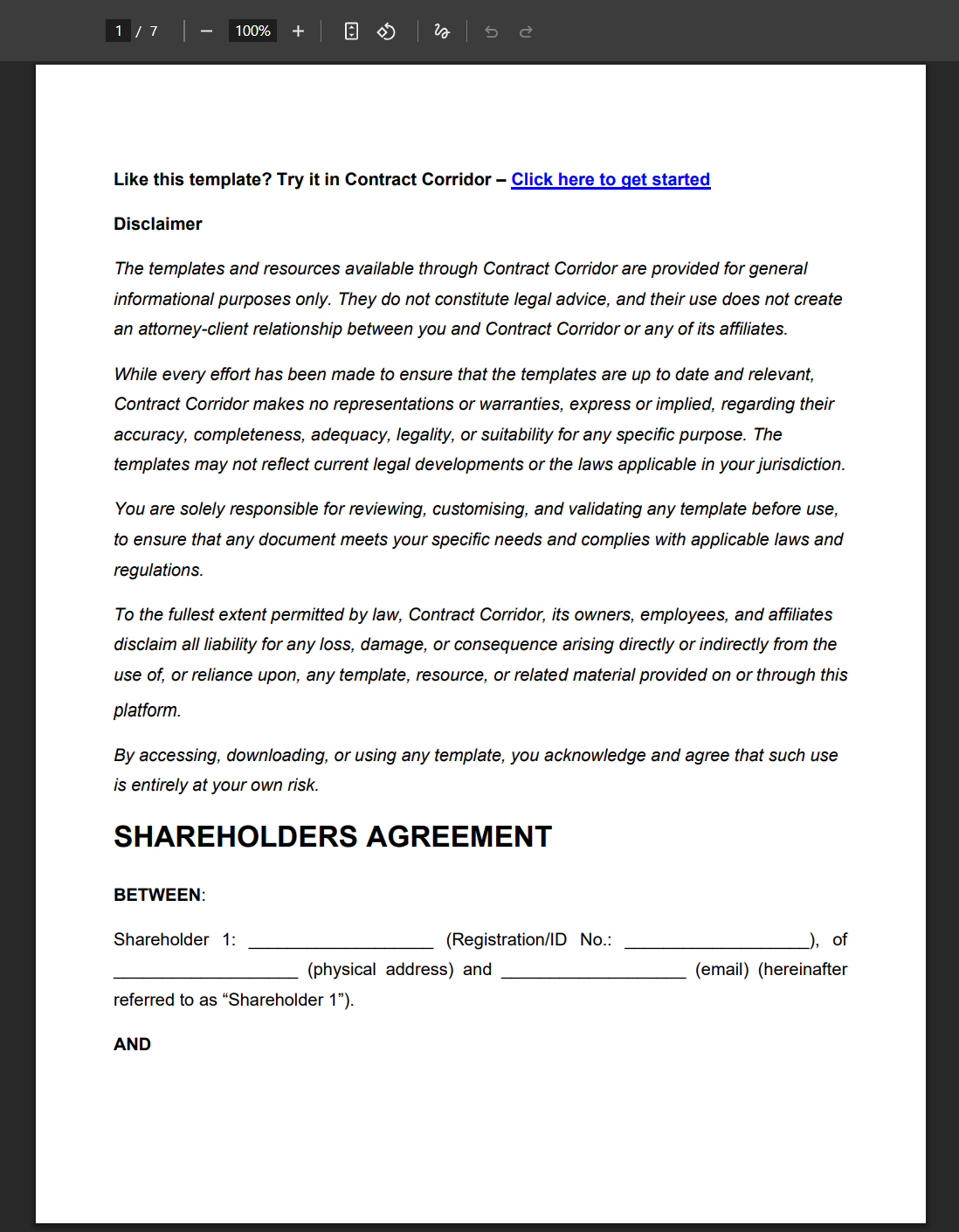
The templates and resources available through Contract Corridor are provided for general informational purposes only. They do not constitute legal advice, and their use does not create an attorney-client relationship between you and Contract Corridor or any of its affiliates.
While every effort has been made to ensure that the templates are up to date and relevant, Contract Corridor makes no representations or warranties, express or implied, regarding their accuracy, completeness, adequacy, legality, or suitability for any specific purpose. The templates may not reflect current legal developments or the laws applicable in your jurisdiction.
You are solely responsible for reviewing, customising, and validating any template before use, to ensure that any document meets your specific needs and complies with applicable laws and regulations.
To the fullest extent permitted by law, Contract Corridor, its owners, employees, and affiliates disclaim all liability for any loss, damage, or consequence arising directly or indirectly from the use of, or reliance upon, any template, resource, or related material provided on or through this platform.
By accessing, downloading, or using any template, you acknowledge and agree that such use is entirely at your own risk.
Contract Corridor Contract Templates