
Joint Venture Agreement
A Comprehensive Guide to Shared Business Growth
Introduction
Many global giants began their journey through a strategic partnership. For example, some of the most famous tech and car brands share risks to enter new markets. This cooperation allows two small companies to compete with industry leaders. However, success depends on a clear and legally binding joint venture agreement. You will learn how to structure these deals effectively in this guide. We will explore how different groups share profits and manage their combined resources. Contract Corridor helps teams navigate these complex legal documents with ease. By the end, you will understand how to protect your interests while growing your business with others.Quick Answer Summary
What Is a Joint Venture?
A joint venture occurs when two independent businesses decide to work together on a unique project. This arrangement creates a new entity or a specific partnership for a set time. Specifically, a joint venture agreement is a legal document that outlines the goals, contributions, and responsibilities of each partner in a shared business project. The term originates from the idea of "adventure," where merchants shared the risks of sea voyages. In today's market, this fits into the broader world of contract management. It bridges the gap between a simple service contract and a full merger. Instead of buying another company, you simply join forces for a win-win outcome. Understanding joint venture what is helps managers see it as a flexible tool. It focuses on cooperation rather than competition. This joint venture business model allows companies to access new technology or geographic regions quickly.Why It Matters
Entering a partnership without a clear plan leads to expensive lawsuits. A strong contract ensures everyone knows their role from day one. Without it, partners might argue over who owns the final product or how to handle losses.Impact of Joint Ventures
- Risk Reduction: Partners often save up to 50% on initial R&D costs by sharing expenses.
- Success Rates: Experts estimate that nearly 40% of large-scale industrial projects use some form of joint venture financing.
- Market Speed: Companies using shared partnerships enter new markets 30% faster than those going alone.
Key Components & Elements
Every solid joint venture contract needs specific sections to function well. These items provide the structure of a joint venture.- Capital Contributions: This section lists exactly how much money or equipment each partner must provide.
- Ownership Percentage: It defines the jv split or how much of the venture each person owns.
- Management and Control: This part explains who makes the daily decisions and who sits on the board.
- Profit and Loss Distribution: Partners must agree on how to divide the money earned or the debts incurred.
- Specific Purpose: The document should clearly state the joint venture description so the project does not drift.
- Termination Clauses: You need a clear exit strategy for when the project ends or if a partner wants to leave.
- Intellectual Property Rights: This dictates who owns the inventions or brands created during the partnership.
Types & Categories
Not all partnerships look the same. Some create new companies, while others stay purely contractual.| Type | Description | Best For | Key Consideration |
|---|---|---|---|
| Equity Joint Venture | Partners create a new jv company as a separate legal entity. | Long-term projects with high capital needs. | Requires more legal setup and separate tax filings. |
| Contractual Joint Venture | An agreement where no new company is formed. | Short-term projects or service sharing. | Liability often stays with the individual partners. |
| Joint Operating Agreement | Often used in oil, gas, or mining sectors. | Resource extraction and heavy industry. | Focuses heavily on daily operational costs and safety. |
Step-by-Step Implementation Guide
Follow these steps to build a strong partnership from the ground up.- Define the Objectives: Sit down with your potential joint venture partners to list specific goals. Clarity here prevents "scope creep" later. Pro tip: Write down what a "win" looks like for both sides.
- Perform Due Diligence: Investigate the financial and legal history of your partner. You must understand the jv partner meaning in your specific context to ensure they are reliable. Pro tip: Check their previous venture contracts and success rates.
- Draft the Agreement: Use a joint venture agreement sample or a jv contract template to start the writing process. This ensures you do not miss standard legal protections. Pro tip: Always have a jv agreement lawyer review the final version.
- Structure the Management: Create a board or a management team to handle the joint venture services. Decide how to settle ties if the partners disagree. Pro tip: Choose an odd number of board members to avoid deadlocks.
- Set Up the Operations: Open separate bank accounts and hire staff if the jv structure requires it. Keep these operations distinct from your main business. Pro tip: Use an independent auditor for the joint venture deals.
Common Mistakes & How to Avoid Them
Avoiding these pitfalls will save your business time and money.| Mistake | Why It Happens | How to Fix It |
|---|---|---|
| Vague exit strategy | Partners are too optimistic at the start. | Include a "buy-sell" clause in the join venture documents. |
| Unequal effort | One partner relies on the other to do all the work. | Define clear milestones and joint venture service levels. |
| Poor communication | Management teams fail to meet regularly. | Schedule monthly reviews as part of the jv agreement. |
| Ignoring tax laws | Partners forget that different structures have different tax rules. | Consult a joint venture advisory expert before signing. |
The most important thing to remember is that trust is the foundation, but the contract is the safety net. Never start work before both parties sign the joint venture agreement contract template.
Industry Examples & Use Cases
Check out how a joint venture explained through these scenarios works in the real world. 1. Real Estate Development Two companies decide to build a new luxury apartment block. One company owns the land, and the other has the construction expertise. They sign a jv agreement real estate contract to split the rental income. This allows the landowner to build without having to learn construction. 2. Technology Innovation A software firm and a hardware manufacturer want to create a new smart device. They enter a joint venture merger and acquisition phase for a specific product line. By sharing their tech, they create a better product than they could alone. 3. Healthcare Research Two pharmaceutical companies join forces to find a cure for a rare disease. They share the high costs of laboratory testing and clinical trials. This joint venture consultancy approach speeds up the time it takes to get to market.Frequently Asked Questions
What is a jv in business?
A jv, or joint venture, is a strategic alliance where two or more parties collaborate on a project. They share resources, risks, and rewards while maintaining their separate legal identities outside the project.
How does a joint venture differ from a partnership?
A partnership usually involves a long-term, ongoing business relationship for all activities. In contrast, a joint venture often focuses on a single project or a limited timeframe.
Who owns the assets in a joint venture?
Ownership depends on the joint venture agreement format. In an equity joint venture, the new company owns the assets. In a contractual version, the partners might retain individual ownership of what they contributed.
Can a joint venture be a single person?
No, a joint venture requires at least two separate parties. These parties can be individuals, existing corporations, or even governments working together.
What is joint venture meaning in legal terms?
Legally, it is an association of persons or entities to carry out a single business enterprise for profit. Courts look at the intent of the parties and their shared control to define the relationship.
How Contract Corridor Helps
Managing a joint venture requires precise documentation and constant oversight. Contract Corridor simplifies this process so you can focus on building your partnership. First, our platform helps you organize your joint venture contracts in one secure location. You can easily track deadlines and milestones for each partner. This ensures that no one misses a capital contribution or an important report. Second, we provide tools to help you draft your joint venture agreement with confidence. Our system helps you track changes and versions during negotiations. Consequently, you will always know which draft is the current version of the joint venture agreement. Finally, our dashboard gives you a bird’s-eye view of all your joint venture partners. You can see the health of every jv deal at a glance. Start your next successful joint venture by organizing your legal documents today.
About the Author: Melissa Jooste
Melissa Jooste is the Head of Marketing at Contract Corridor, where she shapes the voice, narrative, and market positioning of a leading contract lifecycle management platform. Recognized for her expertise in contract lifecycle management content, Melissa is known for producing insightful, high-impact thought leadership that challenges conventional approaches to contract management. Her work goes beyond surface-level marketing, offering clear, strategic perspectives on how organizations can unlock value, reduce risk, and gain control through more effective contract lifecycle practices. Her writing is widely valued for its clarity, depth, and relevance, bridging complex legal, financial, and operational concepts into content that is both accessible and commercially meaningful. By combining strong storytelling with data-driven insight, she consistently delivers content that resonates with senior business leaders, legal professionals, and operational teams alike. Through her work, Melissa plays a key role in establishing Contract Corridor as a leading voice in the contract lifecycle management space, shaping how organizations think about contracts, not as static documents, but as dynamic drivers of business performance.
Connect on LinkedIn
About the reviewer: Jenna Kretzmer
Jenna Kretzmer, CA(SA) is an Executive at Contract Corridor, where she plays a key role in shaping the strategic direction and market positioning of a leading contract lifecycle management platform. A global executive with over a decade of experience, Jenna has led large-scale, international operations and driven growth, transformation, and market expansion across multiple regions. She is recognized for her ability to operate at the intersection of strategy, execution, and commercial performance. Jenna is a leading voice in the contract lifecycle management space, known for her perspectives on contract governance, revenue optimization, and operational efficiency. Her work challenges traditional approaches to contract management, advocating for a shift toward greater visibility, accountability, and value realization across the entire contract lifecycle. She is driving Contract Corridor to enable organizations to move beyond static contract storage toward proactive, value-led contract management, where contracts are treated not as legal documents, but as dynamic instruments that drive measurable business outcomes.
Connect on LinkedInJoint Venture Agreement
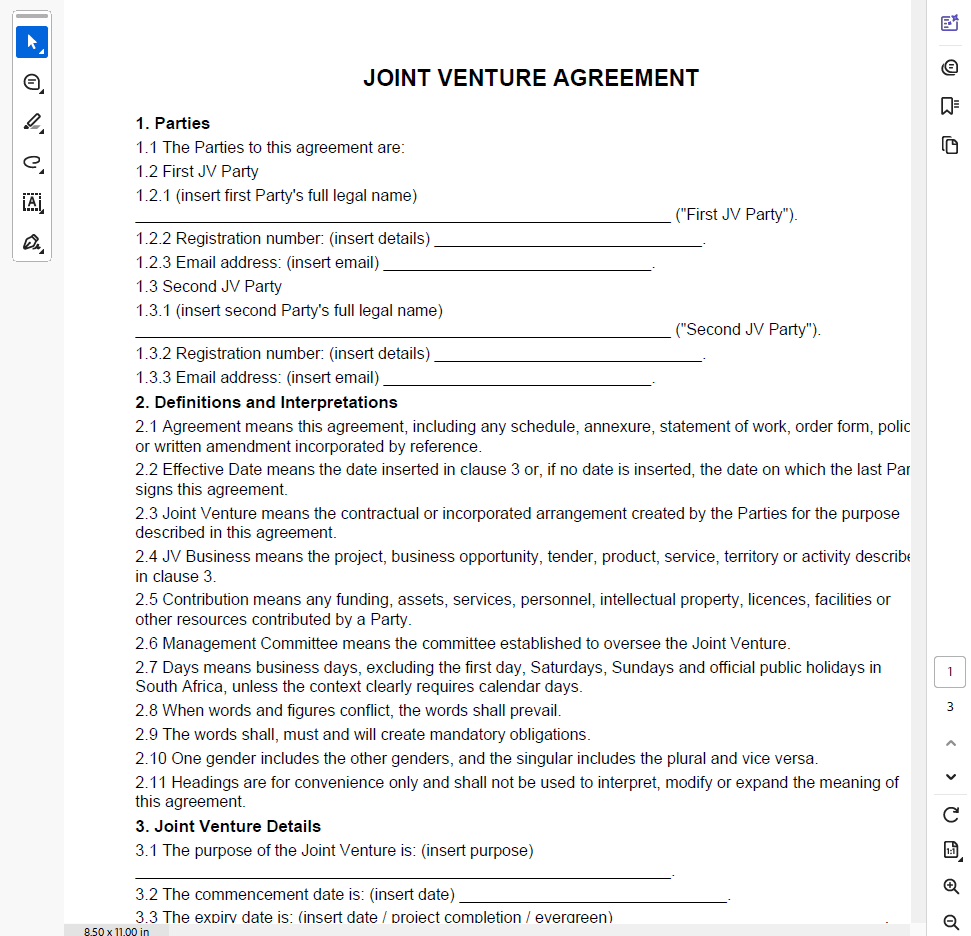
The templates and resources available through Contract Corridor are provided for general informational purposes only. They do not constitute legal advice, and their use does not create an attorney-client relationship between you and Contract Corridor or any of its affiliates.
While every effort has been made to ensure that the templates are up to date and relevant, Contract Corridor makes no representations or warranties, express or implied, regarding their accuracy, completeness, adequacy, legality, or suitability for any specific purpose. The templates may not reflect current legal developments or the laws applicable in your jurisdiction.
You are solely responsible for reviewing, customising, and validating any template before use, to ensure that any document meets your specific needs and complies with applicable laws and regulations.
To the fullest extent permitted by law, Contract Corridor, its owners, employees, and affiliates disclaim all liability for any loss, damage, or consequence arising directly or indirectly from the use of, or reliance upon, any template, resource, or related material provided on or through this platform.
By accessing, downloading, or using any template, you acknowledge and agree that such use is entirely at your own risk.
Contract Corridor Contract Templates