
Indemnity Agreement
How to Guard Your Business Against Financial Risk
Introduction
Imagine your company hires a contractor to fix a roof. During the job, the contractor accidentally drops a tool on a neighbor's car. Without the right protection, you might have to pay for those repairs. This is where an indemnity agreement becomes a shield for your bank account.
In this guide, you will learn how these legal tools protect businesses from unexpected costs. Contract Corridor helps teams navigate these complex documents with ease. We will break down exactly how these promises work in simple terms. You will also see why every manager needs to understand these protections before signing any deal.
Quick Answer Summary
An indemnity agreement is a legal promise where one person agrees to pay for another person's losses or damages. This contract shifts financial risk from one party to another, often in cases of lawsuits or accidents. By signing it, the "indemnitor" pledges to cover costs like legal fees or repair bills for the "indemnitee." This protects the innocent party from losing money due to the actions of the other person.
What Is Indemnity?
The term comes from the Latin word "indemnis," which means unhurt or free from loss. In the business world, a contract of indemnity acts as a form of insurance between two parties. It ensures that if something goes wrong, the party responsible for the risk handles the bill.
An indemnity agreement contract is a written document that defines who pays when a third party makes a legal claim. It basically says, "If I cause a problem that costs you money, I will pay you back." This fits into contract management by helping companies map out their potential liabilities. When you define indemnity, you are essentially creating a safety net for your operations.
These documents often appear in construction, high-tech deals, and real estate. However, almost every service arrangement uses them. An indemnity agreement meaning can change based on the specific words used. Therefore, you must read the fine print to know exactly what you are promising.
Why It Matters
Getting your legal protections right saves more than just money. It protects your brand and keeps your projects moving forward. If you ignore these clauses, a single lawsuit could bankrupt a small business. Meanwhile, large companies use them to manage risks across thousands of vendors.
Legal data suggests that litigation costs for small businesses can range from $3,000 to $150,000 per case. Additionally, roughly 40% of small businesses will face a claim in the next ten years. Proper indemnity provisions can reduce these out-of-pocket costs to zero.
Moreover, these tools help teams work more efficiently. When everyone knows who is responsible for what, there are fewer arguments. This clarity allows managers to focus on growth rather than legal threats. In short, mastering the indemnity definition is a vital skill for any modern leader.
Key Components & Elements
Every strong document needs certain parts to work correctly in court. If a piece is missing, a judge might decide the promise is not valid. You should look for these elements in every indemnity contract sample you review.
- The Indemnitor: This is the person or company who promises to pay for the loss.
- The Indemnitee: This is the person or company who receives the protection.
- Scope of Coverage: This defines exactly which events or accidents the promise covers.
- Notice Requirements: This section explains how and when the protected party must tell the other person about a claim.
- Defense Obligations: This determines if the promisor must also pay for a lawyer to fight the case in court.
- Duration: This tells you how long the protection lasts after the main project ends.
Types & Categories
Not all promises are equal in the eyes of the law. Some offer broad protection, while others are very limited. Use this table to understand the common types of indemnity insurance and legal setups.
| Type | Description | Best For | Key Consideration |
|---|---|---|---|
| Broad Form | Covers all losses, even if the protected party is at fault. | High-risk construction | Often strictly limited by state laws. |
| Intermediate Form | Covers losses unless the protected party is 100% at fault. | Service contracts | A fair middle ground for most deals. |
| Limited Form | Only covers losses caused by the promising party. | Small consulting jobs | Provides the least amount of protection. |
| Mutual Indemnity | Both parties agree to protect each other for their own mistakes. | Partnerships | Ensures both sides take responsibility. |
Step-by-Step Implementation Guide
Creating a solid agreement of indemnity requires a careful process. Follow these steps to ensure your business stays safe.
- Identify the Risks: List every possible thing that could go wrong during the contract. This matters because you cannot protect against what you do not foresee. Pro tip: Consult with your project leads to find hidden operational dangers.
- Draft the Language: Use clear words to define what is indemnity agreement coverage in your specific case. This avoids confusion later if a dispute happens. Pro tip: Always include a section for attorney fees.
- Review State Laws: Some states do not allow certain types of broad form indemnification. This matters because an illegal clause can make your whole contract void. Pro tip: Check if your state has "anti-indemnity" statutes for construction.
- Attach an Indemnity Form: Make the legal promise a formal part of your main contract. This ensures the promise is legally binding and linked to the work. Pro tip: Keep a standard indemnity agreement as a starting point.
- Verify Insurance: Ensure the promisor actually has the money or insurance to pay if a claim arises. This matters because a promise is useless if the person is broke. Pro tip: Ask for a certificate of insurance before work starts.
Common Mistakes & How to Avoid Them
Many people sign these documents without fully understanding the indemnity meaning in law. This can lead to massive financial surprises later on. Here are the most frequent errors people make.
| Mistake | Why It Happens | How to Fix It |
|---|---|---|
| Vague Language | Using "legalese" that no one understands. | Use simple words like those in an indemnity agreement example. |
| Ignoring "Hold Harmless" | Thinking indemnity and hold harmless are exactly the same. | Learn the indemnity vs hold harmless difference to cover all bases. |
| No Defense Clause | Forgetting to mention who pays for the lawyers. | Explicitly state that the indemnitor must provide a legal defense. |
| Overly Broad Scope | Trying to cover every possible event in the universe. | Narrow the scope to the specific services being provided. |
Always check if your insurance policy covers the promises you make in an agreement to indemnify another party.
Industry Examples & Use Cases
To truly understand how this works, we should look at some real-life scenarios. These examples show how a standard indemnity agreement functions in different fields.
Construction: A builder hires a plumber. The plumber leaves a pipe leaking, which ruins a tenant's expensive rug. Because of the indemnity in contract, the plumber must pay for the rug and any legal fees the builder faces.
Real Estate: An environmental indemnity agreement is common when buying old factories. The seller promises to pay for any future cleanup of toxic waste found in the soil. This gives the buyer peace of mind to finish the purchase.
Software Services: A company uses an indemnity clause in service contract to protect against copyright claims. If the software developer steals code from someone else, the developer must pay the bills for any resulting lawsuits.
Corporate Finance: In a tax indemnity, a seller might promise a buyer that all past taxes are paid. If the government finds an old unpaid bill, the seller has an indemnity obligation to pay it immediately.
Frequently Asked Questions
What does indemnity mean in a contract?
It means one party compensates another for a loss. This usually involves paying for damages, legal costs, or settlements caused by a specific event.
Should I sign an indemnity agreement?
You should sign it only after you understand what risks you are taking. Make sure you have insurance that covers the specific promises made in the document.
What is an indemnity bond?
This is a specific type of bond that guarantees a person will be paid back if they lose money. It is often used when replacing lost stock certificates or other valuable papers.
What is the difference between indemnity and insurance?
Insurance is a contract with a professional company to cover risks for a fee. Indemnity is a broader legal promise that can exist between any two parties in any deal.
What does indemnitor mean?
The indemnitor is the person who is making the promise to pay. They are the ones taking on the financial risk for the other party's potential losses.
How Contract Corridor Helps
Managing a complex indemnity agreement does not have to be stressful. Contract Corridor provides the tools you need to stay organized and protected. Our platform simplifies the way you handle every indemnity contract example in your library.
First, we provide a clear indemnity agreement template for your team to use. This ensures all your deals start with professional, vetted language. You will never have to wonder if you missed a key protection again.
Second, our system tracks every indemnity obligation across your entire business. We alert you when insurance certificates expire or when notice periods are coming up. This keeps you ahead of potential problems before they cost you money.
Third, we make collaboration easy for everyone involved. You can share an indemnification agreement example with your lawyer or partner in seconds. This speed helps you close deals faster while keeping your risks low. Join Contract Corridor today to take control of your legal safety.

About the Author: Melissa Jooste
Melissa Jooste is the Head of Marketing at Contract Corridor, where she shapes the voice, narrative, and market positioning of a leading contract lifecycle management platform. Recognized for her expertise in contract lifecycle management content, Melissa is known for producing insightful, high-impact thought leadership that challenges conventional approaches to contract management. Her work goes beyond surface-level marketing, offering clear, strategic perspectives on how organizations can unlock value, reduce risk, and gain control through more effective contract lifecycle practices. Her writing is widely valued for its clarity, depth, and relevance, bridging complex legal, financial, and operational concepts into content that is both accessible and commercially meaningful. By combining strong storytelling with data-driven insight, she consistently delivers content that resonates with senior business leaders, legal professionals, and operational teams alike. Through her work, Melissa plays a key role in establishing Contract Corridor as a leading voice in the contract lifecycle management space, shaping how organizations think about contracts, not as static documents, but as dynamic drivers of business performance.
Connect on LinkedIn
About the reviewer: Jenna Kretzmer
Jenna Kretzmer, CA(SA) is an Executive at Contract Corridor, where she plays a key role in shaping the strategic direction and market positioning of a leading contract lifecycle management platform. A global executive with over a decade of experience, Jenna has led large-scale, international operations and driven growth, transformation, and market expansion across multiple regions. She is recognized for her ability to operate at the intersection of strategy, execution, and commercial performance. Jenna is a leading voice in the contract lifecycle management space, known for her perspectives on contract governance, revenue optimization, and operational efficiency. Her work challenges traditional approaches to contract management, advocating for a shift toward greater visibility, accountability, and value realization across the entire contract lifecycle. She is driving Contract Corridor to enable organizations to move beyond static contract storage toward proactive, value-led contract management, where contracts are treated not as legal documents, but as dynamic instruments that drive measurable business outcomes.
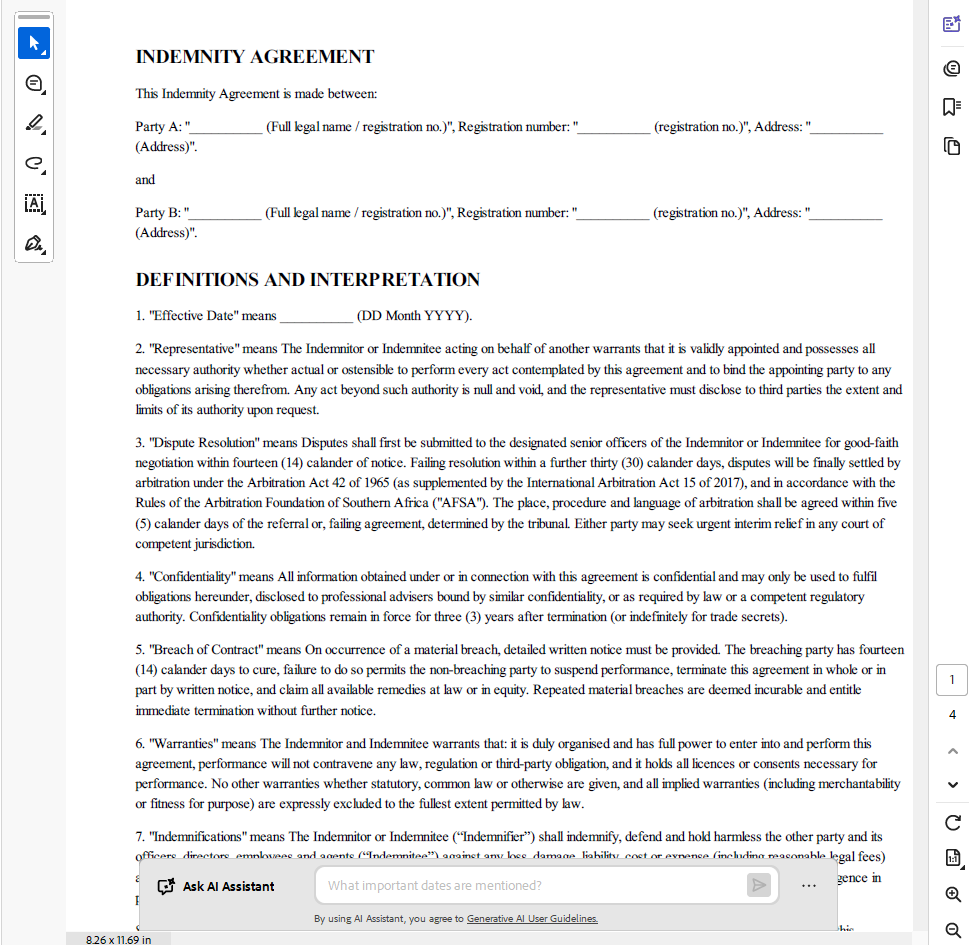
Connect on LinkedInIndemnity Agreement
The templates and resources available through Contract Corridor are provided for general informational purposes only. They do not constitute legal advice, and their use does not create an attorney-client relationship between you and Contract Corridor or any of its affiliates.
While every effort has been made to ensure that the templates are up to date and relevant, Contract Corridor makes no representations or warranties, express or implied, regarding their accuracy, completeness, adequacy, legality, or suitability for any specific purpose. The templates may not reflect current legal developments or the laws applicable in your jurisdiction.
You are solely responsible for reviewing, customising, and validating any template before use, to ensure that any document meets your specific needs and complies with applicable laws and regulations.
To the fullest extent permitted by law, Contract Corridor, its owners, employees, and affiliates disclaim all liability for any loss, damage, or consequence arising directly or indirectly from the use of, or reliance upon, any template, resource, or related material provided on or through this platform.
By accessing, downloading, or using any template, you acknowledge and agree that such use is entirely at your own risk.
Contract Corridor Contract Templates