
Asset Purchase Agreementnew
A Practical Breakdown for Modern Teams
Introduction
Imagine buying a company but accidentally inheriting all its past lawsuits. This nightmare happens to many buyers who do not use a strong asset purchase agreement. Every year, thousands of small businesses change hands. However, many owners fail to list exactly what they are buying. This leads to expensive legal fights. In this article, you will learn how to transfer business items safely. We will look at what makes a solid legal document. You will also see how Contract Corridor helps teams manage these deals with ease. Specifically, we will cover the fine details of an asset purchase to keep your interests safe.Quick Answer Summary
What Is an Asset Purchase Agreement?
An asset purchase agreement is a contract where a buyer chooses specific things to buy from a company. These things might be physical, like desks or computers. They can also be digital, like website domains or software code. This type of deal helps people transfer ownership without buying the whole legal entity. In the legal world, people often call this an apa agreement. Most legal experts use this term to describe the transfer of "stuff" rather than "shares." Historically, these deals help buyers start fresh. For example, a buyer can take the brand name but leave behind the company's old debts. Within contract management, this document acts as the master map for the entire transition.Why It Matters
Dealing with a business asset sale contracts mistake can ruin a firm. If a buyer does not list an item, they might not legally own it. If the seller does not list a debt, they might still owe the money. These documents ensure high operational efficiency during a hand-off.Key Market Insights
- M&A experts report that 70% to 90% of mergers fail due to poor integration or bad contract terms.
- Companies can reduce legal costs by 30% when they use a clear purchase of assets agreement.
- Most buyers prefer asset deals over stock deals because they get tax benefits from depreciating assets.
Key Components & Elements
To make a deal work, you need specific sections in your paperwork. Use this asset purchase agreement checklist to verify your document.- Definitions: Clearly define every technical term used in the text.
- Purchased Assets: List every single piece of equipment, vehicle, and office chair.
- Excluded Assets: Mention items the seller will keep for themselves.
- Purchase Price: State the total money amount and how the buyer will pay it.
- Representations and Warranties: Include promises that the assets actually work and the seller truly owns them.
- Indemnification: Explain who pays if something goes wrong after the deal closes.
Types & Categories
Different deals require different structures. Some buyers want everything. Other buyers only want the customer list. Here is how to classify these agreements.| Type | Description | Best For | Key Consideration |
|---|---|---|---|
| Full Business Sale | Transfer of all equipment and clients. | Small shops or medical practices. | Employee retention plans. |
| Intellectual Property | Focuses on patents and code. | Software and tech startups. | Chain of title for ideas. |
| Distressed Sale | Buying assets from a failing firm. | Turnaround investors. | Existing liens and debts. |
| Partial Asset Sale | Buying one specific branch. | Regional expansion. | Shared service contracts. |
Step-by-Step Implementation Guide
Follow these steps to complete your apa purchase agreement correctly.- Inventory Everything: Walk through the building and count every item. Why? You cannot buy what you have not listed. Pro tip: Take photos of high-value items for the appendix.
- Draft the Document: Use a simple asset purchase agreement to start your outline. This saves time on basic language. Pro tip: Ensure the legal names of both companies are perfect.
- Perform Due Diligence: Check if the seller owes money on the equipment. Why? Liens can follow the asset to the new owner. Pro tip: Run a search for UCC filings.
- Negotiate Terms: Talk about the price and the date of the hand-over. Why? This prevents confusion on closing day. Pro tip: Plan for a transition period where the seller helps you.
- Sign and Close: Execute the asset sale and purchase agreement with official signatures. Why? The deal is not real until the ink is dry. Pro tip: Keep a digital copy in a secure cloud.
Common Mistakes & How to Avoid Them
Many people rush through the purchase assets phase. This causes big problems later.| Mistake | Why It Happens | How to Fix It |
|---|---|---|
| Vague Descriptions | Laziness during the inventory phase. | Use serial numbers for every machine. |
| Ignoring Permits | Focusing only on physical objects. | List all licenses in the contract. |
| No Tax Allocation | Forgetting the IRS during the deal. | Agree on asset values early. |
| Missing Employee Info | Assuming staff will stay for free. | Include clear hiring terms. |
Always check if what is included in a sale assets ip inventory contracts matches the physical reality of the business warehouse.
Industry Examples & Use Cases
Different sectors use these contracts in unique ways. First, consider a restaurant asset purchase agreement. A buyer might want the stoves and the secret recipes. However, they might not want the old health code violations. By using an asset deal, the new owner starts with a clean slate. Second, think about a software company purchase agreement. The buyer wants the source code and the user database. They often leave the physical office space behind. This helps them move the tech to their own servers quickly. Third, look at a factory expansion. A firm uses a business asset purchase agreement to buy a rival's old machines. They do not buy the rival company itself. This allows for fast growth without taking on the rival's old lawsuits. Finally, an asset management agreement helps a firm manage these new items. After the buying is done, someone must track the maintenance and value of the gear.Frequently Asked Questions
What is included in an asset purchase agreement sample?
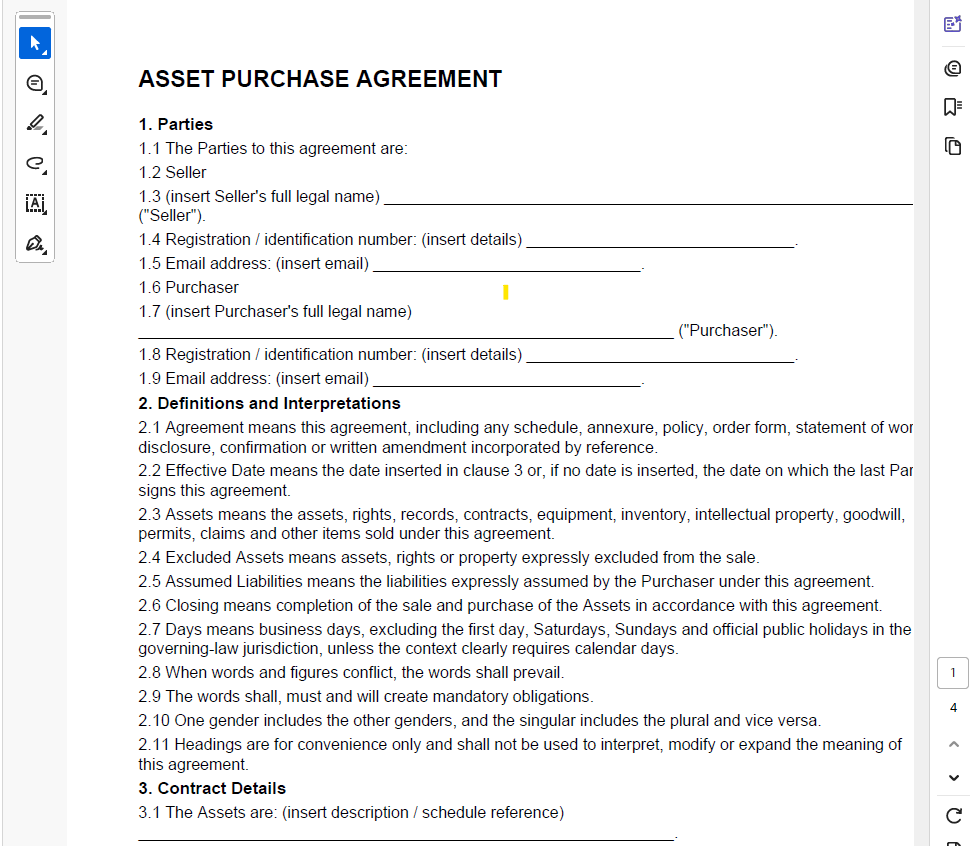
Most samples include the buyer's name, the seller's name, a list of items, and the price. They also feature sections for closing dates and what happens if a party breaks the deal.
How do I find an asset purchase agreement pdf?
You can find these on many legal template websites. However, you should always have a lawyer review any file you download to ensure it matches your state laws.
What is a contract asset in these deals?
A contract asset is a right to payment for goods or services already delivered. When you buy a business, you might buy these rights so you can collect the money later.
Does an asset management contract cover new purchases?
Yes, these contracts usually explain how a professional will handle and grow the portfolio of items you just bought. They focus more on the long-term use of the assets.
Where can I see an asset purchase agreement example?
Many government websites show public deals. You can also view a sample asset purchase agreement in legal textbooks or through professional software platforms like Contract Corridor.
How Contract Corridor Helps
Managing asset purchase and sale agreements does not have to be hard. Contract Corridor simplifies the process for teams of all sizes. First, our platform helps you track every asset purchase agreement in one place. No more searching through messy email chains for the latest version. You can see the status of every deal at a glance. Second, our tools help you organize your asset purchase agreements efficiently. You can set alerts for key dates. This ensures you never miss a deadline for a payment or a transition task. Third, we provide a secure hub for your business asset purchase agreement files. You can share documents with lawyers and sellers safely. This protects your sensitive business data from leaks. Ready to streamline your business asset sale? Visit Contract Corridor today to start managing your legal documents with confidence.
About the Author: Melissa Jooste
Melissa Jooste is the Head of Marketing at Contract Corridor, where she shapes the voice, narrative, and market positioning of a leading contract lifecycle management platform. Recognized for her expertise in contract lifecycle management content, Melissa is known for producing insightful, high-impact thought leadership that challenges conventional approaches to contract management. Her work goes beyond surface-level marketing, offering clear, strategic perspectives on how organizations can unlock value, reduce risk, and gain control through more effective contract lifecycle practices. Her writing is widely valued for its clarity, depth, and relevance, bridging complex legal, financial, and operational concepts into content that is both accessible and commercially meaningful. By combining strong storytelling with data-driven insight, she consistently delivers content that resonates with senior business leaders, legal professionals, and operational teams alike. Through her work, Melissa plays a key role in establishing Contract Corridor as a leading voice in the contract lifecycle management space, shaping how organizations think about contracts, not as static documents, but as dynamic drivers of business performance.
Connect on LinkedIn
About the reviewer: Jenna Kretzmer
Jenna Kretzmer, CA(SA) is an Executive at Contract Corridor, where she plays a key role in shaping the strategic direction and market positioning of a leading contract lifecycle management platform. A global executive with over a decade of experience, Jenna has led large-scale, international operations and driven growth, transformation, and market expansion across multiple regions. She is recognized for her ability to operate at the intersection of strategy, execution, and commercial performance. Jenna is a leading voice in the contract lifecycle management space, known for her perspectives on contract governance, revenue optimization, and operational efficiency. Her work challenges traditional approaches to contract management, advocating for a shift toward greater visibility, accountability, and value realization across the entire contract lifecycle. She is driving Contract Corridor to enable organizations to move beyond static contract storage toward proactive, value-led contract management, where contracts are treated not as legal documents, but as dynamic instruments that drive measurable business outcomes.
Connect on LinkedInAsset Purchase Agreement
The templates and resources available through Contract Corridor are provided for general informational purposes only. They do not constitute legal advice, and their use does not create an attorney-client relationship between you and Contract Corridor or any of its affiliates.
While every effort has been made to ensure that the templates are up to date and relevant, Contract Corridor makes no representations or warranties, express or implied, regarding their accuracy, completeness, adequacy, legality, or suitability for any specific purpose. The templates may not reflect current legal developments or the laws applicable in your jurisdiction.
You are solely responsible for reviewing, customising, and validating any template before use, to ensure that any document meets your specific needs and complies with applicable laws and regulations.
To the fullest extent permitted by law, Contract Corridor, its owners, employees, and affiliates disclaim all liability for any loss, damage, or consequence arising directly or indirectly from the use of, or reliance upon, any template, resource, or related material provided on or through this platform.
By accessing, downloading, or using any template, you acknowledge and agree that such use is entirely at your own risk.
Contract Corridor Contract Templates