
Time And Materials Contract
A Practical Guide to Flexible Project Scaling
Table of Contents
What Is a Time and Materials Contract?
Step-by-Step Implementation Guide
Introduction
Imagine you hire a team to renovate a historic building. You know what you want the final result to look like. However, once workers open the walls, they find hidden structural damage. In this scenario, a rigid price might lead to poor quality or legal battles. For this reason, many professionals choose a time and materials contract to provide flexibility. This specific billing model allows projects to evolve as needs change. Within Contract Corridor, we see many industries shifting toward these adaptable agreements. This article will teach you how to structure these deals fairly. You will learn how to protect your budget while ensuring high-quality work. We also explain how to manage the risks inherent in this open-ended approach.Quick Answer Summary
What Is a Time and Materials Contract?
Typically, a time and materials contract defines a payment method based on hourly labor rates and the cost of supplies. These agreements are very common in industries like construction and software development. In these fields, the client cannot always predict every task at the start. Therefore, the buyer agrees to pay a set rate for every hour the staff works. The term reflects the two main billing categories. "Time" refers to the labor costs, which usually include wages, overhead, and profit margins. "Materials" refers to the physical parts, software licenses, or third-party tools needed to finish the job. This setup places more risk on the buyer because the total price is not guaranteed. However, it also ensures the contractor gets paid for every hour spent on the client's goals. In the broader world of contract management, this model sits between fixed-price and cost-reimbursable setups. It offers a middle ground for uncertain scopes. While some call it a t&m contract, the legal weight remains the same regardless of the acronym used. It facilitates a partnership where quality takes priority over sticking to a strict, early estimate.Why It Matters
Using the wrong billing model can lead to financial disaster. If a project has many unknowns, a fixed price might force a contractor to take shortcuts. Conversely, a poorly managed t&m basis might cause a project to grow far beyond its original budget. Managing these agreements correctly ensures transparency between all parties.Financial Impact Data
- Overrun Risk: Poorly tracked labor can increase final project costs by 25% beyond initial estimates.
- Conflict Reduction: Teams using clear hourly tracking report 40% fewer legal disputes over extra work.
- Efficiency: Digital tracking of hours can save accounting teams up to 10 hours of manual work per month.
Key Components & Elements
Every successful agreement needs specific sections to prevent confusion. Use this list to verify yours.- Labor Rates: Define exactly how much you pay per hour for different staff levels.
- Material Markup: Specify if the contractor can add a percentage to the price of items they buy.
- NTE Clause: Include a Not-To-Exceed limit to set a maximum ceiling on the total budget.
- Reporting Schedule: Set a requirement for weekly or monthly status updates and hour logs.
- Payment Terms: Detail when invoices are due and the penalties for late payments.
- Scope of Work: Write a t&m sow that describes the goals, even if the steps are not yet clear.
- Audit Rights: Ensure the client can review receipts and time cards at any time.
Types & Categories
Different projects require different ways to handle costs. This table shows how various t&m contracts function in the real world.| Type | Description | Best For | Key Consideration |
|---|---|---|---|
| Standard T&M | Simple billing of hours and parts. | Small repairs or short tasks. | Requires high trust. |
| T&M with NTE | Hourly billing with a price cap. | Major construction or software. | Protects buyer from overruns. |
| Tiered Rate T&M | Rates change based on skill level. | Professional consulting. | Needs detailed time sheets. |
| Unit Price T&M | Billing per unit of work completed. | Road work or repetitive tasks. | Easier to track than pure hours. |
Step-by-Step Implementation Guide
Setting up a time and materials contract requires a steady hand. Follow these steps to ensure a smooth process.- Define the Expected Outcome: Write down the general goals of the project clearly. This helps the team stay focused even when the tasks change. Pro Tip: Use a high-level roadmap to guide the hourly work.
- Establish Labor Rates: Mutually agree on the hourly cost for every role involved. Check that these rates include all your social taxes and insurance. Pro Tip: Lock these rates for the duration of the project.
- Set a Maximum Budget: Add a Not-To-Exceed (NTE) amount to the agreement. This forces a discussion if the work starts costing more than expected. Pro Tip: Set the limit at 110% of your initial estimate for safety.
- Create a Reporting Workflow: Decide how the contractor will submit hours and purchase receipts. Use a standard time and material template to keep things organized. Pro Tip: Use digital tools for real-time tracking.
- Monitor and Audit: Frequently check the submitted hours against the work finished. Ask for clarification if you see a spike in labor without a major milestone. Pro Tip: Schedule a formal review every two weeks.
Common Mistakes & How to Avoid Them
Even experienced managers make errors with these flexible deals. Use this table to spot risks early.| Mistake | Why It Happens | How to Fix It |
|---|---|---|
| Vague Labor Definitions | Parties assume everyone knows the rates. | List every billable role in the contract. |
| Missing a Budget Cap | The project feels small at the start. | Always use an NTE clause for protection. |
| Infrequent Billing | Admin staff gets busy with other tasks. | Require weekly time and material billing. |
| No Material Proof | Trusting the contractor's word on prices. | Require original receipts for all items. |
The single most important rule is transparency. If you cannot track it daily, do not bill it hourly.
Industry Examples & Use Cases
To understand the t&m meaning in different worlds, look at these scenarios. Construction A homeowner hires a company for a kitchen remodel in an old house. The contractor uses a time and materials construction contract because they expect mold behind the walls. As workers find issues, they bill for the extra hours spent on cleaning. The project finishes safely because the budget was flexible enough to handle the hidden damage. Software Development A startup needs to build a new mobile app. They choose time and material software development because they want to change features based on user feedback. Every week, the developers code new ideas and bill for the hours. This agile approach allows the startup to launch a product that people actually want. Consulting A large firm hires a legal expert for an ongoing court case. The expert provides t&m services because they do not know how long the trial will last. They charge for every hour of research and every mile traveled. This ensures the expert remains dedicated to the case for as long as needed. Industrial Repair A factory machine breaks down suddenly. The repair team uses a t&m ticket system to log hours spent troubleshooting. Since they do not know which part is broken, they cannot give a flat quote. They fix the machine and bill the factory for the effort and the specialized sensors used.Frequently Asked Questions
What is a t&m contract versus a fixed-price contract?
In a t&m deal, you pay for hours worked and items purchased regardless of the total. In a fixed-price deal, you pay a single set amount for the entire project outcome. Fixed-price deals put risk on the seller, while t&m puts risk on the buyer.
When should I use a time and materials agreement?
You should use this model when you cannot define the full scope of work accurately. It is perfect for research, emergency repairs, or complex software builds. This model ensures the contractor is not penalized for unforeseen problems.
How do I control costs in these agreements?
Use a Not-To-Exceed (NTE) clause to set a hard ceiling on the budget. Additionally, require the contractor to provide detailed time sheets and receipts before you pay. Regular status meetings also help identify budget leaks before they grow.
What does t&m mean in construction specifically?
In construction, it means the client pays for actual labor hours and the cost of building materials. This usually includes a small percentage for the builder's overhead and profit. It is very common for renovations where structural surprises are likely.
What is the difference between t&m vs cost plus?
T&M contracts focus on set hourly rates that already include profit. Cost-plus contracts bill for actual costs and then add a separate fee for profit, often as a percentage. T&M is usually simpler for smaller to mid-sized projects.
How Contract Corridor Helps
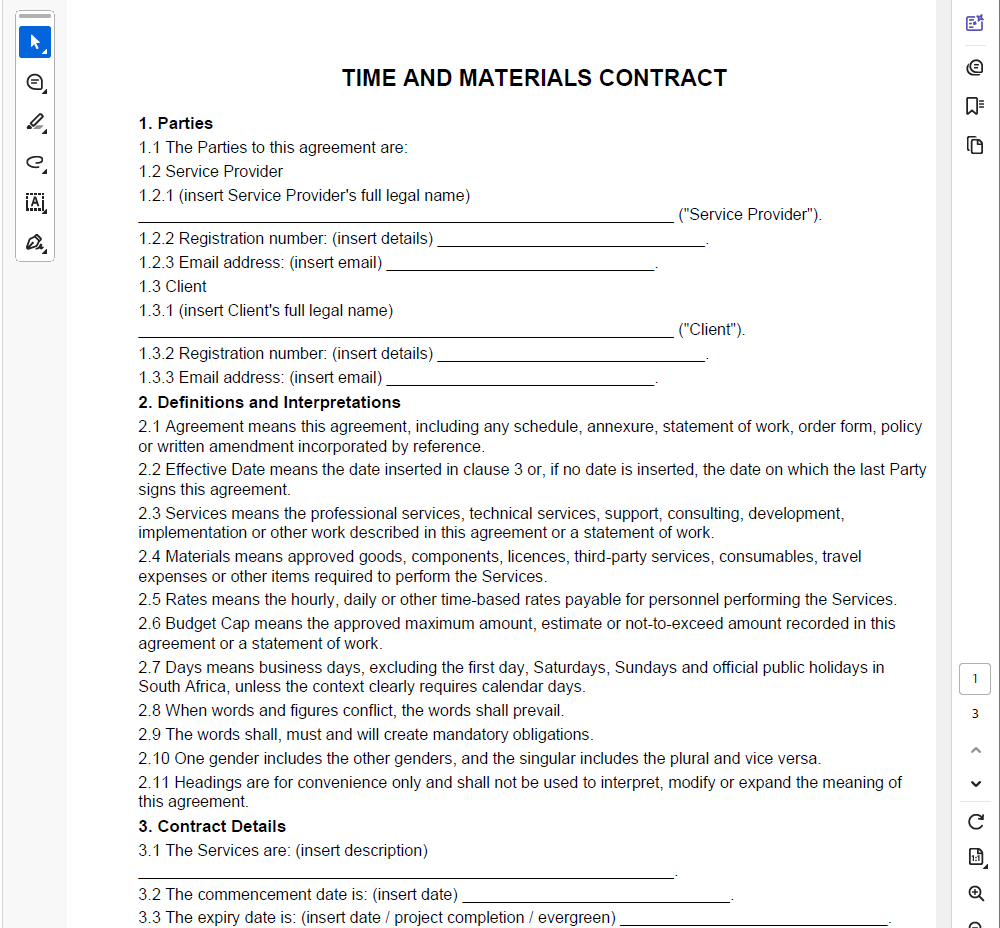
Managing many moving parts requires the right digital foundation. Contract Corridor simplifies the lifecycle of your agreements through several key features. First, our platform provides a standard time and materials contract template. This helps you start with legally sound language that protects both parties. Second, you can centralize your communication. This means all changes to the project scope stay in one accessible place. Third, our alert system reminds you of reporting deadlines. You will never miss an audit window or a billing cycle again. Are you ready to streamline your project billing? Use Contract Corridor to build your next agreement today and take the stress out of your professional partnerships.
About the Author: Melissa Jooste
Melissa Jooste is the Head of Marketing at Contract Corridor, where she shapes the voice, narrative, and market positioning of a leading contract lifecycle management platform. Recognized for her expertise in contract lifecycle management content, Melissa is known for producing insightful, high-impact thought leadership that challenges conventional approaches to contract management. Her work goes beyond surface-level marketing, offering clear, strategic perspectives on how organizations can unlock value, reduce risk, and gain control through more effective contract lifecycle practices. Her writing is widely valued for its clarity, depth, and relevance, bridging complex legal, financial, and operational concepts into content that is both accessible and commercially meaningful. By combining strong storytelling with data-driven insight, she consistently delivers content that resonates with senior business leaders, legal professionals, and operational teams alike. Through her work, Melissa plays a key role in establishing Contract Corridor as a leading voice in the contract lifecycle management space, shaping how organizations think about contracts, not as static documents, but as dynamic drivers of business performance.
Connect on LinkedIn
About the reviewer: Jenna Kretzmer
Jenna Kretzmer, CA(SA) is an Executive at Contract Corridor, where she plays a key role in shaping the strategic direction and market positioning of a leading contract lifecycle management platform. A global executive with over a decade of experience, Jenna has led large-scale, international operations and driven growth, transformation, and market expansion across multiple regions. She is recognized for her ability to operate at the intersection of strategy, execution, and commercial performance. Jenna is a leading voice in the contract lifecycle management space, known for her perspectives on contract governance, revenue optimization, and operational efficiency. Her work challenges traditional approaches to contract management, advocating for a shift toward greater visibility, accountability, and value realization across the entire contract lifecycle. She is driving Contract Corridor to enable organizations to move beyond static contract storage toward proactive, value-led contract management, where contracts are treated not as legal documents, but as dynamic instruments that drive measurable business outcomes.
Connect on LinkedInTime & Materials Agreement
The templates and resources available through Contract Corridor are provided for general informational purposes only. They do not constitute legal advice, and their use does not create an attorney-client relationship between you and Contract Corridor or any of its affiliates.
While every effort has been made to ensure that the templates are up to date and relevant, Contract Corridor makes no representations or warranties, express or implied, regarding their accuracy, completeness, adequacy, legality, or suitability for any specific purpose. The templates may not reflect current legal developments or the laws applicable in your jurisdiction.
You are solely responsible for reviewing, customising, and validating any template before use, to ensure that any document meets your specific needs and complies with applicable laws and regulations.
To the fullest extent permitted by law, Contract Corridor, its owners, employees, and affiliates disclaim all liability for any loss, damage, or consequence arising directly or indirectly from the use of, or reliance upon, any template, resource, or related material provided on or through this platform.
By accessing, downloading, or using any template, you acknowledge and agree that such use is entirely at your own risk.
Contract Corridor Contract Templates