
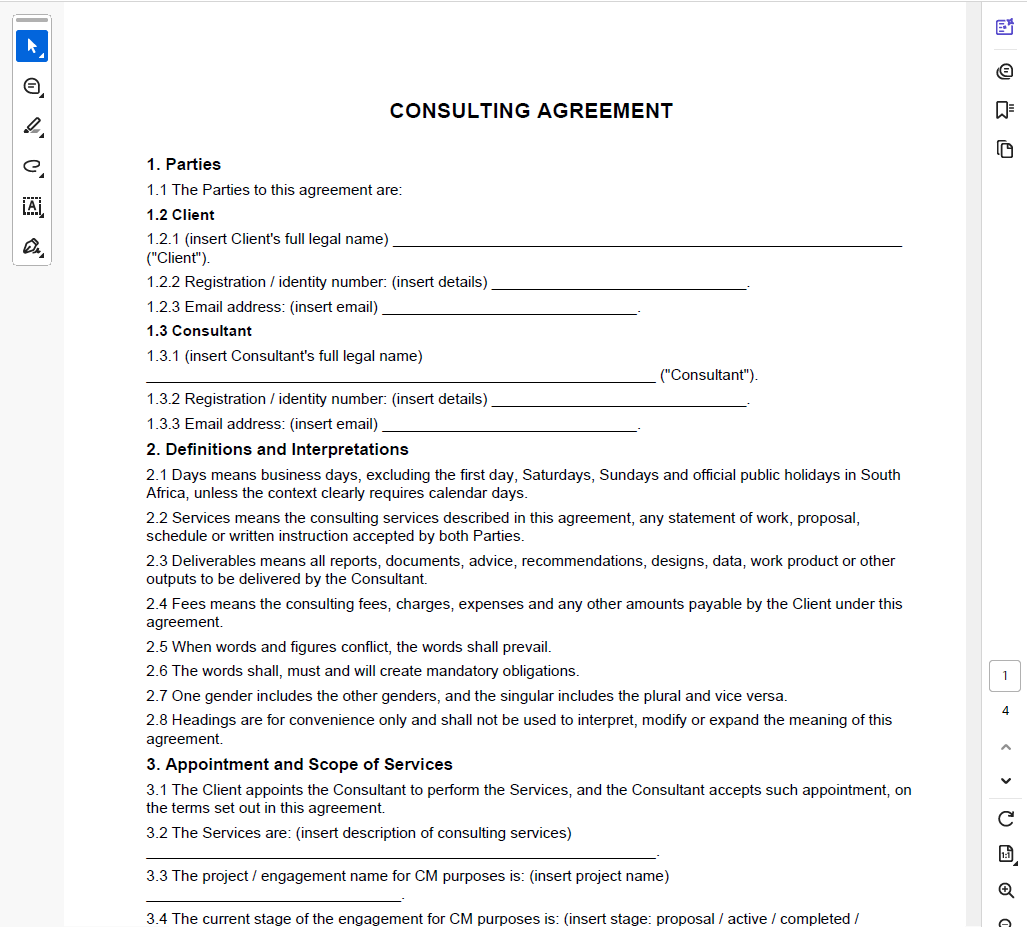
Consulting Agreement
A Complete Framework for Professional Services
Understanding the Consultancy Contract Format
Selecting the right consultancy contract format is the first step in formalizing a professional relationship. A well structured document ensures that both the service provider and the client understand their obligations from day one. Most professionals start with a basic consulting agreement template to cover the essential legal protections while keeping the language simple and clear.
A typical consulting agreement serves as the foundation for various project types, ranging from short term advice to long term strategic planning. Whether you are using a simple consulting contract or a more complex business consultant agreement, the layout should always prioritize readability. Using a standard contract for consulting services helps prevent disputes by defining the scope, payment terms, and confidentiality requirements in a logical order.
Introduction
Many businesses hire experts to solve difficult problems. However, a handshake deal often leads to confusion. A clear consulting agreement protects both the expert and the hiring company. It defines exactly what work the expert will do and how much the company will pay. Furthermore, these documents prevent legal disputes. People use a consulting agreement to set boundaries before a project starts. Contract Corridor helps firms manage these documents with ease. In this guide, you will learn how to create a solid agreement that keeps your projects on track.Quick Answer Summary
What Is a Consulting Agreement?
The term consulting comes from the Latin word "consultare," which means to deliberate or discuss. In a business context, a consulting agreement describes a specific relationship. It is a formal contract where an outside specialist provides advice or services for a fee. Unlike a standard employee, a consultant works as an independent contractor. Consequently, this document must clarify that no employment relationship exists. It fits into the contract management landscape as an essential tool for scaling your operations. For example, a consulting services agreement allows a firm to get expert help without hiring full-time staff. Additionally, this document covers intellectual property. Most companies want to own the work they pay for. Therefore, the agreement consulting process focuses heavily on who owns the final results. Without this paperwork, ownership stays with the creator by default.Consulting Agreement Examples and Use Cases
Reviewing a consulting agreement example can help you visualize how theoretical clauses translate into real world applications. For instance, a sales consultant agreement focuses heavily on commission structures and lead generation targets, whereas a technical consultant agreement might emphasize intellectual property rights and system security. Seeing these differences in action helps you choose the right starting point for your specific needs.
Another common consulting agreement example involves corporate strategy. A sample management consulting agreement often includes detailed milestones for organizational change and efficiency audits. By looking at various consulting contract examples, you can identify which clauses are standard across all industries and which ones are unique to niche fields like marketing or information technology.
Why It Matters
Getting this document right impacts your bottom line. Meanwhile, poor paperwork creates massive legal risks. If a contract is vague, a court might view the consultant as an employee. This mistake could force a company to pay back taxes and benefits.The Impact of Clear Contracts
- 80% of legal disputes in consulting come from a vague scope of work.
- Companies save up to 15% on legal fees by using a standard consulting agreement.
- Proper classification avoids tax penalties that can reach thousands of dollars per worker.
Key Components and Elements
Every contract needs specific parts to be legally binding. Use this list to check your next draft.- Scope of Work: This section explains the exact tasks the expert will perform. Be specific to avoid "scope creep" later.
- Payment Terms: List the fees, billing dates, and any late payment penalties. Most people use a consulting retainer agreement template for ongoing help.
- Term and Termination: Define how long the project lasts. Include how either party can cancel the contract early.
- Confidentiality: This clause protects your trade secrets. It prevents the expert from sharing your private data with competitors.
- Independent Contractor Status: State clearly that the consultant is not an employee. This part helps you avoid tax and benefit liabilities.
- Intellectual Property Rights: Decide who owns the finished work. Usually, the client wants a "work for hire" arrangement.
Essential Templates for Consulting Services
Having a reliable contract template for consulting services allows you to move quickly from a verbal handshake to a signed deal. Many professionals keep a simple consulting agreement template on hand for quick projects that do not require extensive legal jargon. This simple contract for consulting services usually covers the work description, the fee, and the termination clause.
For more formal arrangements, a consulting services agreement template provides a higher level of detail regarding liability and indemnification. You can find a consultancy agreement template that fits almost any scenario, from freelance work to agency partnerships. Using a standardized consulting service agreement template ensures consistency across all your client interactions and builds professional trust.
Customizing Your Consultant Agreements
Every consultant agreement should be modified to reflect the specific goals of the project. While a free sample consulting agreement is a good starting point, you must ensure it reflects the actual tasks you will perform. A sample consultant agreement might show general terms, but your specific agreement of consultancy needs to detail the exact hours, tools, and reports expected.
When drafting, consider if you need a specific consultation agreement template for short term advisory sessions versus a long term engagement. The consultant services agreement should act as a living document that protects your interests. Whether you are looking for a consultancy contract template for a new hire or a consultant contract example for a sub-contractor, customization is key to effective risk management.
Types and Categories
Not all experts provide the same value. Therefore, you must use the right contract for consulting to match the situation.| Type | Description | Best For | Key Consideration |
|---|---|---|---|
| Retainer | Client pays a recurring fee for ongoing access. | Legal or strategy advice. | Unused hours often do not roll over. |
| Project-Based | A one-time fee for a specific result. | IT system setup or website audits. | Requires a very detailed scope. |
| Time and Materials | Billing based on hours worked and costs. | Research and development tasks. | Costs can rise quickly if not monitored. |
Specialized Consulting Contract Templates
Different industries require specific language to protect their unique assets. An IT consulting contract example will likely feature heavy emphasis on data privacy, software ownership, and uptime guarantees. Using a dedicated IT consulting agreement template ensures that you do not overlook critical technical requirements that a basic consulting contract template might miss.
For creative fields, a marketing consultant contract template is essential. This document should outline who owns the final creative assets and how brand guidelines must be followed. Whether you need a marketing consultant contract example for a one time campaign or a marketing consulting services agreement for ongoing brand management, having a tailored template for consulting agreement needs saves time during the drafting phase.
Business and Management Consultancy Agreements
Large scale corporate projects often require a management consulting contract template that addresses high level executive reporting and resource allocation. These documents are typically more robust than a simple consulting contract template. A business consulting agreement must clearly define the relationship between the external advisor and internal teams to avoid confusion over authority.
If you are providing general advisory services, a business consulting services agreement acts as a comprehensive roadmap for the engagement. You might also consider using a sample management consulting agreement to see how top tier firms structure their deliverables. These professional services contract examples provide a benchmark for quality and legal thoroughness in the corporate world.
Step-by-Step Implementation Guide
Follow these steps to build your next consulting agreement.- Define the objective: Write down what success looks like. This helps you create a better basic consulting contract.
- Select a template: Find a professional sample consulting agreement template to use as a base. Pro tip: Ensure the template matches your specific industry needs.
- Detail the services: List the milestones and deliverables. This prevents the consultant from doing less than promised.
- Set the price: Decide if you will pay by the hour or by the project. Pro tip: Always include a maximum "not-to-exceed" amount for hourly work.
- Review with legal: Let a lawyer check your consulting agreements legal services. This ensures you follow local labor laws.
- Sign and store: Use digital signatures to finalize the deal. Pro tip: Store the final document in a central system like Contract Corridor for easy access.
Common Mistakes and How to Avoid Them
Avoid these pitfalls to keep your business safe.| Mistake | Why It Happens | How to Fix It |
|---|---|---|
| Vague scope | Parties want to stay flexible. | Use bullet points for every task. |
| Missing IP clause | Assuming you own what you pay for. | Add a "work for hire" section. |
| Employee wording | Using terms like "manager" or "salary." | Use "contractor" and "fees" instead. |
| No end date | Forgetting to set a timeline. | Include a specific termination date. |
Never start work without a signed document. Work done before a contract is signed often leads to ownership disputes.
Navigating Consultant Contract Negotiations
The process of consultant contract negotiations is where the final details of the partnership are hammered out. During this phase, both parties review the sample consulting contract template to ensure the terms are fair and balanced. It is important to discuss intellectual property, late payment penalties, and the process for changing the project scope before signing the contract for a consultant.
Using a sample contract for consulting services as a reference point can help you identify which terms are non-negotiable for your business. For example, a business consultant contract should always clearly state that the consultant is an independent contractor and not an employee. Understanding these nuances in your consulting contracts helps you advocate for your rights while maintaining a positive relationship with your client.
Retainer and Specialty Consultation Contracts
For ongoing support, a sample retainer agreement for consulting is the ideal framework. This type of arrangement ensures that the consultant is available for a set number of hours each month in exchange for a recurring fee. These consultation contracts are popular in legal, financial, and marketing fields where steady advice is more valuable than project based work.
In technical fields, an IT consulting agreement sample can show how to structure monthly maintenance fees alongside emergency support rates. Whether you are using a consultation contract template for a quick strategy session or a full scale IT consulting contract agreement, the goal is to define the value provided. Having a range of consultant contracts ready allows you to offer different pricing models to your clients.
Industry Examples and Use Cases
Below are scenarios where these contracts are vital. Technology Sector A startup needs to build an app but lacks a specialist. They use an it consultant contract template to hire a developer. The contract defines the code delivery dates. As a result, the startup owns the code and launches on time. Healthcare A hospital wants to improve patient flow. They sign a business management consulting agreement with a data expert. The consultant analyzes records anonymously. Consequently, the hospital improves efficiency without violating privacy laws. Marketing A retail brand wants to run a social media campaign. They use a sample marketing consulting agreement to hire an agency. The contract lists the number of posts and target engagement rates. Therefore, both sides know what success looks like. Finance An investment firm needs an external audit. They sign an agreement for consulting services with an accounting specialist. The expert provides a report on financial health. Finally, the firm uses this report to attract new investors.Managing Consulting Services Agreements
Effective management of your consulting services agreement involves regular reviews to ensure all milestones are being met. Using a sample consulting contract agreement can help you set up a tracking system for deliverables and deadlines. In the world of contracting for consultants, staying organized is just as important as the quality of the advice given.
A well drafted consulting services agreement example serves as a reference point throughout the duration of the project. If disputes arise, the consultation agreement will be the primary tool used for resolution. By utilizing high quality consulting contract templates, you ensure that your business operates smoothly and that every agreement of consultancy is legally sound and professionally presented.
Frequently Asked Questions
What is the difference between a consultant and a contractor?
A consultant usually provides high-level advice and strategy. A contractor typically performs specific manual or technical tasks. However, both use an independent consultant contract template to define the work.
Can I use a free consulting agreement template found online?
Yes, you can use a free consulting contract template as a starting point. Just make sure to customize it for your state's laws. A consultant template contract often needs small tweaks to protect your specific business.
How do I write a consulting contract that covers expenses?
You must add a specific clause for travel and materials. Explain if these costs need prior approval. This keeps your consulting contracting budget predictable and fair.
What should a basic consulting agreement include for termination?
It should include a notice period, such as 30 days. This allows both parties to wrap up tasks professionally. It also prevents one side from leaving the other in a difficult spot.
How Contract Corridor Helps
Contract Corridor makes managing your consulting agreement simple for any team. Our platform provides a central place to store every contract for consulting. This helps you track deadlines and renewal dates automatically. Furthermore, we offer powerful search tools. You can find a specific consulting contract pdf in seconds. No more digging through old email threads to find your terms. Finally, we improve your collaboration. Multiple team members can review a consulting contract sample free from errors. Our system tracks changes and ensures you always use the latest version. This keeps your legal team happy and your projects moving fast. If you want to streamline your consulting with or consulting for partners, try Contract Corridor today. We help you stay organized so you can focus on growing your business.
About the Author: Melissa Jooste
Melissa Jooste is the Head of Marketing at Contract Corridor, where she shapes the voice, narrative, and market positioning of a leading contract lifecycle management platform. Recognized for her expertise in contract lifecycle management content, Melissa is known for producing insightful, high-impact thought leadership that challenges conventional approaches to contract management. Her work goes beyond surface-level marketing, offering clear, strategic perspectives on how organizations can unlock value, reduce risk, and gain control through more effective contract lifecycle practices. Her writing is widely valued for its clarity, depth, and relevance, bridging complex legal, financial, and operational concepts into content that is both accessible and commercially meaningful. By combining strong storytelling with data-driven insight, she consistently delivers content that resonates with senior business leaders, legal professionals, and operational teams alike. Through her work, Melissa plays a key role in establishing Contract Corridor as a leading voice in the contract lifecycle management space, shaping how organizations think about contracts, not as static documents, but as dynamic drivers of business performance.
Connect on LinkedIn
About the reviewer: Jenna Kretzmer
Jenna Kretzmer, CA(SA) is an Executive at Contract Corridor, where she plays a key role in shaping the strategic direction and market positioning of a leading contract lifecycle management platform. A global executive with over a decade of experience, Jenna has led large-scale, international operations and driven growth, transformation, and market expansion across multiple regions. She is recognized for her ability to operate at the intersection of strategy, execution, and commercial performance. Jenna is a leading voice in the contract lifecycle management space, known for her perspectives on contract governance, revenue optimization, and operational efficiency. Her work challenges traditional approaches to contract management, advocating for a shift toward greater visibility, accountability, and value realization across the entire contract lifecycle. She is driving Contract Corridor to enable organizations to move beyond static contract storage toward proactive, value-led contract management, where contracts are treated not as legal documents, but as dynamic instruments that drive measurable business outcomes.
Connect on LinkedInConsulting Agreement
The templates and resources available through Contract Corridor are provided for general informational purposes only. They do not constitute legal advice, and their use does not create an attorney-client relationship between you and Contract Corridor or any of its affiliates.
While every effort has been made to ensure that the templates are up to date and relevant, Contract Corridor makes no representations or warranties, express or implied, regarding their accuracy, completeness, adequacy, legality, or suitability for any specific purpose. The templates may not reflect current legal developments or the laws applicable in your jurisdiction.
You are solely responsible for reviewing, customising, and validating any template before use, to ensure that any document meets your specific needs and complies with applicable laws and regulations.
To the fullest extent permitted by law, Contract Corridor, its owners, employees, and affiliates disclaim all liability for any loss, damage, or consequence arising directly or indirectly from the use of, or reliance upon, any template, resource, or related material provided on or through this platform.
By accessing, downloading, or using any template, you acknowledge and agree that such use is entirely at your own risk.
Contract Corridor Contract Templates