
Confidentiality Agreement
Protecting Your Competitive Advantage through Smart Legal Frameworks
Introduction
Imagine your most valuable trade secret suddenly belongs to your biggest rival. This nightmare happens to businesses every single day because of poor paperwork. In fact, trade secret theft costs global economies billions of dollars every year. Protecting your data requires more than a handshake or a simple talk. You need a solid Confidentiality Agreement to shield your intellectual property from harm. This document acts as a legal wall around your private information. In this article, you will learn how to draft, manage, and enforce these vital contracts. Contract Corridor helps you navigate these complex legal waters with ease. We believe that every business deserves high-quality protection without the high-stress legal jargon. Let us explore how you can keep your secrets safe today.
A Confidentiality Agreement is a legal contract where parties promise to keep sensitive information private. It defines exactly what data stays secret and sets the rules for how to handle that data. If someone breaks the promise, the agreement allows the injured party to seek legal damages. Most businesses use these documents to protect trade secrets, client lists, and financial records during negotiations.
What Is a Confidentiality Agreement?
A confidentiality agreement creates a safe space for business discussions. At its core, it is a contract between at least two parties about shared knowledge. This document legally forbids the person receiving information from sharing it without permission. Many people also call these Non-Disclosure Agreements or NDAs for short. The concept dates back to early European trade secrets where masters protected their crafts. Today, it fits into the broader contract management landscape as an essential risk tool.
Furthermore, these agreements serve as the foundation for future partnerships. You might also encounter an exclusivity agreement form during early deal stages. While different, both focus on building trust during high-stakes talks. Specifically, these contracts tell the world that your information has real value. Without this document, courts might assume your data is public knowledge. Therefore, you must document every secret communication from day one.
Why It Matters
Protecting your secrets is not just about being cautious. Specifically, it is about survival in a competitive market. If a vendor leaks your pricing, your profit margins could vanish instantly. If an employee steals a client list, your revenue might drop overnight. Companies that ignore these contracts face massive financial and legal risks. Moreover, investors often refuse to fund startups that lack proper legal protection.
- Businesses lose nearly $600 billion annually to intellectual property theft globally.
- Companies with automated contract management systems see 20% faster deal cycles.
- Over 60% of data leaks involve third-party partners or loose contract terms.
Furthermore, operational efficiency improves when everyone knows the rules. When you use a clear exclusivity agreement template, parties understand their limits. This clarity reduces friction and speeds up negotiations. As a result, your team spends less time arguing and more time growing the business.
Key Components & Elements
A strong agreement must cover several specific areas to be effective. If you leave out these details, a judge might toss the contract out. Use this list to check your current documents for safety.
- Definition of Confidential Information: You must state exactly what counts as a secret. Does it include verbal talks or just written files?
- Exclusions from Confidentiality: Some information cannot stay secret. For example, facts already known to the public are always excluded.
- Obligations of the Recipient: This section explains how people must guard the data. It often requires "reasonable care" to prevent leaks.
- Time Periods: Secrets do not always stay secret forever. You must define how many years the protection lasts.
- Return or Destruction Clauses: Once the relationship ends, the recipient must return the data. Alternatively, they must prove they destroyed every copy safely.
- Remedies for Breach: This part explains what happens if someone breaks the rules. It usually includes monetary fines and court orders.
Types & Categories
Not every situation needs the same kind of legal shield. You must pick the right version for your specific business goal. Below is a comparison of common confidentiality structures.
| Type | Description | Best For | Key Consideration |
|---|---|---|---|
| Unilateral | Only one party shares secrets. | Hiring employees or contractors. | Protecting the employer's data. |
| Mutual | Both parties share secrets. | Mergers or joint ventures. | Fairness for both sides involved. |
| Multilateral | Three or more parties involved. | Group bidding or consortiums. | managing complex data flows. |
| Exclusivity Focus | Adds limits on other deals. | Supplier partnerships. | Requires an exclusive agreement format. |
Step-by-Step Implementation Guide
Implementing these contracts requires a careful, steady process. Follow these steps to ensure your business stays protected at all times.
- Identify the Secrets: First, list every piece of data that gives you an edge. Why it matters: You cannot protect what you have not identified. Pro tip: Include customer lists and future product plans.
- Select Your Draft: Use a standard exclusivity agreement template to save time. Why it matters: Proven templates reduce the risk of basic legal errors. Pro tip: Always tailor the template to your specific industry needs.
- Define the Scope: Decide how long the agreement should last. Why it matters: Forever is often seen as unfair in a court of law. Pro tip: Three to five years is standard for most business secrets.
- Review and Sign: Have both parties sign before you share a single file. Why it matters: Signed contracts are much easier to enforce later. Pro tip: Use digital signatures to track exactly when and where people signed.
- Monitor Compliance: Check in with partners to ensure they are following the rules. Why it matters: Awareness prevents accidental leaks before they happen. Pro tip: Set reminders to ask for data destruction when projects end.
Common Mistakes & How to Avoid Them
Many managers make simple errors that ruin their legal protection. Use this table to spot and fix these common pitfalls in your workflow.
| Mistake | Why It Happens | How to Fix It |
|---|---|---|
| Too Broad Definitions | People want to protect everything. | Be specific about what data is truly secret. |
| Sharing Before Signing | Deals move fast and people forget. | Set a hard rule: signature first, talk second. |
| Ignoring Local Laws | Laws change between states or countries. | Update your exclusivity contract template annually. |
| Weak Return Clauses | Focus is only on the start of the deal. | Detail exactly how data should be deleted later. |
The most important rule is timing. Never share a secret until the legal contract is fully signed and stored.
Industry Examples & Use Cases
Let us look at how different sectors use these legal tools. These scenarios show why protecting data is a universal business need.
Technology: A software startup meets with a large investor. They share their unique source code and growth plan. By using a strong agreement, the startup ensures the investor cannot give those ideas to a competitor. As a result, the startup grows safely and secures a high valuation.
Healthcare: A hospital shares patient data trends with a cloud storage provider. They use a strict contract to keep this data private. This protect both patient rights and the hospital's legal standing. Consequently, the hospital avoids heavy fines and maintains public trust.
Manufacturing: A car company works with a new parts supplier. They use an exclusive agreement format to keep the new engine design a secret. This allows the car company to launch a revolutionary product before anyone else. Therefore, they capture the market lead and boost sales.
Frequently Asked Questions
How long does a confidentiality agreement usually last?
Most business agreements last between two and five years. However, trade secrets like recipes or formulas may have protection that never expires. You should pick a term that matches the lifespan of your secret data.
Can I use a generic exclusivity agreement template for my business?
Yes, templates provide a great starting point for most standard deals. However, you should always review the specific terms to ensure they fit your industry. Make sure the template covers your unique risks and local legal requirements.
What happens if someone breaks the agreement?
If a breach occurs, the injured party can sue for monetary damages. You can also ask a judge for an injunction to stop further leaks immediately. Clear contracts make it much easier to prove your case and recover losses.
Is a verbal confidentiality promise enough?
Courts rarely find verbal secrets easy to enforce. It is very hard to prove what was said months or years ago. Always put your confidentiality terms in writing to ensure full legal protection for your brand.
How Contract Corridor Helps
Managing legal documents should not slow down your business growth. At Contract Corridor, we simplify the way you handle every confidentiality agreement. Our platform centralizes your files so you never lose an important signature again. First, our automated workflows remind you when contracts are about to expire. This ensures you never leave your secrets unprotected by accident.
Second, we offer easy access to the right forms for every situation. Whether you need a simple NDA or an exclusivity contract template, we have you covered. Third, our secure storage gives you peace of mind that your own data stays safe. We use high-level encryption to guard your most sensitive business files. Finally, our user-friendly interface means your team can find what they need in seconds. Stop wasting time on manual paperwork and start protecting your future today with Contract Corridor.

About the Author: Melissa Jooste
Melissa Jooste is the Head of Marketing at Contract Corridor, where she shapes the voice, narrative, and market positioning of a leading contract lifecycle management platform. Recognized for her expertise in contract lifecycle management content, Melissa is known for producing insightful, high-impact thought leadership that challenges conventional approaches to contract management. Her work goes beyond surface-level marketing, offering clear, strategic perspectives on how organizations can unlock value, reduce risk, and gain control through more effective contract lifecycle practices. Her writing is widely valued for its clarity, depth, and relevance, bridging complex legal, financial, and operational concepts into content that is both accessible and commercially meaningful. By combining strong storytelling with data-driven insight, she consistently delivers content that resonates with senior business leaders, legal professionals, and operational teams alike. Through her work, Melissa plays a key role in establishing Contract Corridor as a leading voice in the contract lifecycle management space, shaping how organizations think about contracts, not as static documents, but as dynamic drivers of business performance.
Connect on LinkedIn
About the reviewer: Jenna Kretzmer
Jenna Kretzmer, CA(SA) is an Executive at Contract Corridor, where she plays a key role in shaping the strategic direction and market positioning of a leading contract lifecycle management platform. A global executive with over a decade of experience, Jenna has led large-scale, international operations and driven growth, transformation, and market expansion across multiple regions. She is recognized for her ability to operate at the intersection of strategy, execution, and commercial performance. Jenna is a leading voice in the contract lifecycle management space, known for her perspectives on contract governance, revenue optimization, and operational efficiency. Her work challenges traditional approaches to contract management, advocating for a shift toward greater visibility, accountability, and value realization across the entire contract lifecycle. She is driving Contract Corridor to enable organizations to move beyond static contract storage toward proactive, value-led contract management, where contracts are treated not as legal documents, but as dynamic instruments that drive measurable business outcomes.
Connect on LinkedInConfidentiality Agreement
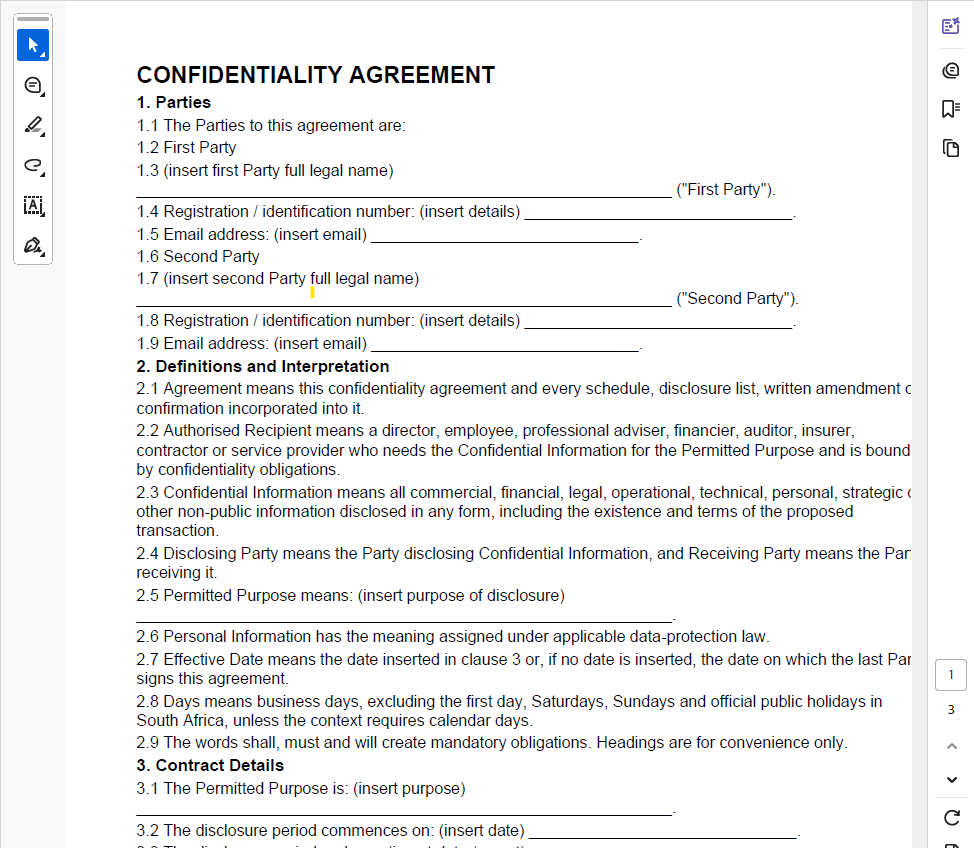
The templates and resources available through Contract Corridor are provided for general informational purposes only. They do not constitute legal advice, and their use does not create an attorney-client relationship between you and Contract Corridor or any of its affiliates.
While every effort has been made to ensure that the templates are up to date and relevant, Contract Corridor makes no representations or warranties, express or implied, regarding their accuracy, completeness, adequacy, legality, or suitability for any specific purpose. The templates may not reflect current legal developments or the laws applicable in your jurisdiction.
You are solely responsible for reviewing, customising, and validating any template before use, to ensure that any document meets your specific needs and complies with applicable laws and regulations.
To the fullest extent permitted by law, Contract Corridor, its owners, employees, and affiliates disclaim all liability for any loss, damage, or consequence arising directly or indirectly from the use of, or reliance upon, any template, resource, or related material provided on or through this platform.
By accessing, downloading, or using any template, you acknowledge and agree that such use is entirely at your own risk.
Contract Corridor Contract Templates