
Joint Marketing Agreementnew
Protecting Your Brand in Collaborative Campaigns
Introduction
Imagine you find the perfect business partner. You both have great products and happy customers. However, a simple handshake deal leads to a branding disaster two months later. Without a written plan, your hard work could vanish instantly. This article teaches you how to build a strong Joint Marketing Agreementnew that keeps everyone safe. Specifically, you will learn about legal protections and essential clauses. You will also discover how to share costs and leads fairly. Contract Corridor helps teams manage these complex documents with ease and speed. By the end of this guide, you will know exactly how to draft a successful marketing contract example for your own business needs.Quick Answer Summary
What Is a Joint Marketing Agreement?
Joint marketing occurs when two separate brands team up to create a single campaign. This collaboration allows companies to share resources and target the same group of buyers. For example, a coffee shop might work with a local bakery to offer a breakfast bundle. A Joint Marketing Agreementnew is a legally binding document that outlines the roles, responsibilities, and liabilities of each partner during such a campaign. In the legal world, these documents fall under the category of commercial contracts. They differ from standard service deals because both parties contribute active effort. You are not just hiring a vendor. Instead, you are building a temporary bridge between two businesses. Within the broader contract management landscape, these agreements require careful oversight. Managers must track shared intellectual property and expiration dates to avoid legal friction later.Why It Matters
Partnerships often fail because of poor communication rather than bad intent. A clear contract prevents these misunderstandings before they start. If one side spends more money than planned, the contract provides a path to reimbursement. Without it, you might face expensive lawsuits or damaged professional relationships. Furthermore, protecting your brand identity is vital. You do not want another company using your logo in a way that looks unprofessional. A solid agreement sets strict rules for visual styles and messaging. This ensures your brand stays consistent even when others handle the promotion.Why Marketing Deals Fail or Succeed
- According to industry data, 60% of brand partnerships fail due to a lack of clear goals.
- Companies that use a formal marketing agreement template report 25% higher campaign ROI.
- Legal disputes over shared data can cost small businesses over $50,000 in attorney fees.
Key Components & Elements
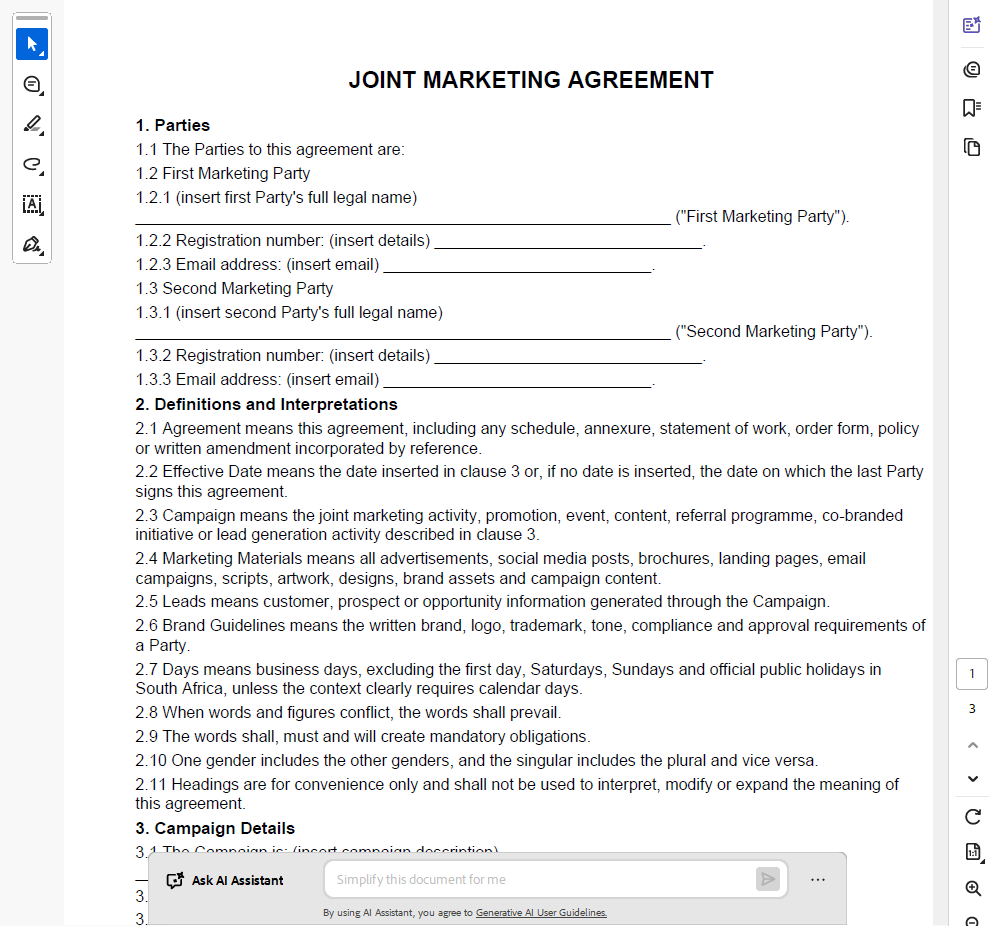
- Scope of Work: This section describes exactly what each company will do. It lists the channels like social media, email, or print ads.
- Brand Guidelines: You must state how the partner uses your logo and colors. This protects your visual identity from being misused.
- Cost Sharing: This part explains how the brands split the bills for ad spend and production. It prevents one side from paying for everything.
- Lead Ownership: You need to decide who keeps the names and emails of new customers. This is crucial for privacy law compliance.
- Confidentiality: This clause stops the partner from sharing your trade secrets or internal sales numbers with competitors.
- Termination Rights: It defines how a partner can leave the deal if things go wrong. Most deals require a 30-day notice period.
Types & Categories
| Type | Description | Best For | Key Consideration |
|---|---|---|---|
| Co-Branding | Two brands create a new product together. | Physical Goods | Intellectual Property |
| Affiliate Agreement | One brand pays the other for every lead sent. | E-commerce | Tracking accuracy |
| Content Sharing | Brands swap blog posts or social media shoutouts. | Digital Media | Quality Control |
| Referral Partnership | Direct intros between sales teams. | B2B Services | Commission rates |
Step-by-Step Implementation Guide
- Define Your Goals: Sit down with your partner to discuss what you want. Do you want more followers or more sales?
Tip: Be specific with numbers so you can measure success later. - Draft the Document: Use a trusted marketing partnership agreement to save time. This ensures you do not miss standard legal protections.
Tip: Always include a section on how you will resolve disagreements. - Set the Budget: List every expected expense in a shared spreadsheet. Decide on a maximum spending limit for the whole project.
Tip: Get written approval before anyone spends over the limit. - Review Brand Assets: Trade logo files and style guides before the campaign starts. Check all ad drafts for errors.
Tip: Assign one person to be the final "brand police" for the project. - Measure and Renew: Look at the data once the campaign ends. If it worked well, use your contract to extend the deal.
Tip: Update the agreement every year to reflect new marketing trends.
Common Mistakes & How to Avoid Them
| Mistake | Why It Happens | How to Fix It |
|---|---|---|
| Ignoring Data Privacy | Teams forget about GDPR or CCPA rules. | Add a clear data processing clause. |
| Vague Roles | Partners assume the "other guy" is doing the work. | Use an itemized task list with deadlines. |
| No End Date | People get excited and forget about an exit plan. | Always include a clear expiration date. |
| Verbal Changes | Managers agree to new terms over the phone. | Require all changes to be in writing. |
Never start a campaign without a signed document. Even if the partner is a close friend, a co-marketing agreement protects both of your livelihoods.
Industry Examples & Use Cases
Technology Sector: A software company and a hardware maker team up. They sell a "work from home" bundle. Their agreement ensures the software is pre-installed on the laptops. As a result, both companies double their sales during the holiday season. Real Estate: A local realtor works with a home staging company. They share the cost of professional photography. The marketing agreement template they use clarifies that both can use the photos in their portfolios. This helps the stager get more local leads. Finance: A credit card company partners with an airline. They launch a joint rewards card. Their legal team uses a cross selling partnership with digital marketing agency legal agreement template to manage the online ads. This leads to thousands of new card sign-ups in one month.Frequently Asked Questions
What is the difference between joint marketing and a joint venture?
A joint marketing deal involves working together on ads and promotions. A joint venture usually creates a completely new legal entity or company. Marketing deals are much simpler and faster to set up.
Can I use a free online template for my agreement?
You can use a template to start, but you should always customize it. Generic forms might leave out specific details about your industry or local laws. It is better to use a professional tool to manage the process.
Who owns the intellectual property in a joint campaign?
Usually, each party keeps ownership of their original logos and trademarks. Anything created specifically for the campaign is often owned jointly. You must define this clearly in your contract to avoid ownership fights.
How do we handle shared customer data?
You must follow privacy laws like the GDPR carefully. The agreement should state if you are sharing email lists or just showing ads to each other's audiences. Always get consent from customers before swapping their personal info.
How Contract Corridor Helps
Contract Corridor makes handling partnerships simple and stress-free. Our platform provides a secure space to store every version of your deals. You can stop searching through old emails for the latest draft. Instead, our centralized dashboard keeps your team organized and on the same page. Our automated alerts notify you before a contract expires. This ensures you never miss a chance to renew a profitable partnership. Additionally, our collaboration tools allow you to edit documents with your partners in real-time. This cuts down on the back-and-forth and gets your campaign live faster. Ready to streamline your collaborative marketing? Contact us today to see how we can simplify your contract management process.
About the Author: Melissa Jooste
Melissa Jooste is the Head of Marketing at Contract Corridor, where she shapes the voice, narrative, and market positioning of a leading contract lifecycle management platform. Recognized for her expertise in contract lifecycle management content, Melissa is known for producing insightful, high-impact thought leadership that challenges conventional approaches to contract management. Her work goes beyond surface-level marketing, offering clear, strategic perspectives on how organizations can unlock value, reduce risk, and gain control through more effective contract lifecycle practices. Her writing is widely valued for its clarity, depth, and relevance, bridging complex legal, financial, and operational concepts into content that is both accessible and commercially meaningful. By combining strong storytelling with data-driven insight, she consistently delivers content that resonates with senior business leaders, legal professionals, and operational teams alike. Through her work, Melissa plays a key role in establishing Contract Corridor as a leading voice in the contract lifecycle management space, shaping how organizations think about contracts, not as static documents, but as dynamic drivers of business performance.
Connect on LinkedIn
About the reviewer: Jenna Kretzmer
Jenna Kretzmer, CA(SA) is an Executive at Contract Corridor, where she plays a key role in shaping the strategic direction and market positioning of a leading contract lifecycle management platform. A global executive with over a decade of experience, Jenna has led large-scale, international operations and driven growth, transformation, and market expansion across multiple regions. She is recognized for her ability to operate at the intersection of strategy, execution, and commercial performance. Jenna is a leading voice in the contract lifecycle management space, known for her perspectives on contract governance, revenue optimization, and operational efficiency. Her work challenges traditional approaches to contract management, advocating for a shift toward greater visibility, accountability, and value realization across the entire contract lifecycle. She is driving Contract Corridor to enable organizations to move beyond static contract storage toward proactive, value-led contract management, where contracts are treated not as legal documents, but as dynamic instruments that drive measurable business outcomes.
Connect on LinkedInJoint Marketing Agreement
The templates and resources available through Contract Corridor are provided for general informational purposes only. They do not constitute legal advice, and their use does not create an attorney-client relationship between you and Contract Corridor or any of its affiliates.
While every effort has been made to ensure that the templates are up to date and relevant, Contract Corridor makes no representations or warranties, express or implied, regarding their accuracy, completeness, adequacy, legality, or suitability for any specific purpose. The templates may not reflect current legal developments or the laws applicable in your jurisdiction.
You are solely responsible for reviewing, customising, and validating any template before use, to ensure that any document meets your specific needs and complies with applicable laws and regulations.
To the fullest extent permitted by law, Contract Corridor, its owners, employees, and affiliates disclaim all liability for any loss, damage, or consequence arising directly or indirectly from the use of, or reliance upon, any template, resource, or related material provided on or through this platform.
By accessing, downloading, or using any template, you acknowledge and agree that such use is entirely at your own risk.
Contract Corridor Contract Templates