
Truck Lease Agreement
Essential Clauses for Fleet Management and Risk Mitigation
Introduction
Imagine your fleet operation stops because a driver disputes their pay or vehicle costs. Thousands of dollars vanish every hour a truck sits idle. A clear truck lease agreement prevents these costly headaches before they start. This document protects both the vehicle owner and the person behind the wheel. In this article, you will learn how to structure these deals to keep your business moving safely.
Managing these documents requires precision and speed. Contract Corridor offers the tools you need to organize every truck leasing contract in one secure place. We help you track expiration dates and compliance rules automatically. By the end of this guide, you will know how to draft a commercial truck lease agreement that stands up to legal scrutiny.
Quick Answer Summary
A truck lease agreement is a legal contract where a vehicle owner allows a carrier or driver to use equipment for a set fee. This document defines payment terms, maintenance duties, and insurance requirements for the parties involved. Properly drafted agreements follow federal rules to ensure safety and fair compensation for everyone. Using a high-quality truck lease agreement template helps fleet managers maintain compliance while protecting their financial interests.
What Is a Truck Lease Agreement?
A truck lease agreement is a binding contract between a lessor and a lessee for the use of a motor vehicle. Specifically, the lessor owns the equipment while the lessee pays to operate it over a fixed period. This document serves as the foundation for the professional relationship between a trucking company and its owner-operators or drivers.
Historically, the shipping industry relied on informal handshakes to move goods across borders. However, modern logistics require detailed paperwork to satisfy government regulators. Within the contract management landscape, this specific agreement type handles high-value assets and significant liability. Consequently, these contracts must address unique factors like fuel taxes, mileage limits, and heavy vehicle use taxes.
Furthermore, a truck rental agreement template often serves smaller or short-term needs. In contrast, long-term leasing deals involve complex ownership options at the end of the term. Whether you use a truck leasing agreement for one van or a thousand rigs, the core principles remain the same. You must define who has control of the equipment at every moment.
Why It Matters
Getting your paperwork right determines the survival of your transportation business. For instance, an incomplete truck rental agreement contract can lead to massive lawsuits after a highway accident. If the contract does not clearly state who provides insurance, a judge may hold both parties liable. Therefore, clarity in your truck lease contract saves you from financial ruin.
Fleet Management Statistics:
- Poorly managed contracts cause businesses to lose up to 9% of their annual revenue.
- Legal disputes over equipment damage cost small carriers an average of $15,000 per case.
- Regulatory fines for non-compliant leases can exceed $10,000 per missing document.
Operational efficiency also depends on these documents. Additionally, a simple commercial truck lease agreement allows you to scale your fleet quickly. Without standard forms, your team wastes hours debating terms with every new hire. Finally, a semi truck lease agreement ensures that maintenance happens on schedule. This prevents breakdowns that could ruin your reputation with shippers.
Key Components & Elements
Every professional lorry rental agreement needs specific sections to be effective. Use this list to verify that your documents cover the essentials.
- Equipment Description: You must list the VIN, make, model, and year of the vehicle to avoid confusion.
- Payment Terms: This section defines the weekly or monthly rate and any mileage-based fees.
- Maintenance Responsibilities: Clearly state if the owner or the driver pays for tires, oil changes, and repairs.
- Insurance Requirements: You need to specify who carries the primary liability and physical damage coverage.
- Term and Termination: Define the start date, end date, and how to end the deal early with a truck lease termination agreement.
- Operating Territory: Establish where the truck can or cannot go to manage wear and tear.
- Compliance Clauses: Include language regarding fmcsa lease agreement rules to stay legal with federal authorities.
Types & Categories
Not every lease serves the same purpose. For example, a food truck lease agreement has very different requirements than a long-haul semi truck lease agreement pdf. Choosing the right category ensures you do not pay for features or protections you do not need.
| Type | Description | Best For | Key Consideration |
|---|---|---|---|
| Operating Lease | Short-term use without ownership. | Fluctuating fleet needs. | Lower monthly payments. |
| Lease Purchase | Payments lead to eventual ownership. | Long-term drivers. | Maintenance costs. |
| Owner-Operator | Independent driver leases to a carrier. | Scaling carrier capacity. | MC authority rules. |
| Terminal Rental Adjustment | Tax-advantaged commercial lease. | Business tax planning. | Final value estimates. |
Many managers prefer a truck rental contract template for local deliveries. Meanwhile, a commercial vehicle lease agreement works better for heavy-duty construction equipment. Always pick the format that matches your specific equipment and business goals.
Step-by-Step Implementation Guide
Follow these steps to set up your leasing program effectively. Taking these actions protects your assets and keeps your drivers happy.
- Select Your Base Document: Start with a truck lease agreement template to ensure you include standard legal language. This saves time and prevents you from forgetting critical clauses.
- Identify the Parties: List the legal names and addresses for both the lessor and the lessee. Pro tip: Always verify business licenses before signing any truck driver contract agreement.
- Inspect the Vehicle: Conduct a thorough walk-around and document every scratch or mechanical issue. Recording the initial condition prevents disputes when the truck rental agreement ends.
- Set the Financials: Decide on a fixed rent or a percentage-of-load model for the truck leasing agreement. Be very specific about when payments are due and what happens if they are late.
- Review for Compliance: Check the document against local laws and the fmcsa lease agreement standards. This step prevents the government from shutting down your operations during an audit.
- Execute and Store: Have both parties sign the lease agreement for truck use. Then, upload the digital copy into a system like Contract Corridor for easy access.
Common Mistakes & How to Avoid Them
Many fleet owners make simple errors that lead to big losses. Consequently, you must watch out for these pitfalls when drafting your truck lease agreement form.
| Mistake | Why It Happens | How to Fix It | |
|---|---|---|---|
| Blanket Maintenance | Vague language in the contract. | List specific repair duties for each party. | |
| Missing Insurance Proof | Assuming the other party has it. | Require a COI before the keys are handed over. | |
| Undefined Ending | Forgetting the termination clause. | Set a clear notice period for leaving the deal. | |
| Verbal Changes | Trying to be "flexible" with drivers. | Require all changes to be in writing and signed. |
Always keep a copy of the semi truck lease agreement in the cab of the vehicle. This helps the driver prove legal possession during a roadside inspection.
Industry Examples & Use Cases
Seeing how others use these contracts helps you apply them to your own work. Here are three common ways companies use a lease agreement for trucking company operations.
Scenario 1: Construction
A heavy equipment company needs ten extra dump trucks for a six-month road project. They use a commercial truck lease agreement template to quickly hire local owners. As a result, the project finishes on time without the company buying new vehicles they won't need later.
Scenario 2: Owner-Operator Growth
A small carrier wants to grow but cannot afford to buy five new tractors. They offer an owner operator lease agreement to experienced drivers who already own rigs. This allows the carrier to take on bigger clients while the drivers keep their independence.
Scenario 3: Short-Term Delivery
A retail florist needs a refrigerated van for the busy Valentine's Day week. They sign a truck rental agreement template free of long-term debt. This small investment allows them to quadruple their daily deliveries during their biggest sales period.
Frequently Asked Questions
Can I use a car lease contract sample for a semi truck?
No, you should not use a standard car lease. Semi trucks have complex regulations, weight limits, and tax rules that a car contract does not cover. Always use a dedicated truck lease contract template for commercial vehicles.
What is an mc authority lease agreement?
This is a specific contract where a driver operates under a company's Motor Carrier (MC) number. The agreement defines how the driver follows the company's safety rules and insurance policies. It is essential for legal interstate hauling.
Does a truck rental contract need to include maintenance?
Yes, every agreement must state who is responsible for the upkeep. Usually, the owner pays for major engine work while the driver might pay for daily fluids. Use a truck leasing agreement template to clarify these roles.
Where can I find a truck lease agreement template free of charge?
Many government and industry websites provide basic versions for small businesses. However, you should have a legal expert review any free commercial truck lease agreement pdf before you sign it. This ensures it meets your specific state laws.
Who handles the fuel taxes in a lease agreement for semi truck?
The contract must specify who files the IFTA (International Fuel Tax Agreement) reports. Often, the carrier handles the paperwork while the driver pays the actual tax amount. Your simple commercial truck lease agreement should detail this calculation.
How Contract Corridor Helps
Managing a pile of paper contracts is a recipe for disaster. Contract Corridor simplifies the entire lifecycle of your truck lease agreement documents. First, we provide a centralized dashboard where you can view every lease status at a glance. You will never miss an expiration date again.
Second, our platform automates the renewal process for your truck driver contract agreement. You can set reminders weeks in advance to ensure constant fleet coverage. This keeps your logistics moving without manual tracking. Our system helps you maintain a consistent truck leasing agreement across your entire workforce.
Third, we offer powerful search tools to find specific clauses in seconds. If a driver asks about maintenance or the truck lease termination agreement, you have the answer instantly. This professionalism builds trust and reduces friction in your operations. Join Contract Corridor today and take total control of your commercial truck lease agreement workflow.

About the Author: Melissa Jooste
Melissa Jooste is the Head of Marketing at Contract Corridor, where she shapes the voice, narrative, and market positioning of a leading contract lifecycle management platform. Recognized for her expertise in contract lifecycle management content, Melissa is known for producing insightful, high-impact thought leadership that challenges conventional approaches to contract management. Her work goes beyond surface-level marketing, offering clear, strategic perspectives on how organizations can unlock value, reduce risk, and gain control through more effective contract lifecycle practices. Her writing is widely valued for its clarity, depth, and relevance, bridging complex legal, financial, and operational concepts into content that is both accessible and commercially meaningful. By combining strong storytelling with data-driven insight, she consistently delivers content that resonates with senior business leaders, legal professionals, and operational teams alike. Through her work, Melissa plays a key role in establishing Contract Corridor as a leading voice in the contract lifecycle management space, shaping how organizations think about contracts, not as static documents, but as dynamic drivers of business performance.
Connect on LinkedIn
About the reviewer: Jenna Kretzmer
Jenna Kretzmer, CA(SA) is an Executive at Contract Corridor, where she plays a key role in shaping the strategic direction and market positioning of a leading contract lifecycle management platform. A global executive with over a decade of experience, Jenna has led large-scale, international operations and driven growth, transformation, and market expansion across multiple regions. She is recognized for her ability to operate at the intersection of strategy, execution, and commercial performance. Jenna is a leading voice in the contract lifecycle management space, known for her perspectives on contract governance, revenue optimization, and operational efficiency. Her work challenges traditional approaches to contract management, advocating for a shift toward greater visibility, accountability, and value realization across the entire contract lifecycle. She is driving Contract Corridor to enable organizations to move beyond static contract storage toward proactive, value-led contract management, where contracts are treated not as legal documents, but as dynamic instruments that drive measurable business outcomes.
Connect on LinkedInTruck Lease Agreement
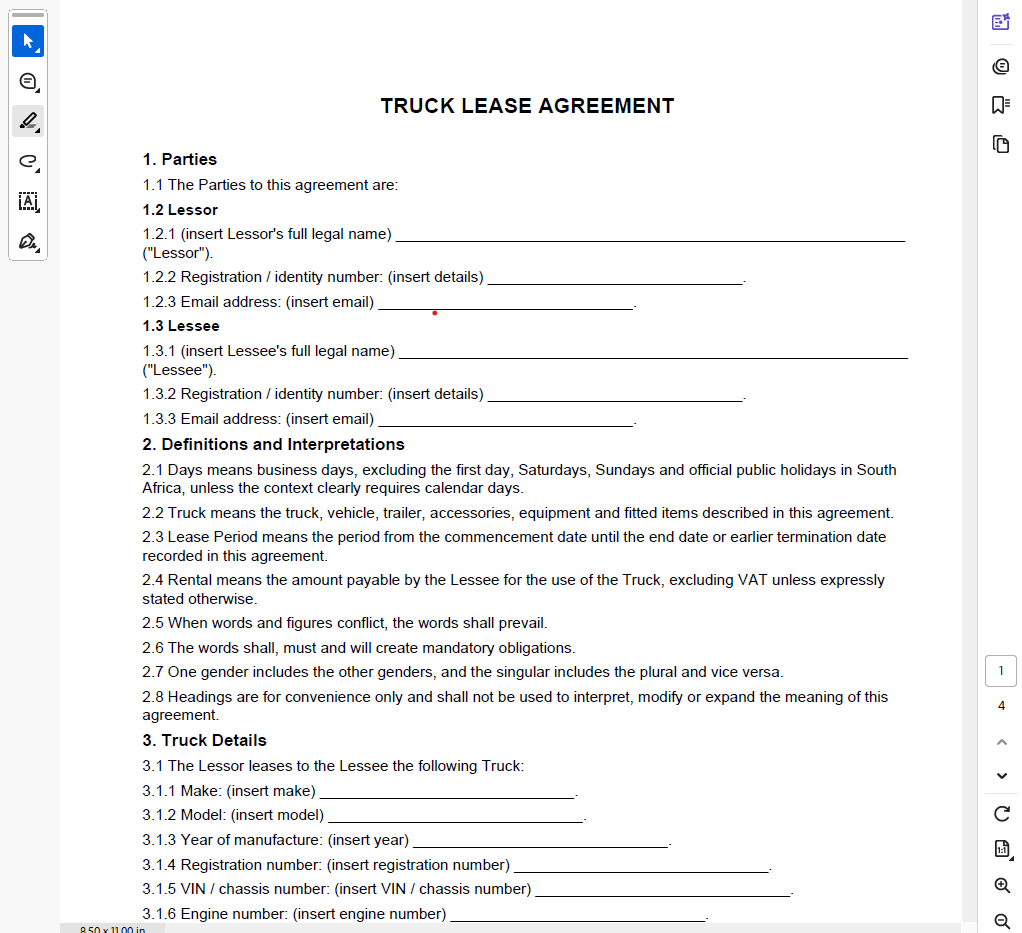
The templates and resources available through Contract Corridor are provided for general informational purposes only. They do not constitute legal advice, and their use does not create an attorney-client relationship between you and Contract Corridor or any of its affiliates.
While every effort has been made to ensure that the templates are up to date and relevant, Contract Corridor makes no representations or warranties, express or implied, regarding their accuracy, completeness, adequacy, legality, or suitability for any specific purpose. The templates may not reflect current legal developments or the laws applicable in your jurisdiction.
You are solely responsible for reviewing, customising, and validating any template before use, to ensure that any document meets your specific needs and complies with applicable laws and regulations.
To the fullest extent permitted by law, Contract Corridor, its owners, employees, and affiliates disclaim all liability for any loss, damage, or consequence arising directly or indirectly from the use of, or reliance upon, any template, resource, or related material provided on or through this platform.
By accessing, downloading, or using any template, you acknowledge and agree that such use is entirely at your own risk.
Contract Corridor Contract Templates