
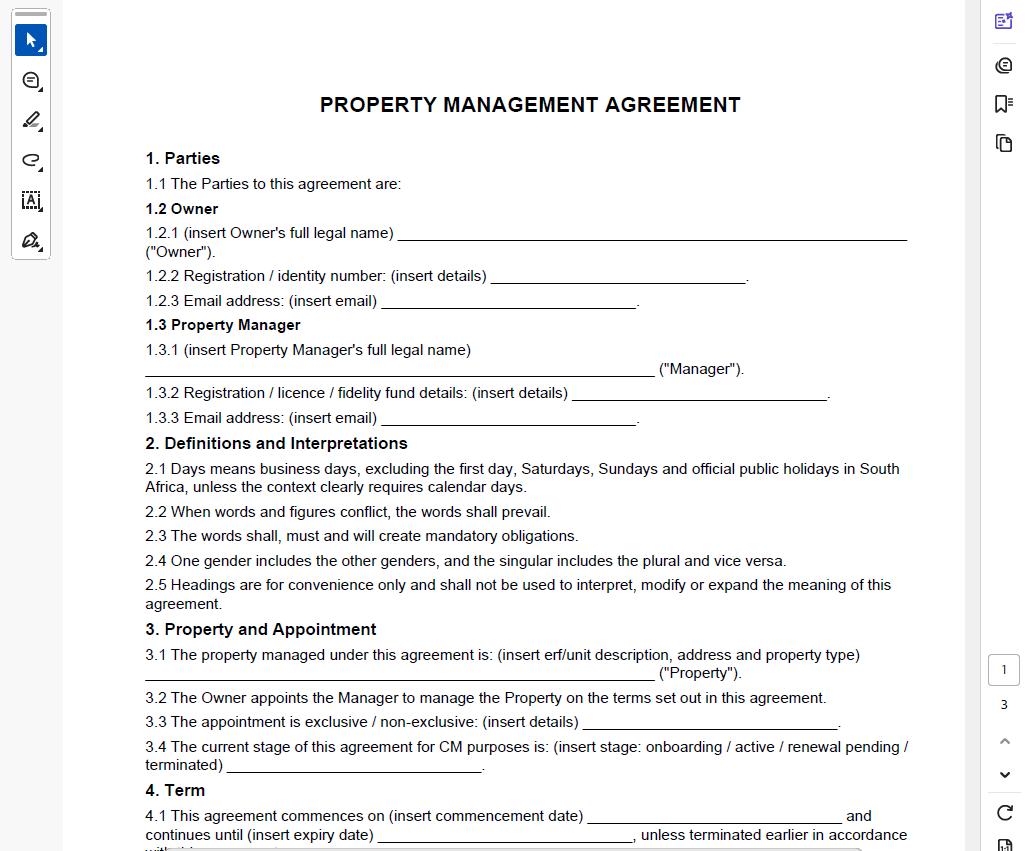
Property Management Agreement
Essential Clauses for Protecting Your Real Estate Assets
Introduction
Imagine owning ten rental houses but spending every weekend fixing leaky toilets. This is why many owners hire professionals. A property management agreement defines the relationship between a landlord and a manager. It ensures both parties know their duties and rights. Without one, you face legal risks and financial stress.
Fortunately, tools like Contract Corridor simplify the process of drafting and storing these documents. Our platform helps you organize every property management agreement in one secure place. In this article, you will learn about the key terms, different types of contracts, and common mistakes to avoid. By the end, you will know how to protect your investment perfectly.
Quick Answer Summary
A property management agreement is a legally binding document between a property owner and a management firm. It outlines the specific tasks the manager will handle, such as collecting rent and maintaining the building. The contract also sets the payment terms and the duration of the partnership. Most importantly, it protects both sides from liability and ensures clear communication throughout the term.
What is a Property Management Agreement?
This document serves as the foundation for your real estate business. It is a legally binding contract that grants a manager the power to act on your behalf. Specifically, the manager handles daily tasks that owners often prefer to avoid. The property management agreement formalizes the transfer of responsibility for the physical and financial health of a real estate asset.
Furthermore, these contracts fit into the broader field of legal operations. They bridge the gap between simple service contracts and complex real estate leases. In the past, people often used a handshake to seal these deals. However, modern laws now require written proof of authority. Today, managers use a property management contract form to ensure compliance with state regulations.
Meanwhile, the document acts as a roadmap for the property. It covers everything from how to handle tenant complaints to who pays for a new roof. Whether you use a simple property management agreement or a complex corporate version, the goal remains the same. You want to define expectations before problems arise.
Why It Matters
Getting your paperwork right can save you thousands of dollars. On the other hand, a bad contract can lead to lawsuits or lost rent. If a manager does not vet a tenant properly, the owner suffers the loss. Consequently, a clear property management contract agreement prevents these disputes from escalating.
Impact by the Numbers:
- Operational Efficiency: Clear contracts can reduce daily tenant disputes by up to 40 percent.
- Financial Risk: Unclear maintenance clauses lead to an average of 15 percent higher repair costs.
- Legal Exposure: Over 30 percent of rental lawsuits stem from poorly defined management duties.
Additionally, a strong contract helps with financial planning. It specifies exactly how much the manager earns each month. This allows owners to predict their cash flow with better accuracy. Without a management agreement contract, hidden fees can eat away at your profits.
Finally, there is the issue of liability. If a guest gets hurt on the property, who is responsible? A well-written contract will include an indemnity clause. This protects the owner from many types of legal claims. Using a tested real estate management agreement template ensures you include these vital protections.
Key Components & Elements
Every contract should cover certain pillars of the business. If you miss one, you leave yourself vulnerable. Use a property management template to check for these essential items.
- Scope of Authority: This section explains exactly what the manager can do, such as signing leases or hiring contractors.
- Management Fees: This clarifies the payment structure, whether it is a flat fee or a percentage of the monthly rent.
- Contract Duration: This sets the start and end dates of the relationship and defines how to renew the deal.
- Liability and Indemnity: This clause protects the owner from legal costs if the manager makes a mistake or an accident occurs.
- Termination Clause: This provides a clear path for either party to end the agreement if they are unhappy.
- Maintenance Limits: This sets a dollar amount the manager can spend on repairs without asking the owner first.
- Reporting Requirements: This ensures the owner receives a property management monthly report to owner template or regular updates on finances.
Types & Categories
Not every property needs the same level of care. Therefore, you should choose a contract that fits your specific asset class. For instance, a college dorm needs different rules than a luxury vacation home.
| Type | Description | Best For | Key Consideration |
|---|---|---|---|
| Residential | Focuses on long-term tenants and local housing laws. | Single-family homes or small apartments. | Tenant screening and eviction procedures. |
| Commercial | Covers offices or retail spaces with complex maintenance. | Shopping malls and office buildings. | Strict budget limits and vendor management. |
| Short-Term Rental | Focuses on high guest turnover and frequent cleaning. | Airbnbs and vacation spots. | Cleaning fees and platform management. |
| HOA Management | Handles common areas and community rule enforcement. | Condos and gated communities. | Governing documents and board relations. |
Specifically, a vacation rental property management agreement must address guest damage very clearly. In contrast, a real estate property management contract for an office building might focus on HVAC systems. You can find many versions online, like a simple property management agreement pdf, to see these differences.
Step-by-Step Implementation Guide
Ready to start the partnership? Follow these steps to ensure a smooth transition. Using a property manager contract sample can serve as a great starting guide.
- Identify Your Needs: Decide which tasks you want to outsource and which you want to keep. This prevents you from paying for services you do not need. Pro tip: List your "must-have" services before looking for templates.
- Select a Template: Find a high-quality real estate management agreement template that fits your property type. This saves time on drafting from scratch. Pro tip: Ensure the template follows your specific state laws.
- Negotiate the Fees: Discuss the percentage or flat rate with the manager. Clear pricing prevents future arguments. Pro tip: Ask about "hidden" fees for things like advertising or late-night calls.
- Review and Edit: Go through the management services contract template with a legal professional. This ensures every clause is fair and legal. Pro tip: Pay close attention to the termination and notice periods.
- Sign and Store: Execute the document using a property manager sign tool or digital signature. Keep the final copy in a safe, central location. Pro tip: Use a system like Contract Corridor to set renewal alerts.
Common Mistakes & How to Avoid Them
Even experienced landlords make errors when signing a property manager agreement. Most of these mistakes happen because people rush the process. They might use a free property management agreement template without reading the fine print.
| Mistake | Why It Happens | How to Fix It |
|---|---|---|
| Vague Duties | Assuming the manager "just knows" what to do. | List every duty in writing within the contract. |
| No Termination Policy | Wanting to be friendly and optimistic. | Define a 30 or 60-day notice period for both sides. |
| Ignoring Local Laws | Using a generic form from another state. | Verify clauses with local statutes or use state-specific forms. |
| Hidden Fees | Not asking about extra costs for repairs or evictions. | Ask for a full fee schedule before signing anything. |
The most important thing to remember is that a contract is only as good as its enforcement. Always check your monthly reports to ensure the manager follows the agreement.
Industry Examples & Use Cases
Let us look at how these documents work in the real world. Every industry has unique needs. For example, a property manager contract template for a tech hub will look different than one for a farm.
Example 1: The Suburban Landlord
A landlord owns three small houses. She uses a simple property management agreement pdf free download to save money. This contract clearly states the manager handles all lawn care. Consequently, the houses stay beautiful, and the neighborhood remains happy.
Example 2: The Healthcare Facility
A group of doctors owns their medical building. They use a management contract template agreement to hire a professional firm. Because the building needs strict cleanliness, the contract includes special cleaning standards. As a result, the facility passes every inspection easily.
Example 3: The Short-Term Rental
A couple rents out their beach house. They use a short term rental management agreement to hire a local host. This document covers dynamic pricing and guest messaging. In the end, their revenue increases by 20 percent due to professional oversight.
Frequently Asked Questions
What is a property management agreement?
It is a legal contract between a property owner and a manager. It defines the manager’s tasks, pay, and legal responsibilities.
Can I cancel a management contract early?
Yes, but you must follow the termination clause in the agreement. Most contracts require a 30-day or 60-day written notice to cancel without penalties.
Do I need a different contract for commercial property?
Yes, commercial deals usually require more detail regarding maintenance and financial reporting. You should use a real estate management agreement form specifically designed for commercial use.
What is a typical management fee?
Most managers charge between 7 percent and 12 percent of the monthly rent. Some also charge a flat fee or a one-time setup fee for new properties.
Is a digital signature legal on these agreements?
In most regions, a digital signature is just as valid as a wet-ink signature. Using a secure tool for your property manager sign process is a great way to save time.
How Contract Corridor Helps
Managing many documents can become overwhelming very quickly. Contract Corridor offers a centralized hub for all your real estate paperwork. Our platform allows you to organize every property management agreement with ease. You can track expiration dates so you never miss a renewal deadline.
Furthermore, our tool improves collaboration between owners and managers. You can share access to a property management monthly report to owner template directly through the system. This ensures transparency and builds trust in the partnership. Instead of searching through emails, you can find your property management agreement pdf in seconds.
Finally, we help you stay compliant with shifting laws. Since laws change, your contracts may need updates. Contract Corridor allows you to edit and version your property management contract agreement quickly. Sign up for a free trial today to see how we can streamline your portfolio management.

About the Author: Melissa Jooste
Melissa Jooste is the Head of Marketing at Contract Corridor, where she shapes the voice, narrative, and market positioning of a leading contract lifecycle management platform. Recognized for her expertise in contract lifecycle management content, Melissa is known for producing insightful, high-impact thought leadership that challenges conventional approaches to contract management. Her work goes beyond surface-level marketing, offering clear, strategic perspectives on how organizations can unlock value, reduce risk, and gain control through more effective contract lifecycle practices. Her writing is widely valued for its clarity, depth, and relevance, bridging complex legal, financial, and operational concepts into content that is both accessible and commercially meaningful. By combining strong storytelling with data-driven insight, she consistently delivers content that resonates with senior business leaders, legal professionals, and operational teams alike. Through her work, Melissa plays a key role in establishing Contract Corridor as a leading voice in the contract lifecycle management space, shaping how organizations think about contracts, not as static documents, but as dynamic drivers of business performance.
Connect on LinkedIn
About the reviewer: Jenna Kretzmer
Jenna Kretzmer, CA(SA) is an Executive at Contract Corridor, where she plays a key role in shaping the strategic direction and market positioning of a leading contract lifecycle management platform. A global executive with over a decade of experience, Jenna has led large-scale, international operations and driven growth, transformation, and market expansion across multiple regions. She is recognized for her ability to operate at the intersection of strategy, execution, and commercial performance. Jenna is a leading voice in the contract lifecycle management space, known for her perspectives on contract governance, revenue optimization, and operational efficiency. Her work challenges traditional approaches to contract management, advocating for a shift toward greater visibility, accountability, and value realization across the entire contract lifecycle. She is driving Contract Corridor to enable organizations to move beyond static contract storage toward proactive, value-led contract management, where contracts are treated not as legal documents, but as dynamic instruments that drive measurable business outcomes.
Connect on LinkedInProperty Management Agreement
The templates and resources available through Contract Corridor are provided for general informational purposes only. They do not constitute legal advice, and their use does not create an attorney-client relationship between you and Contract Corridor or any of its affiliates.
While every effort has been made to ensure that the templates are up to date and relevant, Contract Corridor makes no representations or warranties, express or implied, regarding their accuracy, completeness, adequacy, legality, or suitability for any specific purpose. The templates may not reflect current legal developments or the laws applicable in your jurisdiction.
You are solely responsible for reviewing, customising, and validating any template before use, to ensure that any document meets your specific needs and complies with applicable laws and regulations.
To the fullest extent permitted by law, Contract Corridor, its owners, employees, and affiliates disclaim all liability for any loss, damage, or consequence arising directly or indirectly from the use of, or reliance upon, any template, resource, or related material provided on or through this platform.
By accessing, downloading, or using any template, you acknowledge and agree that such use is entirely at your own risk.
Contract Corridor Contract Templates