
Music License Agreement
Essential Clauses for Musicians and Businesses
Introduction
Imagine waking up to find your song has millions of plays on a viral video. However, you never gave permission for its use. Without a solid music rights contract, you might lose thousands in royalties. This article explains how to protect your creative work and legal interests. Contract Corridor simplifies these complex deals for artists and labels. Next, you will learn about the standard clauses found in a music license agreement. We will cover how to use a music artist contract to secure your revenue. By the end, you will know how to navigate the legal side of the music industry with confidence.Quick Answer Summary
What Is a Music License Agreement?
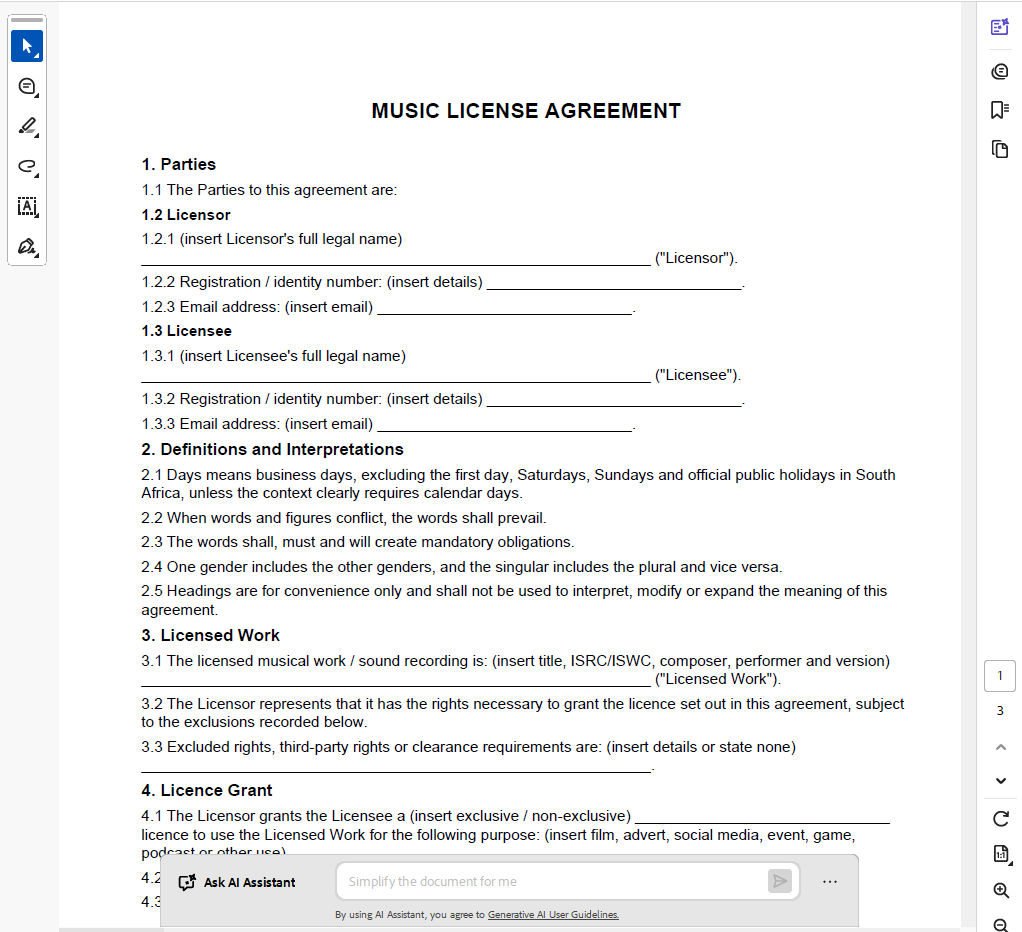
A music license agreement is a document that transfers specific usage rights from an owner to a licensee. Historically, these deals happened between large labels and radio stations. Today, independent artists often use a music licence agreement template to handle deals with streamers and influencers. A music rights agreement serves as the legal backbone for every song you hear in commercials, films, or apps. This document fits into the contract management landscape by defining intellectual property boundaries. Furthermore, it prevents unauthorized use of copyrighted material. You might use a song license agreement template to outline these details clearly. Moreover, this document specifies whether the deal is exclusive or non-exclusive. It also details the geographical area where the music can play. Without this licensing contract, creators cannot legally collect royalties or sue for infringement.Why It Matters
Legal clarity is vital for anyone in the creative arts. If you lack a clear music rights contract template, your business faces massive financial risk. For instance, streamers could remove your content if the rights are unclear.The Impact of Music Contracts
- Up to 90% of independent artists lose revenue due to missing metadata in music licensing terms.
- Legal fees for copyright disputes often exceed $50,000 without a signed music artist agreement.
- Properly managed music agreements can increase a creator's lifetime earnings by 40%.
Key Components & Elements
Every music licensing contract template should include certain pillars. These elements ensure the deal covers all legal bases.- Grant of Rights: This section explains exactly what the licensee can do with the track.
- Territory: This defines the part of the world where the music can be used.
- Term: This sets the duration of the license, such as one year or indefinitely.
- Compensation: This outlines the upfront fee or the royalty agreement template details.
- Credit: This specifies how the artist’s name must appear in the final product.
- Termination: This lists the conditions under which either party can end the deal.
- Ownership: This confirms that the creator keeps the original copyright.
Types & Categories
Different projects require different types of music contracts templates. Below is a breakdown of the most common legal music contracts.| Type | Description | Best For | Key Consideration |
|---|---|---|---|
| Master Use License | Permission to use the actual recording | Film and TV | A master use license agreement is usually separate from the song rights. |
| Sync License | Aligns music with moving images | YouTube and Gaming | A sync license agreement requires approval from the writer. |
| Mechanical License | Permission to reproduce the song on physical media | CDs and Vinyl | These follow strict statutory rates. |
| Public Performance | Permission to play music in public spaces | Bars and Radio | Handled by groups like ASCAP or BMI. |
Step-by-Step Implementation Guide
Using a sample music license agreement is only the first step. You must follow a process to make it legally binding.- Identify the Owners: Find out who owns the "master" and who owns the "composition." Often, these are different people.
Pro Tip: Always check if a producer or a songwriter needs to sign the music collaboration agreement too. - Draft the Terms: Pick a music license agreement template that fits your specific needs. Fill in the territory, term, and payment details.
Pro Tip: Use a music publishing contract template if you are handling songwriting rights specifically. - Review for Exclusivity: Decide if the user has the only right to the music. An exclusive license agreement music deal usually costs more.
Pro Tip: Most beat license agreement template options are non-exclusive to allow for more sales. - Negotiate Royalties: Determine if the artist gets a percentage of sales. Use a record contract template to define these splits clearly.
Pro Tip: Ensure the musician contract template includes "audit rights" to check payment records. - Sign and Store: Get all parties to sign the document digitally or in ink.
Pro Tip: Store your musicians contract sample in a secure database like Contract Corridor.
Common Mistakes & How to Avoid Them
Avoid these common traps when using a music licensing contract sample.| Mistake | Why It Happens | How to Fix It |
|---|---|---|
| Vague Usage Rights | Parties use a generic license contract. | Define exactly where the song will appear. |
| Ignoring "Work for Hire" | The employer assumes they own the art. | Include clear language in the musical contract template. |
| Missing Credits | The licensee forgets to mention the artist. | Add a penalty clause for missing credits. |
| Mixing Master and Sync | Users think one license covers both. | Get both a master and sync agreement. |
Always ensure you have the rights to any samples used in the song before signing a music production agreement.
Industry Examples & Use Cases
Specifically, different industries use music in unique ways. Here are four examples of music agreements in action. Social Media Influencers: A creator uses an example of licensing documents for soundcloud to get a track for their vlog. As a result, they avoid copyright strikes and keep their ad revenue. Film Production: A director uses a music licensing agreement for film to place a hit song in a dramatic scene. This protects the studio from expensive legal claims after the movie hits theaters. Podcast Hosting: A host downloads a podcast contract template to license their intro theme song. Consequently, they can distribute the show across Apple and Spotify without fear. Music Producers: A producer uses a sample music producer contract agreement to define their share of a new hit. This ensures they get paid when the song goes platinum.Frequently Asked Questions
What is the difference between a master and a sync license?
A master license covers the specific sound recording you hear. A sync license covers the underlying melody and lyrics written by the songwriter.
Can I use a free recording contract template for my band?
Yes, but you should customize it to fit your needs. Ensure it covers how profits are split between all band members.
Do I need a music label contract sample for a small release?
Yes, any professional release should have a paper trail. A record company contract sample helps prevent future arguments about money.
Where can I find a standard music license agreement pdf?
You can find templates online, but most professionals use a custom music licensing contract template for better protection.
What is an exclusive beat license agreement template?
This is a contract where a producer sells a beat to only one person. The seller cannot give that track to anyone else afterward.
How Contract Corridor Helps
Managing a music license agreement does not have to be difficult. Contract Corridor provides the tools you need to stay organized and secure. First, our platform uses smart storage for your copyright license agreement documents. You can find any contract in seconds with our powerful search tool. Furthermore, we offer automated reminders for license expirations. This ensures you never miss a renewal or a payment date for your music production deal contract template. Secondly, you can collaborate with artists in real-time. Instead of emailing an artwork licensing agreement template back and forth, you can edit it together online. Finally, we provide secure e-signature tools. This means your record label contract template gets signed faster, letting you get back to the music. Sign up for a demo of Contract Corridor today and take control of your music contracts.
About the Author: Melissa Jooste
Melissa Jooste is the Head of Marketing at Contract Corridor, where she shapes the voice, narrative, and market positioning of a leading contract lifecycle management platform. Recognized for her expertise in contract lifecycle management content, Melissa is known for producing insightful, high-impact thought leadership that challenges conventional approaches to contract management. Her work goes beyond surface-level marketing, offering clear, strategic perspectives on how organizations can unlock value, reduce risk, and gain control through more effective contract lifecycle practices. Her writing is widely valued for its clarity, depth, and relevance, bridging complex legal, financial, and operational concepts into content that is both accessible and commercially meaningful. By combining strong storytelling with data-driven insight, she consistently delivers content that resonates with senior business leaders, legal professionals, and operational teams alike. Through her work, Melissa plays a key role in establishing Contract Corridor as a leading voice in the contract lifecycle management space, shaping how organizations think about contracts, not as static documents, but as dynamic drivers of business performance.
Connect on LinkedIn
About the reviewer: Jenna Kretzmer
Jenna Kretzmer, CA(SA) is an Executive at Contract Corridor, where she plays a key role in shaping the strategic direction and market positioning of a leading contract lifecycle management platform. A global executive with over a decade of experience, Jenna has led large-scale, international operations and driven growth, transformation, and market expansion across multiple regions. She is recognized for her ability to operate at the intersection of strategy, execution, and commercial performance. Jenna is a leading voice in the contract lifecycle management space, known for her perspectives on contract governance, revenue optimization, and operational efficiency. Her work challenges traditional approaches to contract management, advocating for a shift toward greater visibility, accountability, and value realization across the entire contract lifecycle. She is driving Contract Corridor to enable organizations to move beyond static contract storage toward proactive, value-led contract management, where contracts are treated not as legal documents, but as dynamic instruments that drive measurable business outcomes.
Connect on LinkedInMusic License Agreement
The templates and resources available through Contract Corridor are provided for general informational purposes only. They do not constitute legal advice, and their use does not create an attorney-client relationship between you and Contract Corridor or any of its affiliates.
While every effort has been made to ensure that the templates are up to date and relevant, Contract Corridor makes no representations or warranties, express or implied, regarding their accuracy, completeness, adequacy, legality, or suitability for any specific purpose. The templates may not reflect current legal developments or the laws applicable in your jurisdiction.
You are solely responsible for reviewing, customising, and validating any template before use, to ensure that any document meets your specific needs and complies with applicable laws and regulations.
To the fullest extent permitted by law, Contract Corridor, its owners, employees, and affiliates disclaim all liability for any loss, damage, or consequence arising directly or indirectly from the use of, or reliance upon, any template, resource, or related material provided on or through this platform.
By accessing, downloading, or using any template, you acknowledge and agree that such use is entirely at your own risk.
Contract Corridor Contract Templates