
A Comprehensive Guide to Ending Rental Contracts Properly
Introduction
Ending a rental relationship can feel like a complex puzzle. Many businesses struggle with the legal steps needed to close a contract early. Surprisingly, nearly 20% of commercial disputes involve early exits from property deals. You need a clear path to minimize risk and protect your budget.
Furthermore, Contract Corridor helps teams navigate these transitions with ease. We specialize in making legal documents simple for everyone. In this article, you will learn how to use a lease termination agreement to protect your interests. Specifically, we will cover forms, templates, and the best ways to communicate with your landlord or tenant.
Quick Answer Summary
A lease termination agreement is a legal document that lets a landlord and tenant end a rental contract early. This document details the final date of move-out and any remaining payments. Generally, it settles all claims between both parties to prevent future lawsuits. By signing this form, you ensure a clean break and confirm that both sides have met their duties.
What Is a Lease Termination Agreement?
This document serves as an official proof of the dissolution of lease agreement. In simple terms, it is a contract that says another contract is over. The term "lease" comes from old legal words meaning to let or grant. Today, these forms keep the peace in the modern rental market.
Most contracts have an end date. However, sometimes life or business changes. You might need to move out early. Or, a landlord might need to sell the building. In these cases, a termination of lease agreement provides the structure you need. It sits within the contract management field as a "revocation" or "release" tool.
Essentially, this document cancels your previous obligations. It replaces the old rules with new rules for leaving. You can use a lease termination agreement template to ensure you include the right local laws. This helps you avoid messy court battles later on.
Why It Matters
Getting your paperwork right is vital for your financial health. Without a clear lease termination agreement form, you could remain liable for months of rent. Landlords might also face losses if they cannot find a new tenant quickly. For instance, small errors in a lease early termination letter often lead to expensive legal fees.
Key Impact Statistics:
- Businesses lose approximately $15,000 on average during unmanaged lease disputes.
- Over 65% of tenants feel less stressed when they use a formal termination agreement lease.
- Proper documentation reduces the risk of deposit loss by nearly 40%.
Operational efficiency also plays a big role here. If you use a termination of rental agreement template, you save your team hours of work. You do not have to guess what needs to be written. Instead, you follow a set path that keeps the business moving forward.
Key Components & Elements
When you prepare to terminate lease agreement obligations, you must include specific details. These parts protect you from future claims. Use this checklist to review your document before signing.
- Party Identification: List the full legal names of the landlord and the tenant precisely.
- Original Lease Reference: Include the start date and the address of the rental property.
- Termination Date: State the exact day the tenant must move out and return the keys.
- Financial Settlements: Clarify if any money is owed or if a party pays a fee to leave early.
- Security Deposit: Outline when and how the landlord will return the security deposit.
- Mutual Release Statement: Confirm that neither party will sue the other after this date.
- Property Condition: Describe how the tenant should leave the space, such as "broom clean."
Types & Categories
Not every lease ends the same way. You should choose the document that fits your specific situation. Review this table to see which termination lease agreement best meets your needs.
| Type | Description | Best For | Key Consideration |
|---|---|---|---|
| Mutual Agreement | Both sides agree to end the deal. | Amicable splits. | Requires both signatures. |
| Early Exit Clause | A tenant uses a pre-set right to leave. | Changing business needs. | Watch for high exit fees. |
| Notice of Non-Renewal | One side decides not to extend the year. | Fixed-term leases. | Review notice periods. |
| Termination for Cause | One side breaks a rule in the contract. | Rule violations. | Legal proof is required. |
Step-by-Step Implementation Guide
Ending your rental deal requires a careful process. Follow these steps to ensure you use your agreement to terminate lease form correctly.
- Review the Original Lease: Search for an early termination clause for lease agreement details. This tells you if you must pay a penalty.
Pro Tip: Take photos of these clauses to keep them handy during talks. - Draft a Formal Request: Send a lease termination letter tenant to landlord to start the conversation. This starts the clock on your notice period.
Pro Tip: Use a sample of lease termination letter to keep your tone professional. - Negotiate the Terms: Talk about the move-out date and the security deposit refund. Be ready to compromise to reach a mutual lease termination agreement.
Pro Tip: Keep a log of every call or email you exchange. - Complete the Paperwork: Fill out a termination of rental agreement form with all the agreed details. Make sure everyone signs the document.
Pro Tip: Use an electronic signature to speed up the process. - Conduct a Walkthrough: Meet at the property on the final day to check for damage. Document everything with photos.
Pro Tip: Use a lease release document to sign off on the condition of the space.
Common Mistakes & How to Avoid Them
Many people make simple errors when they use an end lease agreement form. These mistakes can cost thousands of dollars. Use this table to spot risks early.
| Mistake | Why It Happens | How to Fix It |
|---|---|---|
| Verbal Agreements | People trust each other and skip the form. | Always use a written termination of lease document. |
| Wrong Dates | Simple typos in the move-out date. | Double-check the calendar before signing anything. |
| Ignoring "Notice" Rules | Tenants forget to give 30 or 60 days' notice. | Set a reminder 90 days before you want to leave. |
| Unclear Deposit Terms | Parties forget to talk about the money back. | Define the refund date in the lease release form. |
The most important step is getting every promise in writing. Never move out until both parties sign the termination of lease agreement sample or a fresh contract.
Industry Examples & Use Cases
Different industries handle lease endings in unique ways. Here are a few ways a termination of rental agreement might look in the real world.
Technology: A software startup grows too fast for its office. They use an early lease termination agreement template to move to a larger space. Consequently, they pay a two-month fee but avoid a three-year commitment. This allows them to scale without legal delays.
Trucking: An independent driver decides to stop hauling for a specific firm. They fill out a trucking lease termination agreement to return the equipment. This document ensures the company cannot charge the driver for repairs after the return date.
Retail: A boutique store in a mall closes because sales are low. They negotiate a lease cancellation agreement with the mall owner. By using a rent contract termination letter sample, they explain their financial hardship. The mall owner agrees to let them leave if they find a new tenant.
Healthcare: A private clinic moves to a modern hospital building. They use a termination of lease form to end their current rental. This ensures they do not pay rent at two locations at the same time.
Frequently Asked Questions
How do I write a letter to end my lease?
You should start with a clear subject line and state your intent to leave. Mention the date of your move-out and reference your original contract. Use a sample lease cancellation letter to ensure you follow the right format.
Can I break my lease without a penalty?
Usually, you only avoid penalties if the landlord agrees or if the property is unsafe. You should look for an early lease termination template that includes a "mutual release" section. This protects you from extra charges if both sides agree to part ways.
What is a lease release form?
It is a document that clears the tenant from any future debt or duty to the landlord. Once you sign this, the landlord cannot come back later and ask for more rent money. It is the final step in closing your rental account.
Where can I find a template for ending a contract?
You can find a termination agreement template on legal help sites or through contract software. Contract Corridor provides these tools to make sure your exit is legally sound and easy to manage.
What happens if I leave without a signed agreement?
The landlord could sue you for the remaining rent on the contract. They might also report the debt to credit bureaus, which hurts your score. Always use an end of rental agreement form to protect your future.
How Contract Corridor Helps
Managing a termination of lease contract does not have to be a headache. Contract Corridor offers the tools you need to handle every exit with confidence. Our platform simplifies the entire lifecycle of your rental agreements.
First, our software stores all your lease termination agreement pdf files in one secure place. You never have to hunt through old folders for your notice dates. Second, we offer smart alerts. These tell you exactly when you need to send a lease termination letter to tenant to avoid auto-renewals.
Third, our template library allows you to create a professional termination of rental contract in minutes. You simply fill in the blanks, and our system does the rest. This speed helps you stay ahead of deadlines and keep your landlord happy.
Finally, we help you track the status of your release of lease agreement. You can see when it was sent, opened, and signed. This transparency reduces stress for your entire team. Ready to streamline your lease management? Contact us today to see how we can help you get more out of your contracts.

About the Author: Melissa Jooste
Melissa Jooste is the Head of Marketing at Contract Corridor, where she shapes the voice, narrative, and market positioning of a leading contract lifecycle management platform. Recognized for her expertise in contract lifecycle management content, Melissa is known for producing insightful, high-impact thought leadership that challenges conventional approaches to contract management. Her work goes beyond surface-level marketing, offering clear, strategic perspectives on how organizations can unlock value, reduce risk, and gain control through more effective contract lifecycle practices. Her writing is widely valued for its clarity, depth, and relevance, bridging complex legal, financial, and operational concepts into content that is both accessible and commercially meaningful. By combining strong storytelling with data-driven insight, she consistently delivers content that resonates with senior business leaders, legal professionals, and operational teams alike. Through her work, Melissa plays a key role in establishing Contract Corridor as a leading voice in the contract lifecycle management space, shaping how organizations think about contracts, not as static documents, but as dynamic drivers of business performance.
Connect on LinkedIn
About the reviewer: Jenna Kretzmer
Jenna Kretzmer, CA(SA) is an Executive at Contract Corridor, where she plays a key role in shaping the strategic direction and market positioning of a leading contract lifecycle management platform. A global executive with over a decade of experience, Jenna has led large-scale, international operations and driven growth, transformation, and market expansion across multiple regions. She is recognized for her ability to operate at the intersection of strategy, execution, and commercial performance. Jenna is a leading voice in the contract lifecycle management space, known for her perspectives on contract governance, revenue optimization, and operational efficiency. Her work challenges traditional approaches to contract management, advocating for a shift toward greater visibility, accountability, and value realization across the entire contract lifecycle. She is driving Contract Corridor to enable organizations to move beyond static contract storage toward proactive, value-led contract management, where contracts are treated not as legal documents, but as dynamic instruments that drive measurable business outcomes.
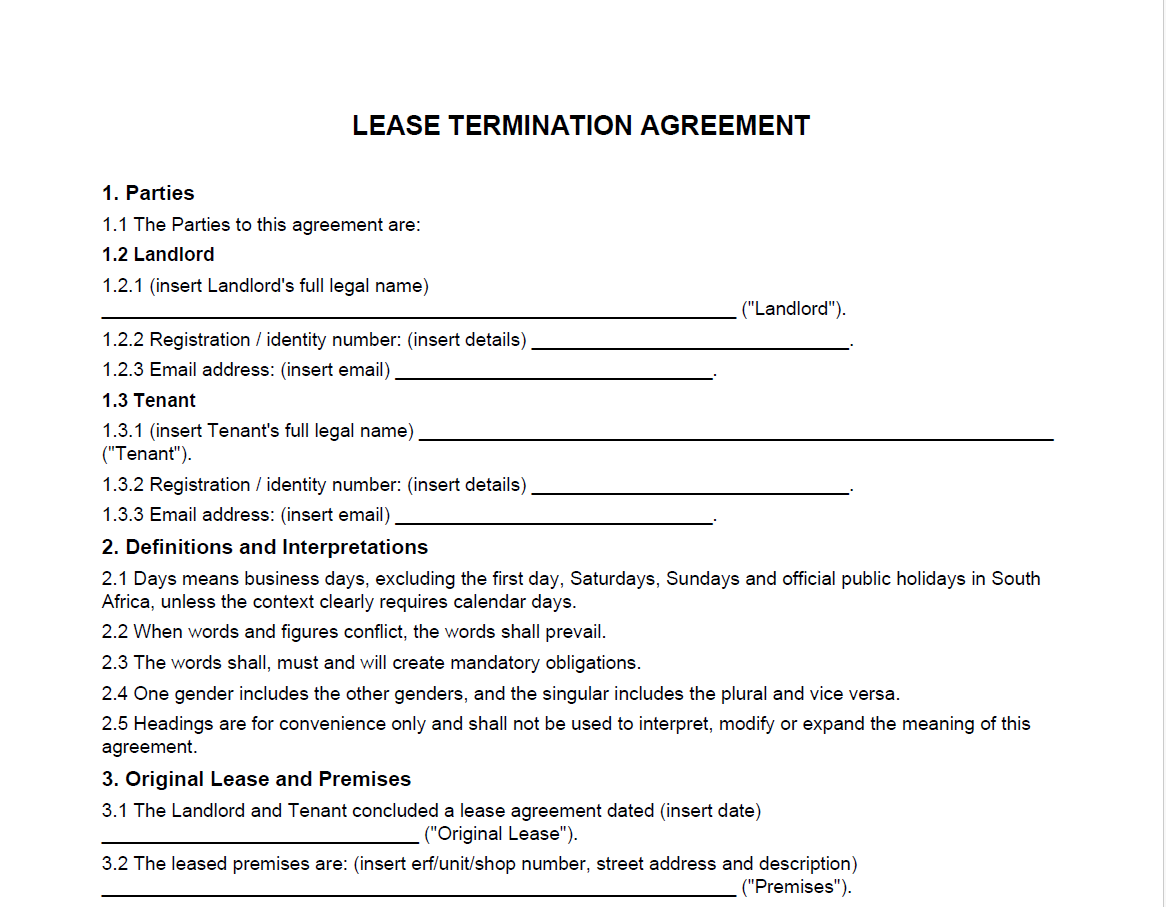
Connect on LinkedInLease Termination Agreement
The templates and resources available through Contract Corridor are provided for general informational purposes only. They do not constitute legal advice, and their use does not create an attorney-client relationship between you and Contract Corridor or any of its affiliates.
While every effort has been made to ensure that the templates are up to date and relevant, Contract Corridor makes no representations or warranties, express or implied, regarding their accuracy, completeness, adequacy, legality, or suitability for any specific purpose. The templates may not reflect current legal developments or the laws applicable in your jurisdiction.
You are solely responsible for reviewing, customising, and validating any template before use, to ensure that any document meets your specific needs and complies with applicable laws and regulations.
To the fullest extent permitted by law, Contract Corridor, its owners, employees, and affiliates disclaim all liability for any loss, damage, or consequence arising directly or indirectly from the use of, or reliance upon, any template, resource, or related material provided on or through this platform.
By accessing, downloading, or using any template, you acknowledge and agree that such use is entirely at your own risk.
Contract Corridor Contract Templates