
Share Purchase Agreement
A Practical Breakdown for Modern Business Teams
Introduction
Imagine you worked for ten years to build a successful startup. A big buyer finally offers to buy your company for millions. However, a single hidden clause in a messy document ruins the deal at the last second. This happens more often than you might think. Business owners and investors must understand the share purchase agreement to protect their wealth. This legal document acts as the final bridge between a handshake and a closed deal. In this article, you will learn how these contracts work and how to navigate them safely. Contract Corridor helps teams stay organized during these high-stakes moments. Our platform ensures that every version of your contract remains secure and easy to find.Quick Answer Summary
What Is a Share Purchase Agreement?
First, we must look at the share purchase agreement meaning. At its core, this document represents a binding deal between two parties. One person or entity wants to sell ownership in a company. Another person or entity wants to buy those specific shares. A share purchase agreement is the primary legal document used to finalize the sale and transfer of ownership interest in a corporation. This contract differs from an asset purchase. In an asset deal, the buyer only picks specific items like desks or software. In this case, the buyer takes over the entire corporate entity through its shares. This includes the company's history, debts, and legal standing. You might hear people ask: what is an spa in business? The term stands for the same concept. It serves as a roadmap for the transition of power. In legal circles, lawyers often call it a share transfer contract or a shares contract. No matter the name, the goal remains the same. It clearly defines who owns what after the closing date.Why It Matters
Getting the details right prevents expensive lawsuits. If you use a poor share purchase agreement draft, you leave yourself open to risk. For example, a buyer might discover hidden debts after the sale. Without the right protections, the buyer might have to pay those debts themselves. Conversely, sellers need protection too. They want to ensure they get paid on time. They also want to limit their liability for the company's future performance. Furthermore, a solid share purchase agreement m&a ensures a smooth transition for employees and customers.Transaction Impact Data
- Over 40% of business deals face delays due to paperwork errors.
- Legal disputes regarding warranties cost companies an average of $150,000 in legal fees.
- Poorly managed contracts reduce the total value of a merger by nearly 10% on average.
Key Components & Elements
Every standard share purchase agreement contains specific sections. These parts work together to create a fair deal. Use this list to check your next share purchase agreement document.- Parties Involved: This defines the legal names of the buyer and the seller. It ensures the right people sign the shares purchase agreement.
- Purchase Price: This section lists the exact amount of money. It also explains how the buyer will pay, such as cash, wire transfer, or stock.
- Conditions Precedent: These are tasks that both sides must finish before the deal closes. For example, the buyer might need to secure a bank loan first.
- Representations and Warranties: These are factual statements about the company. The seller might promise that the company owns all its patents.
- Indemnification: This part explains who pays if something goes wrong later. It acts like an insurance policy within the share agreement contract.
- Dispute Resolution: This tells the parties where they will go if they argue. They might choose a specific court or an arbitrator.
Types & Categories
Not every deal looks the same. Different situations require different contract structures. The table below compares common versions of these agreements.| Type | Description | Best For | Key Consideration |
|---|---|---|---|
| Private SPA | A deal between private owners. | Small businesses and startups. | Strict transfer restrictions. |
| LLC Agreement | Specific to limited liability companies. | Partnerships and small firms. | Must follow the LLC operating plan. |
| Restricted Stock | Shares that vest over time. | Employee hiring and retention. | Tax rules for the employee. |
| Public M&A | Large deals involving public companies. | Corporate mergers. | Government regulation and filing. |
Step-by-Step Implementation Guide
Follow these steps to complete a stock purchase agreement successfully.- Draft the Letter of Intent: Before the full spa legal document, sign a simple summary. This shows both sides are serious. Pro Tip: Keep this letter short to save on legal fees.
- Perform Due Diligence: The buyer must inspect the company's books. They look for hidden risks or unpaid taxes. Pro Tip: Use a digital data room to share files safely.
- Create the First Draft: Lawyers create the initial share purchase agreement draft. This starts the negotiation phase. Pro Tip: Use a sample share purchase agreement template to save time on basic terms.
- Negotiate Terms: Both sides argue over the price and warranties. This is often the longest step in the process. Pro Tip: Focus on the "indemnity" section to protect your wallet.
- Sign and Close: Both parties sign the the share sale and purchase agreement. The buyer sends the money, and the seller hands over the shares. Pro Tip: Ensure you have a shareholder purchase agreement sample for future reference.
Common Mistakes & How to Avoid Them
Many people rush through the share purchase agreement form. This leads to big mistakes.| Mistake | Why It Happens | How to Fix It |
|---|---|---|
| Vague Price Terms | Parties use verbal promises. | Put the exact dollar amount in writing. |
| Ignoring Taxes | People focus only on the sale price. | Consult a tax expert before signing. | The team loses track of dates. | Use automated alerts to track milestones. |
Always double-check the "Definitions" section. Small changes in word meanings can cost you thousands of dollars later.
Industry Examples & Use Cases
Specifically, different industries use these contracts in unique ways. First, consider a small tech startup in Alberta. The founders might use a share purchase agreement alberta variant to sell to a larger firm. They must follow local laws while transferring their intellectual property. This ensure the buyer owns the code and the brand. Second, a healthcare clinic might change owners. The new doctor signs a stock sale and purchase agreement to take over the practice. They must ensure the contract covers patient privacy rules. Third, a manufacturing company in Singapore might expand. They use a share purchase agreement singapore version to buy a competitor. This helps them grow their market share quickly while following local trade rules. Finally, a real estate group might buy a building held by an LLC. They would use an llc share purchase agreement to gain control of the property. This is faster than buying the building directly.Frequently Asked Questions
What is a share purchase agreement exactly?
It is a legal contract that documents the sale of stock between two parties. It covers the price, rights, and duties of the buyer and seller.
What is an spa in finance used for?
Finance professionals use it to move ownership from one entity to another. It helps them track capital gains and investment changes accurately.
Can I use a shareholder purchase agreement template?
Yes, templates provide a great starting point for many deals. However, you should always have a lawyer review the final version to fit your needs.
What does spa definition business mean?
In a business context, it refers to the formal agreement to trade shares. It defines the rules of the trade to prevent future legal fights.
How Contract Corridor Helps
Managing a share purchase agreement requires precision and timing. Contract Corridor provides the tools you need to succeed. Our platform makes it easy to handle your share purchase agreement document from start to finish. First, our version control feature ensures everyone looks at the latest draft. You never have to guess if you have the right file. Second, our automated reminders help you hit every deadline in your deal. Third, our secure storage keeps your sensitive details safe from prying eyes. Are you ready to simplify your next big deal? Let Contract Corridor manage the complexity for you. Visit our website today to see how our software streamlines your legal workflows.
About the Author: Melissa Jooste
Melissa Jooste is the Head of Marketing at Contract Corridor, where she shapes the voice, narrative, and market positioning of a leading contract lifecycle management platform. Recognized for her expertise in contract lifecycle management content, Melissa is known for producing insightful, high-impact thought leadership that challenges conventional approaches to contract management. Her work goes beyond surface-level marketing, offering clear, strategic perspectives on how organizations can unlock value, reduce risk, and gain control through more effective contract lifecycle practices. Her writing is widely valued for its clarity, depth, and relevance, bridging complex legal, financial, and operational concepts into content that is both accessible and commercially meaningful. By combining strong storytelling with data-driven insight, she consistently delivers content that resonates with senior business leaders, legal professionals, and operational teams alike. Through her work, Melissa plays a key role in establishing Contract Corridor as a leading voice in the contract lifecycle management space, shaping how organizations think about contracts, not as static documents, but as dynamic drivers of business performance.
Connect on LinkedIn
About the reviewer: Jenna Kretzmer
Jenna Kretzmer, CA(SA) is an Executive at Contract Corridor, where she plays a key role in shaping the strategic direction and market positioning of a leading contract lifecycle management platform. A global executive with over a decade of experience, Jenna has led large-scale, international operations and driven growth, transformation, and market expansion across multiple regions. She is recognized for her ability to operate at the intersection of strategy, execution, and commercial performance. Jenna is a leading voice in the contract lifecycle management space, known for her perspectives on contract governance, revenue optimization, and operational efficiency. Her work challenges traditional approaches to contract management, advocating for a shift toward greater visibility, accountability, and value realization across the entire contract lifecycle. She is driving Contract Corridor to enable organizations to move beyond static contract storage toward proactive, value-led contract management, where contracts are treated not as legal documents, but as dynamic instruments that drive measurable business outcomes.
Connect on LinkedInShare Purchase Agreement
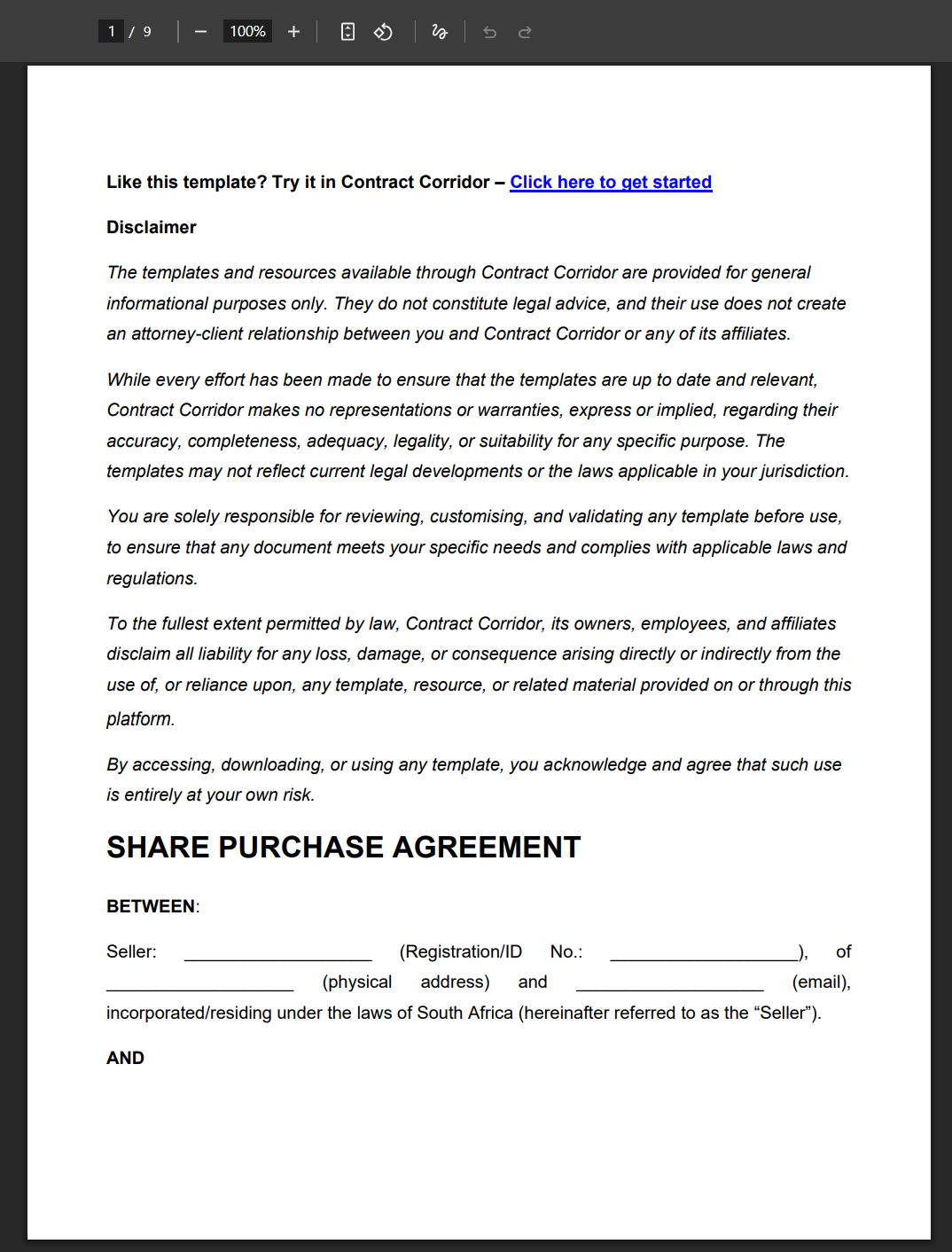
The templates and resources available through Contract Corridor are provided for general informational purposes only. They do not constitute legal advice, and their use does not create an attorney-client relationship between you and Contract Corridor or any of its affiliates.
While every effort has been made to ensure that the templates are up to date and relevant, Contract Corridor makes no representations or warranties, express or implied, regarding their accuracy, completeness, adequacy, legality, or suitability for any specific purpose. The templates may not reflect current legal developments or the laws applicable in your jurisdiction.
You are solely responsible for reviewing, customising, and validating any template before use, to ensure that any document meets your specific needs and complies with applicable laws and regulations.
To the fullest extent permitted by law, Contract Corridor, its owners, employees, and affiliates disclaim all liability for any loss, damage, or consequence arising directly or indirectly from the use of, or reliance upon, any template, resource, or related material provided on or through this platform.
By accessing, downloading, or using any template, you acknowledge and agree that such use is entirely at your own risk.
Contract Corridor Contract Templates