
Joint Venture Agreement
A Practical Breakdown for Modern Business Teams
Introduction
Imagine two rival companies suddenly working together to build a revolutionary new product. This happens every day in the global market when brands decide to share resources. Specifically, they use a formal contract to define how they will cooperate without losing their individual identities.
Furthermore, these partnerships allow small businesses to compete with massive giants. However, you must handle the legal paperwork correctly to avoid expensive disputes. Contract Corridor helps teams navigate these complex documents with ease and transparency. In this article, you will learn the essentials of the joint venture agreement and how to structure your own successful partnership.
Quick Answer Summary
A joint venture agreement is a legal document that unites two or more parties for a specific business project. It defines how partners share costs, profits, and manage daily operations. Most companies use this contract to enter new markets or combine technical expertise for a limited time. Unlike a total merger, each partner keeps their own distinct legal status throughout the deal.
What Is a Joint Venture?
The term describes a strategic arrangement where two or more businesses pool their assets. Usually, they do this to achieve a goal that they could not reach alone. The joint venture agreement serves as the foundational rulebook for this collaboration. It protects each side by setting clear boundaries and professional expectations.
Historically, sailors and merchants used these arrangements to fund long voyages across the sea. Today, the joint-venture concept applies to everything from software development to real estate. In the world of contract management, these documents are vital. They sit between simple service contracts and full corporate mergers. You might also hear people refer to these as a business joint venture or a joint partnership. Ultimately, they all mean two groups working as one for a common reward.
Why It Matters
Getting your paperwork right determines the success of your project. For instance, a vague contract leads to confusion about who pays the bills. If you fail to define the jv split, partners might fight over revenue later. Consequently, clear language prevents lawsuits and keeps the project moving forward on schedule.
Key Joint Venture Statistics
- Over 25% of global revenue comes from strategic alliances and partnerships.
- Companies using automated contract tools see a 15% reduction in administrative costs.
- Roughly 50% of partnerships fail early due to poor communication and weak legal structures.
Operational efficiency also depends on these contracts. When you have a solid jv agreement in place, employees know their roles. Also, investors feel more confident when they see a professional joint venture agreement contract. Without it, you risk your reputation and your capital.
Key Components & Elements
Every jv contract must include certain sections to be effective. These elements ensure that everyone understands the rules of the game. Use this list as a starting point for your next deal.
- Scope of the Venture: This defines the exact goals and limits of the project so that mission creep does not occur.
- Financial Contributions: Partners must list how much cash, equipment, or intellectual property they will provide initially.
- Management Structure: You need to decide who makes the big decisions and who manages the daily tasks.
- Profit and Loss Sharing: This section explains how the jv partner meaning translates into actual dollar amounts for each side.
- Termination Clause: Every contract needs an exit strategy that explains how to close the business when the work is finished.
- Confidentiality Rules: Specifically, this protects private trade secrets from being shared outside the partnership boundaries.
Types & Categories
Choosing the right structure of a joint venture is critical for tax and legal reasons. Different projects require different levels of formality. Use the table below to compare your options.
| Type | Description | Best For | Key Consideration |
|---|---|---|---|
| Equity Joint Venture | Partners create a new, separate jv company. | Long-term projects like factory construction. | Requires complex legal setup and filing. |
| Contractual Joint Venture | Companies work together via contract only. | Short-term projects or service sharing. | Lower setup costs and easier to dissolve. |
| Joint Operating Agreement | Focuses on shared tasks rather than a new entity. | Oil, gas, and mining industries. | Highly technical and industry-specific rules. |
Step-by-Step Implementation Guide
If you are ready to start a project, follow these steps to build a strong foundation. Planning early saves time and helps you find the right joint venture partners.
- Define Your Goals: Identify exactly what you want to achieve together. This helps you explain the venture contracts to stakeholders.
Pro Tip: Write a one-page summary before drafting the long legal document.
- Vet Your Partner: Check the financial health and reputation of the other company. Research the jv partner meaning in their previous deals.
Pro Tip: Ask for references from their other business partners.
- Draft the Agreement: Use a joint venture agreement contract template to ensure you cover all legal bases. This makes the process much faster.
Pro Tip: Always have a jv agreement lawyer review the final draft.
- Allocate Resources: Transfer the agreed-upon funds or equipment to the project. Clear tracking prevents future arguments about who brought what.
Pro Tip: Use a dedicated bank account for all venture money.
Common Mistakes & How to Avoid Them
Even experienced leaders can make mistakes during a joint venture deal. Recognizing these pitfalls early can save your business. Below are the most common errors seen in the industry.
| Mistake | Why It Happens | How to Fix It |
|---|---|---|
| Vague Exit Strategy | Partners are too optimistic at the start. | Include clear "divorce" steps in the jv contracts. |
| Poor Talent Matching | Companies focus only on money, not people. | Assign a dedicated lead from each side. |
| Ignoring Local Laws | International deals forget about regional rules. | Hire local joint venture services for advice. |
| Weak Data Security | Teams share passwords and files too loosely. | Use a secure platform like Contract Corridor. |
The most important thing to remember is that trust is a feeling, but a contract is a fact. Never rely on handshakes when dealing with significant assets.
Industry Examples & Use Cases
To understand what is a jv in business, it helps to see real-world scenarios. Many household names use these structures to expand their reach.
First, consider the technology sector. A phone manufacturer might partner with a camera company. They create a new mobile device with professional-grade lenses. Through a contractual joint venture agreement, they share the marketing costs and the sales revenue.
Second, look at the construction industry. Two small building firms might join forces to win a bid for a massive bridge. They sign a jv agreement real estate firms often use to pool equipment and labor. This helps them finish a project that neither could handle alone.
Third, healthcare companies often use a joint venture merger and acquisition strategy. Two labs might fund a new research facility. By using joint venture financing, they split the high cost of expensive medical machinery. Both labs then benefit from the resulting cures or patents.
Frequently Asked Questions
What is a joint venture agreement in simple terms?
It is a legal contract where two businesses agree to work on a single project together. It covers how they will share the work, the costs, and the eventual profits.
How does a jv split work legally?
The contract defines what percentage of profit each person receives. Usually, this depends on how much money or time each partner puts into the venture.
Can I find a joint venture agreement draft free online?
Yes, many websites offer a free joint venture contract template. However, you should always have a legal professional check it to make sure it fits your specific needs.
What happens if a joınt venture fails?
The agreement should have a termination clause. This tells the partners how to sell off assets and pay back any remaining debts before closing the project.
How Contract Corridor Helps
Managing a joint venture agreement requires organized record-keeping and clear communication. Contract Corridor provides the tools you need to stay on top of your obligations. Our platform makes it easy to store and track multiple versions of your jv agreements.
Specifically, our automated alerts help you never miss a deadline. This is vital for managing complex joint venture contracts with several stakeholders. Additionally, our secure portal allows all joint venture partners to view the document at any time. This creates a high level of transparency and builds trust between companies.
Furthermore, you can use our templates to speed up the drafting process. Instead of starting from scratch, you can use a proven joint venture agreement format. Ready to simplify your next big partnership? Sign up for a demo of Contract Corridor today and protect your business interests.

About the Author: Melissa Jooste
Melissa Jooste is the Head of Marketing at Contract Corridor, where she shapes the voice, narrative, and market positioning of a leading contract lifecycle management platform. Recognized for her expertise in contract lifecycle management content, Melissa is known for producing insightful, high-impact thought leadership that challenges conventional approaches to contract management. Her work goes beyond surface-level marketing, offering clear, strategic perspectives on how organizations can unlock value, reduce risk, and gain control through more effective contract lifecycle practices. Her writing is widely valued for its clarity, depth, and relevance, bridging complex legal, financial, and operational concepts into content that is both accessible and commercially meaningful. By combining strong storytelling with data-driven insight, she consistently delivers content that resonates with senior business leaders, legal professionals, and operational teams alike. Through her work, Melissa plays a key role in establishing Contract Corridor as a leading voice in the contract lifecycle management space, shaping how organizations think about contracts, not as static documents, but as dynamic drivers of business performance.
Connect on LinkedIn
About the reviewer: Jenna Kretzmer
Jenna Kretzmer, CA(SA) is an Executive at Contract Corridor, where she plays a key role in shaping the strategic direction and market positioning of a leading contract lifecycle management platform. A global executive with over a decade of experience, Jenna has led large-scale, international operations and driven growth, transformation, and market expansion across multiple regions. She is recognized for her ability to operate at the intersection of strategy, execution, and commercial performance. Jenna is a leading voice in the contract lifecycle management space, known for her perspectives on contract governance, revenue optimization, and operational efficiency. Her work challenges traditional approaches to contract management, advocating for a shift toward greater visibility, accountability, and value realization across the entire contract lifecycle. She is driving Contract Corridor to enable organizations to move beyond static contract storage toward proactive, value-led contract management, where contracts are treated not as legal documents, but as dynamic instruments that drive measurable business outcomes.
Connect on LinkedInJoint Operating & Venture Agreement
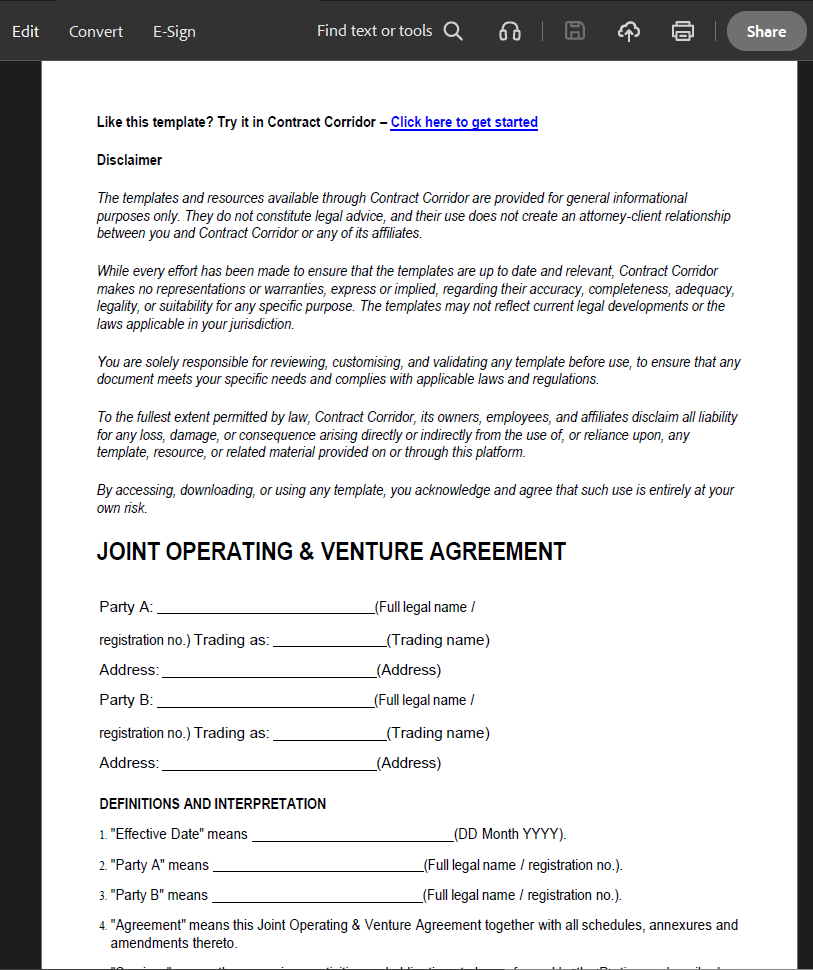
The templates and resources available through Contract Corridor are provided for general informational purposes only. They do not constitute legal advice, and their use does not create an attorney-client relationship between you and Contract Corridor or any of its affiliates.
While every effort has been made to ensure that the templates are up to date and relevant, Contract Corridor makes no representations or warranties, express or implied, regarding their accuracy, completeness, adequacy, legality, or suitability for any specific purpose. The templates may not reflect current legal developments or the laws applicable in your jurisdiction.
You are solely responsible for reviewing, customising, and validating any template before use, to ensure that any document meets your specific needs and complies with applicable laws and regulations.
To the fullest extent permitted by law, Contract Corridor, its owners, employees, and affiliates disclaim all liability for any loss, damage, or consequence arising directly or indirectly from the use of, or reliance upon, any template, resource, or related material provided on or through this platform.
By accessing, downloading, or using any template, you acknowledge and agree that such use is entirely at your own risk.
Contract Corridor Contract Templates