
Internship Agreement
Essential Protections for Your Growing Team
Introduction
Imagine hiring a talented student only to face a lawsuit over intellectual property months later. Many companies skip formal paperwork for temporary staff. However, a handshake protects neither the company nor the student. In fact, legal disputes over unpaid work have increased by 20% in the last decade.
Therefore, you must formalize every professional relationship. You will learn how to create a solid internship agreement in this guide. We will cover legal requirements, essential clauses, and best practices. Contract Corridor helps teams manage these documents with ease. Our platform ensures your interns start their journey with clear expectations and proper legal safeguards.
Quick Answer Summary
An internship agreement is a legal document that defines the relationship between a company and an intern. It outlines work responsibilities, compensation, and confidentiality rules to protect both parties. By using a formal contract, organizations prevent legal risks and ensure compliance with labor laws. Effective agreements transform temporary roles into productive learning experiences for everyone involved.
What Is an Internship Agreement?
An internship agreement is a specialized contract that governs a short-term educational work relationship. Unlike a standard employment contract, it emphasizes learning objectives and professional development. Historically, these documents evolved from medieval apprenticeship papers. Back then, masters and pupils signed strict terms for learning a craft.
Today, this document serves as a roadmap for the intern’s tenure. It tells the intern exactly what they will do and what they will learn. Specifically, an internship agreement acts as a legal shield that defines the intern’s status as a non-employee or temporary staff member. Within the broader contract management landscape, these agreements require careful tracking. Since they often have short durations, companies must monitor their start and end dates closely.
Furthermore, these documents clearly state whether the role provides a salary or college credit. If you use a sample internship agreement, you must customize it to your local labor laws. This ensures the document remains enforceable in court. As a result, both the business and the student feel secure during the term.
Why It Matters
Getting your paperwork right saves your company from massive financial headaches. Without a written intern agreement, the lines between an employee and a trainee become blurry. This confusion often leads to wage claims or tax penalties. Additionally, you might lose ownership of work created by the intern if you do not have a signed contract.
Impact of Proper Documentation:
- 65% of companies without formal contracts report higher turnover among temporary staff.
- Average legal costs for a single labor dispute can exceed $50,000 for small businesses.
- Organizations with clear training goals see a 30% increase in intern productivity.
Operational efficiency also improves when you use a standardized internship contract template. Leaders can hire faster when they have a ready-to-go process. Moreover, clear terms reduce the time HR spends answering basic questions about hours or pay. Finally, these documents protect your brand reputation by showing you value fair and professional standards.
Key Components & Elements
A strong document must contain specific sections to provide full protection. You should include these elements in every internship template you create for your office.
- Learning Objectives: Describe the specific skills the student will gain during their time with your team.
- Compensation Details: Clearly state the hourly rate or explain why the role is unpaid based on legal criteria.
- Duration and Schedule: Define the start date, the end date, and the expected weekly hours to avoid overtime issues.
- Confidentiality: Include a clause that prevents the intern from sharing sensitive company data or trade secrets.
- Intellectual Property: Ensure the company owns any designs, code, or reports the intern creates.
- Termination Clause: Explain how either party can end the relationship before the scheduled completion date.
- Supervision: Name the specific manager who will provide guidance and evaluate the intern’s performance.
Types & Categories
Not all internships are the same. You must choose the right format based on your goals and the intern’s status. The following table compares common structures.
| Type | Description | Best For | Key Consideration |
|---|---|---|---|
| Paid Internship | Provides a regular hourly wage or a fixed monthly stipend. | Competitive talent acquisition. | Must comply with minimum wage laws. |
| Academic Credit | The student receives school credit instead of financial payment. | University partnerships. | Requires coordination with school advisors. |
| Unpaid (Non-Profit) | Voluntary work for charities or government entities. | Civic engagement. | Limited to specific tax-exempt groups. |
| Remote Internship | All work happens through digital tools and video calls. | Tech and creative roles. | Needs strong data security rules. |
Step-by-Step Implementation Guide
Follow these steps to launch a successful program using a reliable intern contract. This process ensures you meet all legal and professional standards.
- Review Labor Laws: Research the local and federal rules for interns in your specific region. This matters because laws change frequently. Pro tip: Always check the latest Department of Labor "Primary Beneficiary Test."
- Draft the Document: Use a high-quality internship contract agreement template to build your first version. This provides a professional structure. Pro tip: Keep the language simple so the student understands their rights.
- Define the Role: Collaborate with department heads to list actual tasks and learning goals. This prevents the intern from doing only "busy work." Pro tip: Set three main goals the intern should achieve.
- Send for Signature: Distribute the document through a secure digital platform for electronic signing. This creates a digital audit trail. Pro tip: Send the document at least two weeks before the start date.
- Conduct Orientation: Review the signed agreement with the intern on their first day. This reinforces the rules and expectations. Pro tip: Give the intern a copy for their own records.
Common Mistakes & How to Avoid Them
Many managers make simple errors that lead to big problems. Use this list to stay on the right track when you manage an internship agreement contract.
| Mistake | Why It Happens | How to Fix It |
|---|---|---|
| Replacing employees | Companies try to save money on labor costs. | Ensure interns augment staff rather than replace them. |
| Vague job duties | Managers are too busy to write a full description. | List specific projects in the internship agreement example. |
| Ignoring IP rights | Teams assume they own everything by default. | Include a specific clause for work product ownership. |
| No end date | The contract is copied from a full-time offer letter. | Set a firm expiration date for the term. |
The most important thing to remember is that an intern should never do the work of a regular staff member without pay. Always ensure the "primary beneficiary" of the relationship is the student, not the company.
Industry Examples & Use Cases
Different sectors use these documents in unique ways. Review these scenarios to see how a sample internship contract agreement works in the real world.
Technology: A software startup hires a coding intern. Their agreement specifies that the company owns all code written. Therefore, the startup can safely launch the new feature. As a result, the intern gains experience with professional version control systems.
Healthcare: A local clinic brings in a pre-med student for shadowing. The internship agreement form emphasizes patient privacy and HIPAA rules. Consequently, the student learns about patient care while the clinic stays legally compliant. Meanwhile, the clinic protects its medical licenses.
Marketing Agency: A firm uses an unpaid internship agreement for a college junior. The document aligns with the school’s requirements for credit hours. In fact, the agency provides weekly mentoring sessions. This ensures the student receives a high-quality education in digital strategy.
Frequently Asked Questions
Can an internship be unpaid?
Yes, but you must meet strict legal criteria. The intern must be the "primary beneficiary" of the arrangement. Usually, this involves academic credit and significant training components.
What is the difference between an intern and an employee?
Interns focus on learning and development within a temporary timeframe. Employees perform essential business operations for an indefinite period. Generally, employees receive full benefits while interns do not.
Do I need an intern template for remote work?
Absolutely. Remote agreements should include extra clauses regarding data security and home office equipment. You must also define how you will track hours virtually.
What should I include in a sample unpaid internship offer letter?
Your letter must clearly state the role is unpaid. It should also detail the educational benefits and the specific dates of the program. Make sure the candidate signs it before they start.
Can I end an internship early?
Yes, if your contract includes a termination clause. Most agreements allow either party to end the relationship with short notice. This provides flexibility if the fit is not right.
How Contract Corridor Helps
Managing multiple temporary roles can become overwhelming. Contract Corridor simplifies this by centralizing your documents in one secure place. Our platform allows you to create an internship contract with just a few clicks. You can store every unpaid intern contract and paid agreement in a searchable library.
First, our automation tools remind you when an internship is about to end. This prevents interns from working past their agreed dates. Second, our clear dashboard shows you exactly which documents still need signatures. This ensures your legal protection is always active. Third, you can customize any unpaid intern agreement to fit your specific department needs.
Ready to professionalize your hiring process? Start using a better internship contract sample today. Visit Contract Corridor to streamline your legal workflow and protect your business growth.

About the Author: Melissa Jooste
Melissa Jooste is the Head of Marketing at Contract Corridor, where she shapes the voice, narrative, and market positioning of a leading contract lifecycle management platform. Recognized for her expertise in contract lifecycle management content, Melissa is known for producing insightful, high-impact thought leadership that challenges conventional approaches to contract management. Her work goes beyond surface-level marketing, offering clear, strategic perspectives on how organizations can unlock value, reduce risk, and gain control through more effective contract lifecycle practices. Her writing is widely valued for its clarity, depth, and relevance, bridging complex legal, financial, and operational concepts into content that is both accessible and commercially meaningful. By combining strong storytelling with data-driven insight, she consistently delivers content that resonates with senior business leaders, legal professionals, and operational teams alike. Through her work, Melissa plays a key role in establishing Contract Corridor as a leading voice in the contract lifecycle management space, shaping how organizations think about contracts, not as static documents, but as dynamic drivers of business performance.
Connect on LinkedIn
About the reviewer: Jenna Kretzmer
Jenna Kretzmer, CA(SA) is an Executive at Contract Corridor, where she plays a key role in shaping the strategic direction and market positioning of a leading contract lifecycle management platform. A global executive with over a decade of experience, Jenna has led large-scale, international operations and driven growth, transformation, and market expansion across multiple regions. She is recognized for her ability to operate at the intersection of strategy, execution, and commercial performance. Jenna is a leading voice in the contract lifecycle management space, known for her perspectives on contract governance, revenue optimization, and operational efficiency. Her work challenges traditional approaches to contract management, advocating for a shift toward greater visibility, accountability, and value realization across the entire contract lifecycle. She is driving Contract Corridor to enable organizations to move beyond static contract storage toward proactive, value-led contract management, where contracts are treated not as legal documents, but as dynamic instruments that drive measurable business outcomes.
Connect on LinkedInInternship Agreement
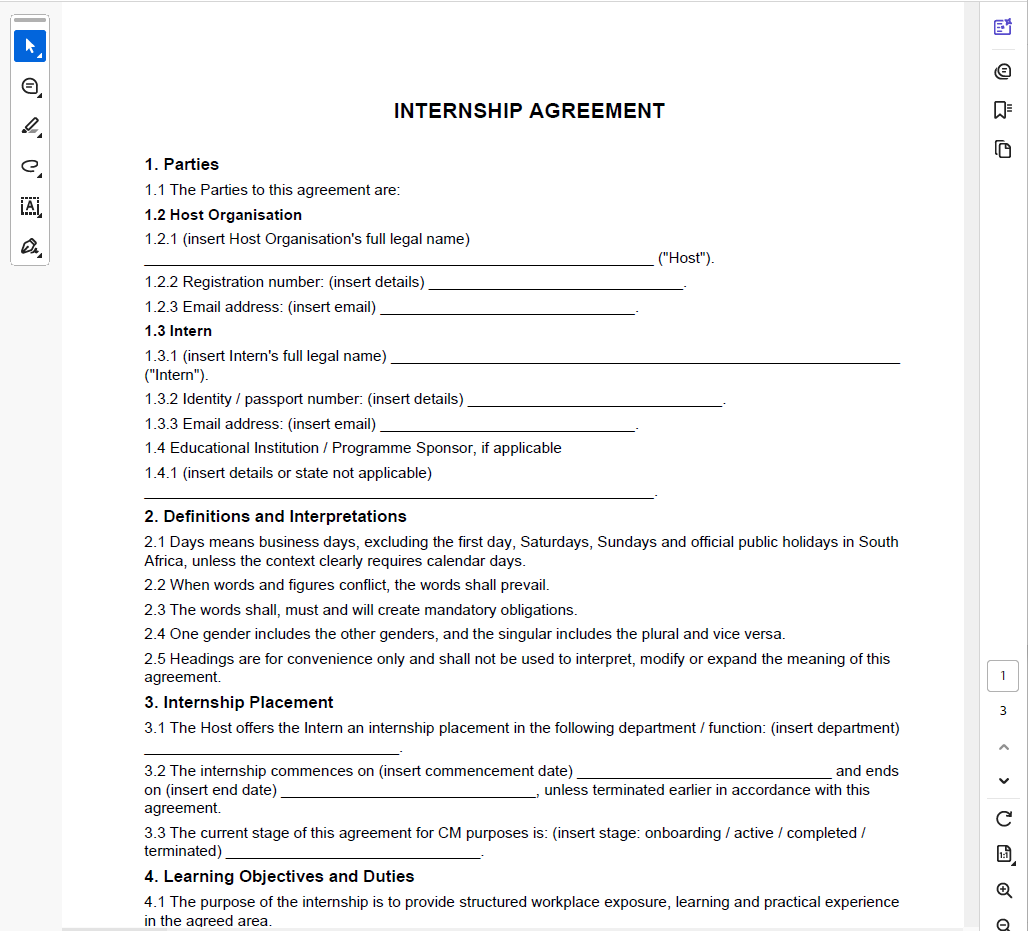
The templates and resources available through Contract Corridor are provided for general informational purposes only. They do not constitute legal advice, and their use does not create an attorney-client relationship between you and Contract Corridor or any of its affiliates.
While every effort has been made to ensure that the templates are up to date and relevant, Contract Corridor makes no representations or warranties, express or implied, regarding their accuracy, completeness, adequacy, legality, or suitability for any specific purpose. The templates may not reflect current legal developments or the laws applicable in your jurisdiction.
You are solely responsible for reviewing, customising, and validating any template before use, to ensure that any document meets your specific needs and complies with applicable laws and regulations.
To the fullest extent permitted by law, Contract Corridor, its owners, employees, and affiliates disclaim all liability for any loss, damage, or consequence arising directly or indirectly from the use of, or reliance upon, any template, resource, or related material provided on or through this platform.
By accessing, downloading, or using any template, you acknowledge and agree that such use is entirely at your own risk.
Contract Corridor Contract Templates