
Memorandum Of Understanding Mou
Strengthening Partnerships Through Clear Communication
Introduction
Imagine two companies want to work together on a major project. They are not ready for a strict legal fight, but they need a shared plan. This scenario happens every day in global business. In fact, many successful billion-dollar ventures started with just a simple handshake and a written outline. Specifically, this outline clarifies what each side expects before they sign a final deal. Using Contract Corridor helps teams track these early agreements easily. In this article, you will learn the definition of mou and how it differs from a standard contract. We will look at the memorandum of understanding mou to see how it protects your interests. By the end, you will know exactly when to use this specific document.Quick Answer Summary
What Is a Memorandum Of Understanding?
The term refers to a preliminary document used in business and government settings. People often wonder what is a memorandum of understanding when they start a new partnership. Essentially, it is a "gentleman’s agreement" written down. The meaning of mou centers on the "meeting of the minds." It shows that all sides agree on a path forward. In the world of paperwork, this document sits between a verbal talk and a legal contract. It carries more weight than a lunch meeting but less than a signed purchase order. Furthermore, the document of understanding definition emphasizes intent over strict obligation. It describes the m o u meaning as a bridge. This bridge connects the initial idea to the final legal execution. If you ask what is mou, think of it as a foundation for a future house. It defines the shape, but you cannot move in quite yet.Why It Matters
Using these documents correctly can save your company from expensive legal battles. Many partners jump into work without clear goals. This often leads to missed deadlines or budget overruns. However, a well-written draft prevents these issues by putting everyone on the same page.Key Business Impact
- Cost Savings: Organizations spend 30% less on legal fees when they use an mou memorandum of understanding to resolve details early.
- Speed: Teams conclude final contracts 40% faster after they sign an initial agreement of understanding.
- Conflict Reduction: Clearly defined roles reduce project disputes by nearly half.
Key Components & Elements
Every solid draft needs specific sections to be effective. Even if it is not a "contract," it should look professional and cover the basics.- Identification of Parties: You must list the legal names of everyone involved.
- Intent and Purpose: This section defines what is mou in business for your specific project.
- Roles and Responsibilities: Explain exactly what work each person or company will perform.
- Timeline: Include start dates, end dates, and major milestones.
- Confidentiality: Protect your secrets by adding a clause about private information.
- Termination: Explain how someone can leave the agreement if things go wrong.
- Signatures: Even a non-binding m o u requires signatures to show commitment.
Types & Categories
Not every agreement looks the same. Depending on your industry, the structure might change. Note how the mou long form differs from a simple letter of intent.| Type | Description | Best For | Key Consideration |
|---|---|---|---|
| Business Partnership | Focuses on joint ventures or sales. | Two companies starting a pilot. | mou meaning in business context. |
| Public Agency | Used by government offices. | Sharing data between departments. | memorandum of understanding army style. |
| Academic | Research or student exchanges. | Two universities sharing a lab. | Intellectual property rights. | |
Step-by-Step Implementation Guide
Creating one of these documents does not have to be hard. Follow these steps to ensure you create a reliable memo understanding.- Initial Discussion: Meet with the other side to talk about big goals. Why do you want to work together?
Pro Tip: Take detailed notes during this meeting to use as your outline later. - Draft the Scope: Write down the specific actions each side will take. Avoid vague language like "we will help each other."
Pro Tip: Use bullet points to make the duties clear and easy to read. - Set the Legal Status: Decide if you want this to be binding or non-binding. Most of these documents are non-binding.
Pro Tip: Explicitly state "This document is not a legally binding contract" to avoid confusion. - Legal Review: Have a professional look at the draft. They check if the memorandum of understanding legal language protects you.
Pro Tip: Check for any hidden traps that might accidentally create a binding deal. - Final Signature: Gather all parties to sign the document. Store a digital copy in a safe place.
Pro Tip: Use a management tool to set alerts for the document’s expiration date.
Common Mistakes & How to Avoid Them
Many people treat these documents too casually. Consequently, they run into trouble when the project hits a snag.| Mistake | Why It Happens | How to Fix It |
|---|---|---|
| Vague Language | Parties want to stay "flexible." | Use specific dates and numbers for all tasks. |
| Accidental Binding | Using words like "shall" or "must." | Use words like "intend to" or "plan to." |
| No Exit Strategy | Thinking nothing will go wrong. | Add a simple clause for ending the deal. |
| Losing the File | Poor organization habits. | Use a digital storage system like Contract Corridor. |
Always clarify if the document is meant to be a binding contract or a non-binding roadmap. This one step prevents 90% of future legal headaches.
Industry Examples & Use Cases
How does this work in the real world? Here are three scenarios where these agreements make a difference. **The Tech Startup and the Giant** A small software firm wants to integrate with a major cloud provider. They sign an mou memorandum of to start sharing API access. The giant company stays safe because they have not promised a permanent partnership yet. The startup gains a clear path to follow for development. **Healthcare Shared Services** Two hospitals decide to share an expensive MRI machine. They use an agreement of understanding contract to define the schedule. It lists who pays for maintenance and how to handle insurance. This avoids a messy full contract while they test the shared service. **Construction Sub-Contractors** A builder wants to work with a specific plumber for a city project. They sign a memorandum of undertaking meaning they will work together if they win the bid. Once the city awards the project, they upgrade to a formal mou contract agreement.Frequently Asked Questions
Are memorandum of understanding legally binding?
Usually, they are not legally binding. However, some sections like confidentiality or non-solicitation can be binding if you write them that way. Always check the specific wording in your document.
What does mou stand for in a business context?
It stands for Memorandum of Understanding. In business, it signifies a non-binding agreement where parties outline their mutual goals and plans for a future official contract.
What is the difference between mou and moa?
An MOA stands for Memorandum of Agreement. It is often more specific and a bit more formal than an MOU, sometimes carrying more legal weight depending on the jurisdiction.
When should I use a memorandum of understanding vs contract?
Use an MOU during the negotiation phase or when money is not changing hands yet. Switch to a contract when you need a legally enforceable guarantee and full commitment from both sides.
How Contract Corridor Helps
Managing a memorandum of understanding mou is much easier with the right tools. Contract Corridor streamlines your entire workflow so you never miss a detail. First, our platform provides templates for every type of mou business agreement. You do not have to start from zero every time you meet a new partner. Second, we offer central storage for all your memoranda of understanding. This means your team can find any document in seconds, even years later. Finally, our automated alerts tell you when an agreement is about to expire. This helps you decide if you should move to a full contract or end the partnership. Use Contract Corridor to transform your messy folders into a professional, organized system today.
About the Author: Melissa Jooste
Melissa Jooste is the Head of Marketing at Contract Corridor, where she shapes the voice, narrative, and market positioning of a leading contract lifecycle management platform. Recognized for her expertise in contract lifecycle management content, Melissa is known for producing insightful, high-impact thought leadership that challenges conventional approaches to contract management. Her work goes beyond surface-level marketing, offering clear, strategic perspectives on how organizations can unlock value, reduce risk, and gain control through more effective contract lifecycle practices. Her writing is widely valued for its clarity, depth, and relevance, bridging complex legal, financial, and operational concepts into content that is both accessible and commercially meaningful. By combining strong storytelling with data-driven insight, she consistently delivers content that resonates with senior business leaders, legal professionals, and operational teams alike. Through her work, Melissa plays a key role in establishing Contract Corridor as a leading voice in the contract lifecycle management space, shaping how organizations think about contracts, not as static documents, but as dynamic drivers of business performance.
Connect on LinkedIn
About the reviewer: Jenna Kretzmer
Jenna Kretzmer, CA(SA) is an Executive at Contract Corridor, where she plays a key role in shaping the strategic direction and market positioning of a leading contract lifecycle management platform. A global executive with over a decade of experience, Jenna has led large-scale, international operations and driven growth, transformation, and market expansion across multiple regions. She is recognized for her ability to operate at the intersection of strategy, execution, and commercial performance. Jenna is a leading voice in the contract lifecycle management space, known for her perspectives on contract governance, revenue optimization, and operational efficiency. Her work challenges traditional approaches to contract management, advocating for a shift toward greater visibility, accountability, and value realization across the entire contract lifecycle. She is driving Contract Corridor to enable organizations to move beyond static contract storage toward proactive, value-led contract management, where contracts are treated not as legal documents, but as dynamic instruments that drive measurable business outcomes.
Connect on LinkedInMemorandum of Understanding
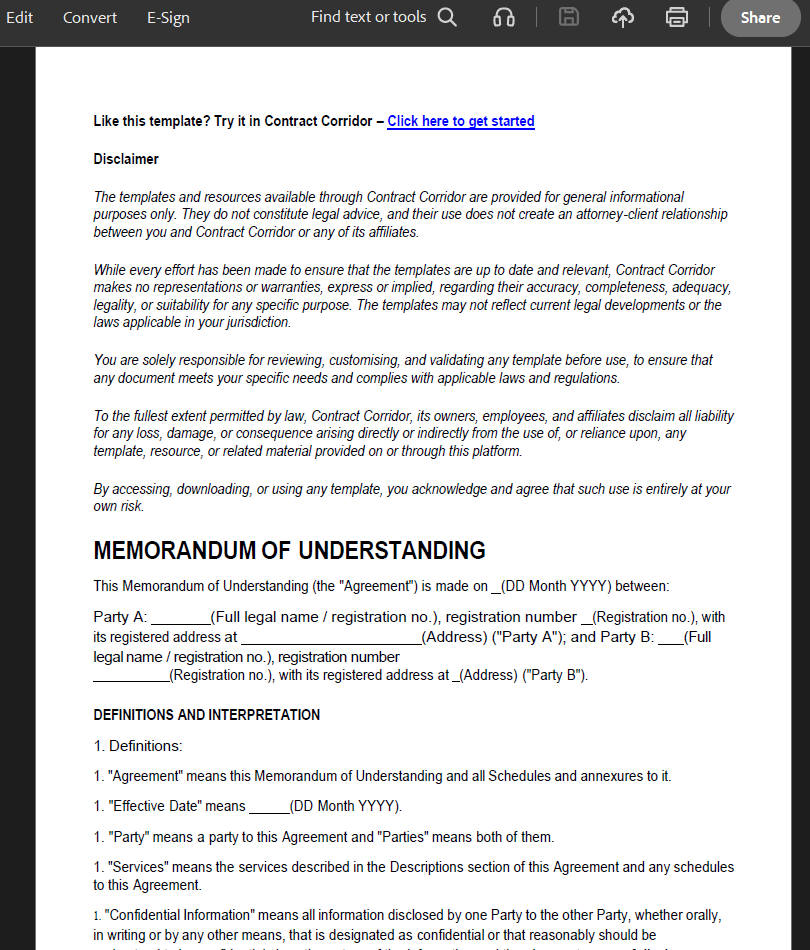
The templates and resources available through Contract Corridor are provided for general informational purposes only. They do not constitute legal advice, and their use does not create an attorney-client relationship between you and Contract Corridor or any of its affiliates.
While every effort has been made to ensure that the templates are up to date and relevant, Contract Corridor makes no representations or warranties, express or implied, regarding their accuracy, completeness, adequacy, legality, or suitability for any specific purpose. The templates may not reflect current legal developments or the laws applicable in your jurisdiction.
You are solely responsible for reviewing, customising, and validating any template before use, to ensure that any document meets your specific needs and complies with applicable laws and regulations.
To the fullest extent permitted by law, Contract Corridor, its owners, employees, and affiliates disclaim all liability for any loss, damage, or consequence arising directly or indirectly from the use of, or reliance upon, any template, resource, or related material provided on or through this platform.
By accessing, downloading, or using any template, you acknowledge and agree that such use is entirely at your own risk.
Contract Corridor Contract Templates