
Business Associate Agreement Baa
Ensuring Privacy and Compliance in Your Data Partnerships
Introduction
Imagine a vendor accidentally leaks thousands of patient medical records. Because you shared the data, federal regulators hold your company responsible. This scenario happens every day to businesses that fail to secure their partnerships. Protect your organization by understanding the Business Associate Agreement Baa and its legal role. Contract Corridor helps teams navigate these complex legal requirements with ease. Specifically, we provide the tools to track every hippa baa throughout its entire lifecycle. In this guide, you will learn why these documents are vital. We will also show you how to manage them effectively to prevent massive fines.Quick Answer Summary
What Is a Business Associate Agreement Baa?
A business associate agreement definition focuses on the protection of sensitive health data. Basically, it is a contract that binds a service provider to follow federal privacy rules. If a company handles protected health information (PHI) for a medical entity, they become a business associate. Therefore, they must follow specific security standards. The term baa acronym stands for Business Associate Agreement. In the broader contract management landscape, this document acts as a safety net. It transfers risk and sets clear expectations for data handling. Moreover, what is a baa agreement often involves clarifying who can access data and why. Without this document, both parties face significant legal danger under healthcare regulations.Why It Matters
Getting your vendor contracts right protects your company from financial ruin. For example, civil penalties for non-compliance can reach millions of dollars per year. Furthermore, the government can prosecute individuals for criminal negligence if they ignore these rules. A business associate contract hipaa helps you avoid these harsh outcomes.Impact of Data Breaches:
- Average cost of a healthcare data breach: $10.9 million.
- Percentage of breaches caused by third-party vendors: Over 40%.
- Maximum annual fine for HIPAA violations: $1.9 million per provision.
Key Components & Elements
Every hipaa compliance baa must contain specific legal safeguards. Federal law requires these sections to be present for the contract to be valid.- Permitted Uses: This section explains exactly how the vendor can use the health data they receive.
- Security Safeguards: It lists the physical and digital tools the vendor will use to protect privacy.
- Breach Notification: The vendor must agree to report any data leaks to you within a specific timeframe.
- Subcontractor Limits: This clause ensures that any subcontractors also follow the same strict privacy rules.
- Access Rights: It defines how patients can see or change their own records held by the vendor.
- Termination Clause: This explains how to return or destroy data once the partnership ends.
Types & Categories
Different vendors require different levels of oversight. Use this table to understand which approach fits your specific professional business associates.| Type | Description | Best For | Key Consideration |
|---|---|---|---|
| Standard BAA | A general template following basic federal rules. | Software vendors and cloud storage providers. | Low cost but lacks specific industry details. |
| Service-Specific BAA | Customized for a specific function like billing. | Medical billing firms or legal consultants. | Higher protection for specialized data workflows. |
| Subcontractor BAA | Extends rules from one associate to another. | Vendors who hire outside help for IT support. | Essential for maintaining a chain of trust. |
Step-by-Step Implementation Guide
Follow these steps to ensure your organization stays baa compliant at all times.- Identify Your Associates: List every vendor that sees or stores your patient data. This helps you know when is a business associate agreement required.
- Draft a Custom Template: Use a baa template that includes your specific security needs. Do not just use a random form you found online.
- Conduct a Security Review: Check the vendor's digital defenses before you sign a baa. This confirms they can actually keep their promises.
- Execute the Agreement: Ensure both parties provide what is associate signature on the final document. A signed baa is only valid once it has all required signatures.
- Store and Monitor: Keep a copy of every baa agreement in a central location. Review them once a year to keep up with changing laws.
Common Mistakes & How to Avoid Them
Avoid these pitfalls to keep your hipaa compliance vendor contracts healthcare providers safe from audits.| Mistake | Why It Happens | How to Fix It |
|---|---|---|
| Missing Subcontractors | Forgetting that vendors hire other vendors. | Require your associates to sign baa's with their helpers. |
| Vague Breach Timelines | Using phrases like "reasonable time" instead of "24 hours." | Put exact hourly or daily deadlines in the contract. |
| No Data Return Plan | Failing to discuss what happens when the job ends. | Include a specific plan for data destruction or return. |
| Ignoring Minor Vendors | Thinking small entities like shredding companies do not count. | Sign a baa document with anyone who touches PHI. |
Always remember: A business associate agreement is not just a formality. It is your primary defense against federal fines and lawsuits.
Industry Examples & Use Cases
The following scenarios show how a baa agreement hipaa works in the real world. Scenario 1: Cloud Storage A local clinic moves their records to a digital cloud provider. Before moving any files, they sign a hipaa compliant business associate agreement. Later, the cloud provider experiences a minor hack. Because the contract was in place, the clinic was not legally responsible for the provider's tech failure. Scenario 2: Medical Billing A doctor hires a firm to handle insurance claims. This firm is one of many potential examples of business associates hipaa. The billing firm signs a baa contract meaning they must encrypt all claim data. This protects the doctor if the billing firm leaves a laptop in an unlocked car. Scenario 3: IT Support A hospital uses an IT company to fix their servers. Since the techs might see patient names, they must define baa terms immediately. They sign a business associate contract that limits what the techs can do with the data. This keeps the hospital compliant with baa law.Frequently Asked Questions
What is a baa in healthcare?
It is a contract that ensures third-party vendors protect patient privacy. It allows healthcare providers to share sensitive data safely with outside help.
When is a baa needed?
You need one whenever an outside person or company handles protected health information for you. This includes tech support, lawyers, and billing companies.
What does baa stand for?
The acronym stands for Business Associate Agreement. It refers to the legal document required by federal privacy laws.
What is the purpose of a baa?
The purpose is to hold vendors accountable for data security. It protects the health entity from being held liable for a vendor's mistakes.
What are the baa requirements?
A valid agreement must include permitted uses of data and security rules. It also needs breach notification plans and data destruction steps.
How Contract Corridor Helps
Managing a large volume of hipaa/baa documents can feel overwhelming for any team. Fortunately, Contract Corridor simplifies this process through smart automation and central storage. We provide a single dashboard where you can see every business associate agreement at a glance. First, our platform alerts you when a contract is about to expire. This ensures you never have a gap in your compliance coverage. Second, we make it easy to collect a digital signed baa from your vendors. You can send documents and track signatures in real-time. Finally, our search tools let you find specific clauses across all your baa agreements instantly. Protect your business today and streamline your legal workflow. Use Contract Corridor to transform how you handle every Business Associate Agreement Baa in your system.
About the Author: Melissa Jooste
Melissa Jooste is the Head of Marketing at Contract Corridor, where she shapes the voice, narrative, and market positioning of a leading contract lifecycle management platform. Recognized for her expertise in contract lifecycle management content, Melissa is known for producing insightful, high-impact thought leadership that challenges conventional approaches to contract management. Her work goes beyond surface-level marketing, offering clear, strategic perspectives on how organizations can unlock value, reduce risk, and gain control through more effective contract lifecycle practices. Her writing is widely valued for its clarity, depth, and relevance, bridging complex legal, financial, and operational concepts into content that is both accessible and commercially meaningful. By combining strong storytelling with data-driven insight, she consistently delivers content that resonates with senior business leaders, legal professionals, and operational teams alike. Through her work, Melissa plays a key role in establishing Contract Corridor as a leading voice in the contract lifecycle management space, shaping how organizations think about contracts, not as static documents, but as dynamic drivers of business performance.
Connect on LinkedIn
About the reviewer: Jenna Kretzmer
Jenna Kretzmer, CA(SA) is an Executive at Contract Corridor, where she plays a key role in shaping the strategic direction and market positioning of a leading contract lifecycle management platform. A global executive with over a decade of experience, Jenna has led large-scale, international operations and driven growth, transformation, and market expansion across multiple regions. She is recognized for her ability to operate at the intersection of strategy, execution, and commercial performance. Jenna is a leading voice in the contract lifecycle management space, known for her perspectives on contract governance, revenue optimization, and operational efficiency. Her work challenges traditional approaches to contract management, advocating for a shift toward greater visibility, accountability, and value realization across the entire contract lifecycle. She is driving Contract Corridor to enable organizations to move beyond static contract storage toward proactive, value-led contract management, where contracts are treated not as legal documents, but as dynamic instruments that drive measurable business outcomes.
Connect on LinkedInBusiness Associate Agreement
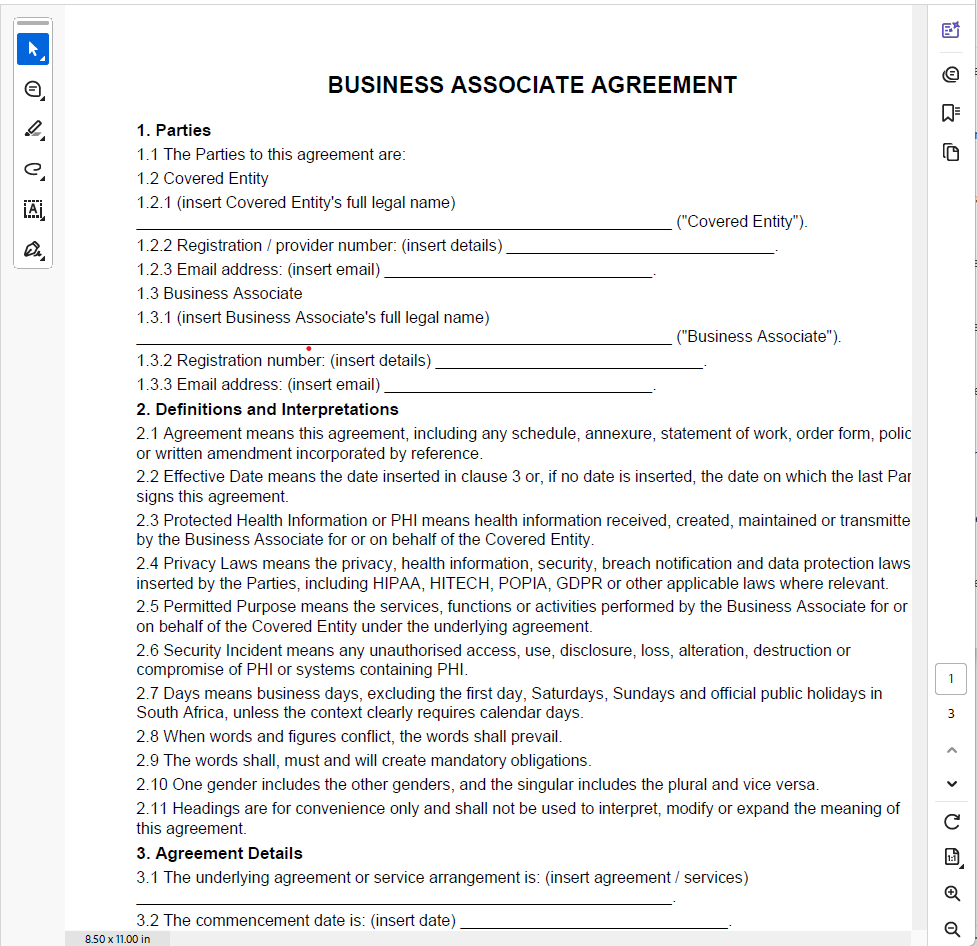
The templates and resources available through Contract Corridor are provided for general informational purposes only. They do not constitute legal advice, and their use does not create an attorney-client relationship between you and Contract Corridor or any of its affiliates.
While every effort has been made to ensure that the templates are up to date and relevant, Contract Corridor makes no representations or warranties, express or implied, regarding their accuracy, completeness, adequacy, legality, or suitability for any specific purpose. The templates may not reflect current legal developments or the laws applicable in your jurisdiction.
You are solely responsible for reviewing, customising, and validating any template before use, to ensure that any document meets your specific needs and complies with applicable laws and regulations.
To the fullest extent permitted by law, Contract Corridor, its owners, employees, and affiliates disclaim all liability for any loss, damage, or consequence arising directly or indirectly from the use of, or reliance upon, any template, resource, or related material provided on or through this platform.
By accessing, downloading, or using any template, you acknowledge and agree that such use is entirely at your own risk.
Contract Corridor Contract Templates