
Data Use Agreementnew
A Practical Guide to Protecting Your Information Assets
Introduction
In many modern businesses, data is more valuable than gold. However, sharing that data carries huge risks. One small leak can cost millions of dollars in fines or lost secrets. Companies must control how others handle their proprietary information. You need a solid Data Use Agreementnew to set clear ground rules for everyone involved.
Specifically, this article teaches you how to draft and manage these vital legal documents. At Contract Corridor, we help teams simplify their most complex paperwork. In this guide, you will learn about essential clauses and common pitfalls. We will also provide tips to keep your digital assets safe. By the end, you will know exactly how to protect your organization's future.
Quick Answer Summary
A data usage agreement is a legal contract between two parties that describes how information may be used. It defines who owns the data, how it must be protected, and when it must be destroyed. These documents prevent unauthorized sharing and ensure compliance with privacy laws. Organizations use them to maintain control over shared datasets while meeting legal safety requirements.
What Is This Document?
A data use agreement functions as a binding contract. It governs the transfer and use of non-public datasets between organizations. Managers often use this document when sharing information for research, marketing, or operations. In fact, most modern data sharing requires data use agreements to satisfy legal regulators.
Historically, these agreements grew out of Intellectual Property law. They ensure that the person receiving the data does not become the owner. Furthermore, the document limits the recipient to specific activities. For example, a marketing firm might only have permission to analyze trends without identifying individuals. This level of control is vital in the digital age. It protects privacy and preserves business advantages.
Why It Matters
Ignoring these rules leads to disaster. Without a clear contract, you have no recourse if someone leaks your secrets. Therefore, legal teams prioritize these documents to avoid lawsuits. Also, global privacy laws demand strict oversight of data transfers. Failing to comply can result in massive government penalties.
Statistical Snapshot:
- Data breaches cost companies an average of $4.45 million per incident.
- Over 60% of data leaks involve third-party partners or vendors.
- Regulatory fines for privacy violations can reach 4% of a company's global revenue.
In addition to legal safety, these contracts improve operational clarity. They tell employees exactly what they can and cannot do. Consequently, this reduces confusion between departments. When everyone follows the same data use agreement template, security becomes part of the daily workflow.
Key Components & Elements
Effective usage agreements share several common parts. Each section serves a different purpose for your legal protection.
- Scope of Use: This defines the specific tasks the recipient can perform with the information.
- Security Requirements: It lists the technical steps the user must take to keep files safe, like encryption.
- Period of Performance: This section sets a clear start and end date for information access.
- Data Destruction: It explains how the user must delete or return files once the project finishes.
- Breach Notification: This clause requires the user to tell you immediately if a leak occurs.
- Ownership Rights: It confirms that you retain all rights to the original information provided.
Types & Categories
Different situations require different approaches. Use this table to decide which framework fits your needs.
| Type | Description | Best For | Key Consideration |
|---|---|---|---|
| Research Agreement | Focuses on academic or scientific discovery. | Universities and Labs | Publication rights |
| Commercial Agreement | Governs data for profit-driven projects. | Software and SaaS | Revenue sharing |
| Health Data Agreement | Strict rules for medical records. | Hospitals and Clinics | HIPAA compliance |
| Internal Agreement | Rules for data moving between branches. | Global Corporations | Cross-border laws |
Step-by-Step Implementation Guide
Following a clear process ensures you do not miss anything important. Use these steps to launch your next agreement.
- Identify the Data: List every file and database you plan to share. Pro tip: Always classify data by sensitivity level before sharing.
- Select a User Agreement Template: Start with a pre-approved legal form to save time. Pro tip: Ensure your legal team reviews any template before its first use.
- Define the Purpose: Write a clear description of why the recipient needs this information. Pro tip: Be very specific to prevent "scope creep" later.
- Set Security Standards: Demand specific protective measures like password policies or secure servers. Pro tip: Ask for proof of security audits from the recipient.
- Execute the Document: Gather signatures from authorized representatives on both sides. Pro tip: Use digital signatures to track the exact time of signing.
- Audit Compliance: Check in periodically to ensure the recipient follows the rules. Pro tip: Set a calendar reminder to confirm data destruction at the end of the term.
Common Mistakes & How to Avoid Them
Many teams make simple errors that lead to big problems. Use this table to spot risks early.
| Mistake | Why It Happens | How to Fix It |
|---|---|---|
| Vague definitions | Rushing the drafting process. | Define every technical term clearly. |
| No end date | Assuming the project is permanent. | Always include a termination clause. |
| Skipping audits | Trusting partners too much. | Schedule regular security checks. |
| Ignoring local laws | Using a "one size fits all" form. | Check laws for the user's location. |
The most important thing to remember is that data cannot be unshared. Once it leaves your server, your contract is your only shield.
Industry Examples & Use Cases
Seeing these documents in action helps clarify their value. Here are four scenarios across different sectors.
Healthcare Scenario: A hospital shares patient records with a university for a heart disease study. They use a sample data use agreement to ensure the university removes all names. As a result, the researchers get the data they need while patients stay anonymous.
Finance Scenario: A bank provides transaction history to a fintech startup. The startup uses a user agreement sample to promise they will only use the data to build a budgeting tool. This prevents the startup from selling the data to third-party advertisers.
Technology Scenario: A software company hires a vendor to test their new AI model. They provide a user agreement template that forbids the vendor from copying the code. Consequently, the company keeps its trade secrets safe while improving its product.
Retail Scenario: A grocery chain shares loyalty card data with a logistics firm. They look at a user agreement example to draft a clause about data storage locations. This ensures the data stays within their home country to avoid legal issues.
Frequently Asked Questions
What is the difference between a privacy policy and a usage agreement?
A privacy policy tells customers how you handle their personal information. In contrast, an agreement between two businesses sets legal rules for sharing that information between them.
Do I need a lawyer for a sample use agreement?
While you can start with a sample, a lawyer should always review the final draft. Specifically, they ensure the document matches the laws in your specific region and industry.
Can I find user agreement examples online for free?
Yes, many government agencies and universities provide free examples online. However, generic forms may not cover your specific business risks or technical requirements.
What happens if someone breaks a data usage agreement?
Usually, the injured party can sue for damages or end the partnership immediately. Some contracts also include specific financial penalties for every day the data remains at risk.
How Contract Corridor Helps
Contract Corridor simplifies the way your team handles sensitive documents. First, our platform centralizes all your legal forms in one secure place. This ensures everyone uses the latest usage agreement and avoids outdated versions. Second, we offer automated workflows to speed up the approval process. You can move from a draft to a signed document in minutes rather than days.
Third, our tracking tools remind you when agreements are about to expire. You never have to worry about data staying with a vendor longer than allowed. Finally, our intuitive search features help you find specific clauses across hundreds of files instantly. Stop struggling with disorganized folders and risky manual processes. Let Contract Corridor protect your data and save your team time today.

About the Author: Melissa Jooste
Melissa Jooste is the Head of Marketing at Contract Corridor, where she shapes the voice, narrative, and market positioning of a leading contract lifecycle management platform. Recognized for her expertise in contract lifecycle management content, Melissa is known for producing insightful, high-impact thought leadership that challenges conventional approaches to contract management. Her work goes beyond surface-level marketing, offering clear, strategic perspectives on how organizations can unlock value, reduce risk, and gain control through more effective contract lifecycle practices. Her writing is widely valued for its clarity, depth, and relevance, bridging complex legal, financial, and operational concepts into content that is both accessible and commercially meaningful. By combining strong storytelling with data-driven insight, she consistently delivers content that resonates with senior business leaders, legal professionals, and operational teams alike. Through her work, Melissa plays a key role in establishing Contract Corridor as a leading voice in the contract lifecycle management space, shaping how organizations think about contracts, not as static documents, but as dynamic drivers of business performance.
Connect on LinkedIn
About the reviewer: Jenna Kretzmer
Jenna Kretzmer, CA(SA) is an Executive at Contract Corridor, where she plays a key role in shaping the strategic direction and market positioning of a leading contract lifecycle management platform. A global executive with over a decade of experience, Jenna has led large-scale, international operations and driven growth, transformation, and market expansion across multiple regions. She is recognized for her ability to operate at the intersection of strategy, execution, and commercial performance. Jenna is a leading voice in the contract lifecycle management space, known for her perspectives on contract governance, revenue optimization, and operational efficiency. Her work challenges traditional approaches to contract management, advocating for a shift toward greater visibility, accountability, and value realization across the entire contract lifecycle. She is driving Contract Corridor to enable organizations to move beyond static contract storage toward proactive, value-led contract management, where contracts are treated not as legal documents, but as dynamic instruments that drive measurable business outcomes.
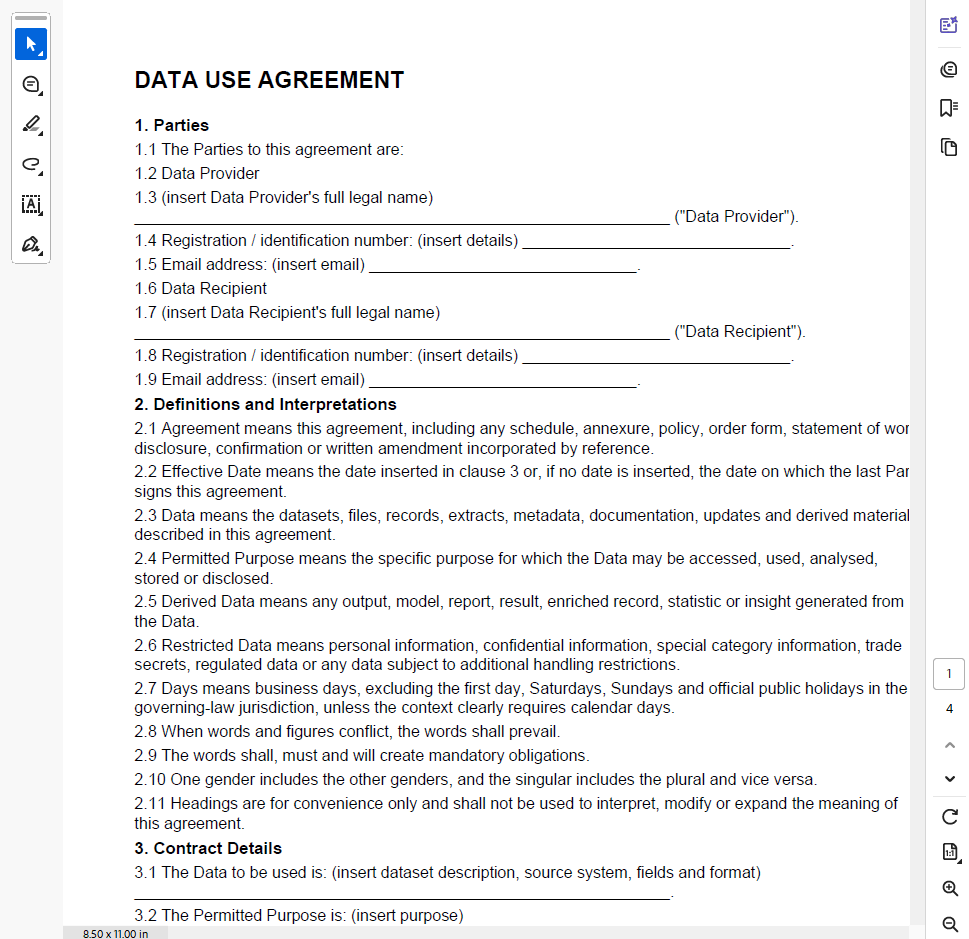
Connect on LinkedInData Use Agreement
The templates and resources available through Contract Corridor are provided for general informational purposes only. They do not constitute legal advice, and their use does not create an attorney-client relationship between you and Contract Corridor or any of its affiliates.
While every effort has been made to ensure that the templates are up to date and relevant, Contract Corridor makes no representations or warranties, express or implied, regarding their accuracy, completeness, adequacy, legality, or suitability for any specific purpose. The templates may not reflect current legal developments or the laws applicable in your jurisdiction.
You are solely responsible for reviewing, customising, and validating any template before use, to ensure that any document meets your specific needs and complies with applicable laws and regulations.
To the fullest extent permitted by law, Contract Corridor, its owners, employees, and affiliates disclaim all liability for any loss, damage, or consequence arising directly or indirectly from the use of, or reliance upon, any template, resource, or related material provided on or through this platform.
By accessing, downloading, or using any template, you acknowledge and agree that such use is entirely at your own risk.
Contract Corridor Contract Templates