
Data Disclosure Agreement
Essential Terms for Secure Information Sharing
Introduction
Modern businesses trade data like currency. However, one small leak can cost a company millions of dollars in fines or lost secrets. Most organizations share sensitive files every day without a clear plan. Thus, savvy leaders use a Data Disclosure Agreement to set firm boundaries.
Specifically, Contract Corridor helps teams organize these vital papers smoothly. In this article, you will learn how to draft these documents correctly. We will cover the essential terms that keep your secrets safe. Additionally, you will discover how to avoid legal traps that many businesses miss. Protecting your digital assets starts with a solid foundation.
Quick Answer Summary
A Data Disclosure Agreement is a legal contract between two parties that describes how they share and protect information. It defines what data they can swap, who can see it, and how they must secure it. Furthermore, it sets penalties if someone breaks these rules. This document prevents the unauthorized use of your private company intelligence.
What Is Data Disclosure Agreement?
This document serves as a roadmap for sharing private info. It is a formal contract that governs the exchange, use, and protection of specific datasets between organizations. Companies often refer to these as disclosure contracts when they talk about broad information sharing.
Historically, businesses used general non-disclosure agreements for everything. But today, digital data requires much more detail. For example, a modern deal must address pixels, bytes, and cloud storage locations. It fits into the broader field of risk management. Therefore, it acts as a gatekeeper for your company's digital perimeter. It ensures that any third party treats your information with the same care as your internal staff.
Why It Matters
Ignoring these rules leads to massive financial risks. If a partner loses your customer list, you face lawsuits and bad press. In fact, many regulators now demand proof of these deals before they allow data transfers.
1. Data breaches cost companies an average of $4.45 million per incident.
2. About 60% of data leaks happen through third-party partners or vendors.
3. Regulators can fine companies up to 4% of global revenue for privacy failures.
Operational efficiency also improves when everyone knows the rules. When you define access early, projects move faster. You avoid long debates about who owns what. Consequently, your team spends less time in court and more time building products.
Key Components & Elements
Every agreement needs specific sections to be effective. Without these details, your protections might fail in court.
- Definition of Data: You must list exactly what information the deal covers. This prevents confusion later.
- Permitted Use: Clearly state why the other party needs the info. They should not use it for anything else.
- Access Controls: Name the specific people or roles allowed to view the files. This limits the "blast radius" if a leak happens.
- Security Standards: List the technical rules the partner must follow. For instance, they might need to use encryption.
- Duration and Disposal: Explain how long the partner can keep the files. Also, specify how they should delete the data when done.
- Breach Notification: Set a strict timeline for reporting a hack. You need to know immediately if your data is at risk.
Types & Categories
Not every deal looks the same. Different situations require different levels of detail.
| Type | Description | Best For | Key Consideration |
|---|---|---|---|
| Mutual | Both sides share and protect data equally. | Strategic Partnerships | Ensuring both parties have similar security. |
| One-Way | Only one side gives data to another. | Vendor Relationships | Focusing heavily on the receiver's duties. |
| Research-Only | Restricts data use to specific academic study. | Universities and Labs | Prohibiting any commercial use. |
Step-by-Step Implementation Guide
Follow these steps to build a strong protection plan today.
- Identify Your Data Assets: List every piece of info you plan to share. Knowing what you have is the first step to protecting it.
Pro Tip: Categorize data by sensitivity level. - Vetting the Partner: Check the other company's security habits. You want to ensure they can actually follow your rules.
Pro Tip: Ask for a security audit report. - Draft the Terms: Write the contract using clear and simple language. Avoid vague phrases that lawyers could twist later.
Pro Tip: Use disclosure contracts as a template to save time. - Sign and Store: Execute the document and keep it in a safe place. Both parties need easy access to the final version.
Pro Tip: Keep a digital copy in a central management system. - Monitor Compliance: Check in with the partner regularly. Verify they still follow the security rules you agreed upon.
Pro Tip: Schedule a brief check-up every six months.
Common Mistakes & How to Avoid Them
Many teams make simple errors that ruin their legal standing. Watch out for these four pitfalls.
| Mistake | Why It Happens | How to Fix It |
|---|---|---|
| Being Too Vague | Teams want to move fast. | Use concrete lists of data types. |
| Forgetting Disposal | People focus only on the start. | Require a certificate of destruction. |
| Ignoring Sub-contractors | Parties assume they work alone. | Ban sharing with fourth parties. |
| Missing Deadlines | Contracts sit in drawers. | Use alerts for expiration dates. |
Above all, remember that an agreement is only as good as your ability to enforce it.
Industry Examples & Use Cases
Each industry uses these documents in unique ways. Here are a few scenarios.
Healthcare Scenario: A hospital shares patient records with a software developer. The developer creates an app to track heart rates. The hospital uses a contract to ensure the developer obeys privacy laws. As a result, patient data stays safe and the app works well.
Finance Scenario: A bank sends transaction logs to a fraud detection firm. They sign an agreement to limit the firm's access to account numbers only. Consequently, the firm stops hackers without seeing private customer names.
Retail Scenario: A clothing store gives its email list to a marketing agency. The deal states the agency must delete the list after one month. This protects the store from the agency selling their leads to a rival later.
Frequently Asked Questions
How is this different from an NDA?
A non-disclosure agreement protects all secrets, while this deal focuses specifically on datasets. It includes technical rules that a standard NDA often misses.
Do I need one for my small business?
Yes, any size business should use one when sharing customer or secret data. It protects you from liability and builds trust with your clients.
What happens if a partner loses my data?
If they sign a contract, they must notify you immediately and pay for damages. The document outlines exactly how they should compensate your business.
Can I use a template for these deals?
You can start with a template, but you should customize it for every project. Every data exchange has different risks and requirements.
How Contract Corridor Helps
Managing your protection papers does not have to be hard. Contract Corridor simplifies the entire process for your team. Specifically, it offers tools that keep your documents organized and accessible.
First, the platform centralizes all your disclosure contracts in one cloud location. This means you never lose a signed page again. Second, automated alerts remind you when an agreement is about to expire. You can renew terms before your data protection lapses. Finally, the system allows for easy collaboration between your legal and tech teams. Everyone can see the security requirements in real-time.
In conclusion, a Data Disclosure Agreement is your best defense in a digital world. Start protecting your company’s future today. Visit Contract Corridor to streamline your document management and secure your data exchanges.

About the Author: Melissa Jooste
Melissa Jooste is the Head of Marketing at Contract Corridor, where she shapes the voice, narrative, and market positioning of a leading contract lifecycle management platform. Recognized for her expertise in contract lifecycle management content, Melissa is known for producing insightful, high-impact thought leadership that challenges conventional approaches to contract management. Her work goes beyond surface-level marketing, offering clear, strategic perspectives on how organizations can unlock value, reduce risk, and gain control through more effective contract lifecycle practices. Her writing is widely valued for its clarity, depth, and relevance, bridging complex legal, financial, and operational concepts into content that is both accessible and commercially meaningful. By combining strong storytelling with data-driven insight, she consistently delivers content that resonates with senior business leaders, legal professionals, and operational teams alike. Through her work, Melissa plays a key role in establishing Contract Corridor as a leading voice in the contract lifecycle management space, shaping how organizations think about contracts, not as static documents, but as dynamic drivers of business performance.
Connect on LinkedIn
About the reviewer: Jenna Kretzmer
Jenna Kretzmer, CA(SA) is an Executive at Contract Corridor, where she plays a key role in shaping the strategic direction and market positioning of a leading contract lifecycle management platform. A global executive with over a decade of experience, Jenna has led large-scale, international operations and driven growth, transformation, and market expansion across multiple regions. She is recognized for her ability to operate at the intersection of strategy, execution, and commercial performance. Jenna is a leading voice in the contract lifecycle management space, known for her perspectives on contract governance, revenue optimization, and operational efficiency. Her work challenges traditional approaches to contract management, advocating for a shift toward greater visibility, accountability, and value realization across the entire contract lifecycle. She is driving Contract Corridor to enable organizations to move beyond static contract storage toward proactive, value-led contract management, where contracts are treated not as legal documents, but as dynamic instruments that drive measurable business outcomes.
Connect on LinkedInData Disclosure Agreement
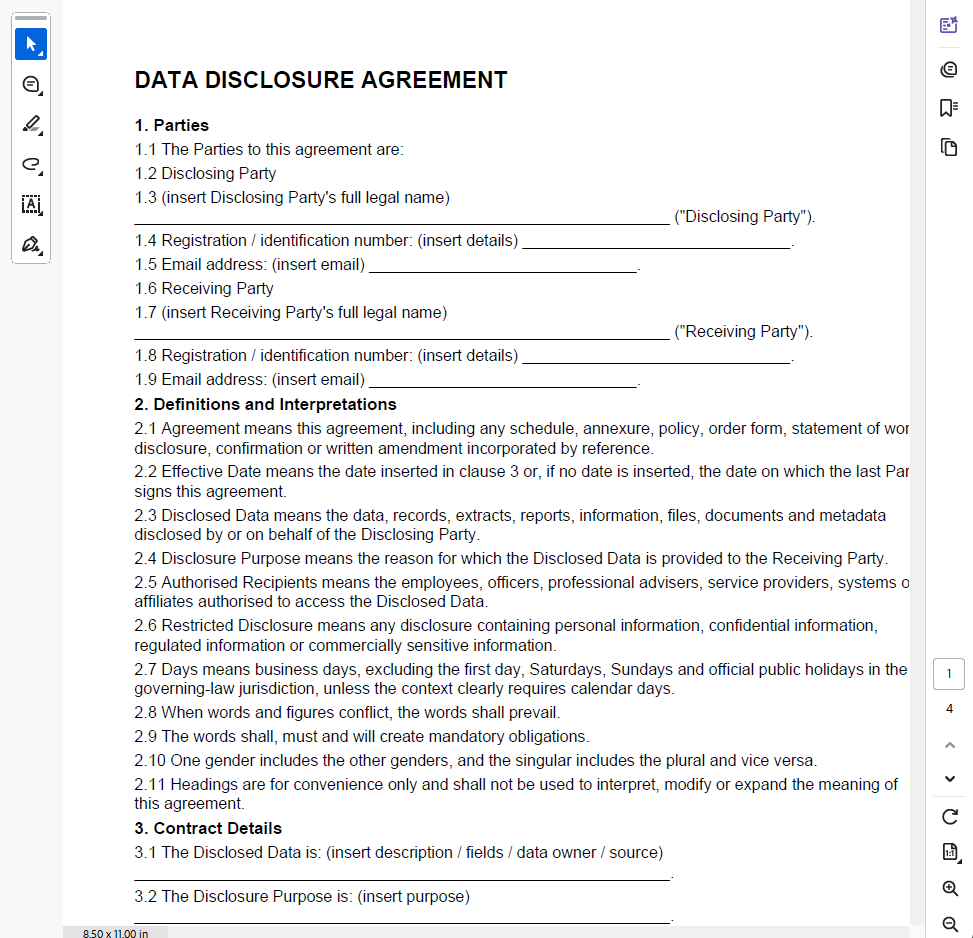
The templates and resources available through Contract Corridor are provided for general informational purposes only. They do not constitute legal advice, and their use does not create an attorney-client relationship between you and Contract Corridor or any of its affiliates.
While every effort has been made to ensure that the templates are up to date and relevant, Contract Corridor makes no representations or warranties, express or implied, regarding their accuracy, completeness, adequacy, legality, or suitability for any specific purpose. The templates may not reflect current legal developments or the laws applicable in your jurisdiction.
You are solely responsible for reviewing, customising, and validating any template before use, to ensure that any document meets your specific needs and complies with applicable laws and regulations.
To the fullest extent permitted by law, Contract Corridor, its owners, employees, and affiliates disclaim all liability for any loss, damage, or consequence arising directly or indirectly from the use of, or reliance upon, any template, resource, or related material provided on or through this platform.
By accessing, downloading, or using any template, you acknowledge and agree that such use is entirely at your own risk.
Contract Corridor Contract Templates