
Actor Contract
Key Performance Clauses and Protection Strategies
Introduction
Did you know that legal disputes can stall a film production for years? A single missing signature often costs studios millions of dollars in lost revenue. You must protect your creative projects with clear, professional legal documents. This article teaches you how to draft and manage a solid actor contract to keep your production safe.
Managing these documents does not have to be a headache. Contract Corridor helps producers organize every actor agreement contract in one secure place. Specifically, you will learn about essential clauses, payment structures, and rights management. Let us dive into the details of professional performer agreements.
Quick Answer Summary
An actor contract is a legally binding document that defines the relationship between a performer and a producer. It specifies the work schedule, pay rates, and how the studio can use the actor's image or voice. Most importantly, it protects both parties by setting clear expectations for conduct and compensation. Using a standardized film actor contract template ensures you cover all local labor laws and union requirements.
What Is an Actor Contract?
An actor contract is a specialized legal agreement that outlines the specific services, compensation, and rights transfers for a performance in a media production. The term finds its roots in general employment law but evolved through entertainment industry unions. It serves as the foundation for any professional film, television, or theater project.
In the broader world of contract management, this document acts as a service agreement. However, it includes unique sections regarding "usage rights" and "likeness." Producers use these documents to ensure they own the final footage. Without a signed actor agreement, a producer might not have the legal right to distribute their own film.
Furthermore, these agreements often follow strict union guild rules. For instance, many professional projects must use a specific film contract sample approved by a local union. Producers must track these dates and expirations carefully to avoid heavy fines.
Why It Matters
Mistakes in your paperwork can lead to total project failure. If you lose the rights to an actor's performance, you cannot sell your movie to a streaming service. Therefore, legal clarity remains the most important part of any production. Small errors in an actor contract agreement often lead to expensive lawsuits.
Key Production Statistics: Project delays due to legal issues increase costs by 20% on average. Furthermore, 15% of independent films face distribution hurdles because of incomplete paperwork. Finally, companies using digital management save 30% on legal administrative time.
Financial impact is just one factor. You also face operational risks. For example, if an actor leaves early, you need a clause that covers replacement costs. A well-written acting contract keeps the cameras rolling and the budget on track.
Key Components & Elements
Every successful production starts with a detailed checklist. You must include these items to ensure your document stands up in court.
- Scope of Work: Clearly define the character name, rehearsal dates, and filming locations.
- Compensation: List the daily or weekly rate and any potential bonuses or residuals.
- Ownership of Work: Ensure the producer owns the final footage through "Work Made for Hire" language.
- Likeness Rights: Grant the studio permission to use the actor's face and voice for promotion.
- Exclusivity: State whether the actor can work on other projects during the production dates.
- Termination: Explain how either party can end the relationship if things go wrong.
- Credit: Detail exactly how the actor's name will appear on screen and in advertisements.
Types & Categories
Not all performers require the same legal treatment. You must choose the right format based on the project size and the actor's role. Use this table as a starting point for your selections.
| Type | Description | Best For | Key Consideration |
|---|---|---|---|
| Principal Talent | Comprehensive long-form agreement. | Lead actors and stars. | Includes hair/makeup and travel perks. |
| Background/Extra | Simplified one-page waiver. | Crowd scenes and atmospheric roles. | Focuses mainly on likeness release. |
| Deal Memo | Short summary of main terms. | Fast-paced hiring and initial offers. | Must be followed by a full contract. |
| Voiceover | Audio-only performance rights. | Animation or radio ads. | Requires specific usage limits. |
Step-by-Step Implementation Guide
Follow these steps to secure your talent and protect your creative assets.
- Draft the Initial Offer: Start with a deal memo for actors to outline the money and dates. Using a basic movie contract sample helps you stay consistent.
- Choose the Full Template: Select an actors contract template that matches your specific project type. Never start from a blank page.
- Verify Union Status: Check if the performer belongs to a union. This often changes which actors agreement you must use.
- Negotiate Terms: Talk through the credit and travel clauses. Clear communication prevents arguments on set later.
- Execute and Store: Get digital signatures from all parties. Store the final movie contract template in a secure cloud folder for easy access.
Common Mistakes & How to Avoid Them
Even experienced producers make mistakes. Avoid these common pitfalls to keep your production running smoothly.
| Mistake | Why It Happens | How to Fix It |
|---|---|---|
| Vague Dates | Production schedules change often. | Use a "start on or about" date range. |
| Missing Signatures | Rush to start filming. | Do not let talent work until they sign. |
| No Work-For-Hire Clause | Using an old acting contract sample. | Always include specific ownership language. |
| Forgetting Extras | Assuming background talent does not need a cast contract template. | Require signatures for everyone on camera. |
Always ensure your legal documents comply with local labor laws for the state where you are actually filming.
Industry Examples & Use Cases
Let us look at how different industries handle these agreements in the real world.
Independent Film: A small studio uses an actor contract template to hire a local lead. They include a "deferred payment" clause. This allows them to pay the actor after the film makes a profit. Consequently, the project stays under budget during filming.
Corporate Training: A software company hires a host for their video tutorials. They use a talent management contract template to ensure the video stays active for five years. This prevents the actor from asking for more money after the video goes viral.
Commercial Advertising: An agency hires a model for a shoe brand. They use a specific actor agent contract to define where the ads will run. For instance, the ads might only appear on social media. As a result, the agency avoids paying expensive television buyout fees.
Mobile Gaming: A game developer needs a voice for their main character. They use an acting agent contract to secure the recording sessions. Because they have a clear agreement, they can use those recordings in future sequels without legal trouble.
Frequently Asked Questions
What is the difference between a deal memo and a full contract?
A deal memo is a short document that lists the big details like pay and dates. A full actors agreement contains all the legal "fine print" and protections. Usually, the deal memo acts as a temporary placeholder.
Can I use a free actor agreement template from the internet?
You can use a template as a starting point, but you should always have a lawyer check it. Every state has different rules about labor and intellectual property. A generic actor contract might miss a key local requirement.
Why do I need an acting agent contract?
This document defines how much commission an agent receives from an actor's earnings. It also explains the agent's duty to find work for the performer. It protects the relationship between the talent and their representation.
What happens if an actor refuses to sign the film contract template?
You should not allow any performer to step onto your set without a signed document. If they work without a contract, you may not legally own the footage they appear in. This can lead to a total loss of your production investment.
How Contract Corridor Helps
Modern production teams need modern tools. Contract Corridor streamlines your workflow by providing a central hub for every actor contract. You can stop digger through emails to find that one missing signature.
First, our platform uses automated alerts. You will receive a notification before any usage rights expire. This helps you avoid legal penalties when rebroadcasting old content. Second, our secure storage keeps your film contract template organized. You can find exactly what you need in seconds using our search tools.
Finally, we make sharing easy. You can send an actor agreement to an agent with just two clicks. Digital signing happens right inside the platform. Start your journey toward better production management today with Contract Corridor.

About the Author: Melissa Jooste
Melissa Jooste is the Head of Marketing at Contract Corridor, where she shapes the voice, narrative, and market positioning of a leading contract lifecycle management platform. Recognized for her expertise in contract lifecycle management content, Melissa is known for producing insightful, high-impact thought leadership that challenges conventional approaches to contract management. Her work goes beyond surface-level marketing, offering clear, strategic perspectives on how organizations can unlock value, reduce risk, and gain control through more effective contract lifecycle practices. Her writing is widely valued for its clarity, depth, and relevance, bridging complex legal, financial, and operational concepts into content that is both accessible and commercially meaningful. By combining strong storytelling with data-driven insight, she consistently delivers content that resonates with senior business leaders, legal professionals, and operational teams alike. Through her work, Melissa plays a key role in establishing Contract Corridor as a leading voice in the contract lifecycle management space, shaping how organizations think about contracts, not as static documents, but as dynamic drivers of business performance.
Connect on LinkedIn
About the reviewer: Jenna Kretzmer
Jenna Kretzmer, CA(SA) is an Executive at Contract Corridor, where she plays a key role in shaping the strategic direction and market positioning of a leading contract lifecycle management platform. A global executive with over a decade of experience, Jenna has led large-scale, international operations and driven growth, transformation, and market expansion across multiple regions. She is recognized for her ability to operate at the intersection of strategy, execution, and commercial performance. Jenna is a leading voice in the contract lifecycle management space, known for her perspectives on contract governance, revenue optimization, and operational efficiency. Her work challenges traditional approaches to contract management, advocating for a shift toward greater visibility, accountability, and value realization across the entire contract lifecycle. She is driving Contract Corridor to enable organizations to move beyond static contract storage toward proactive, value-led contract management, where contracts are treated not as legal documents, but as dynamic instruments that drive measurable business outcomes.
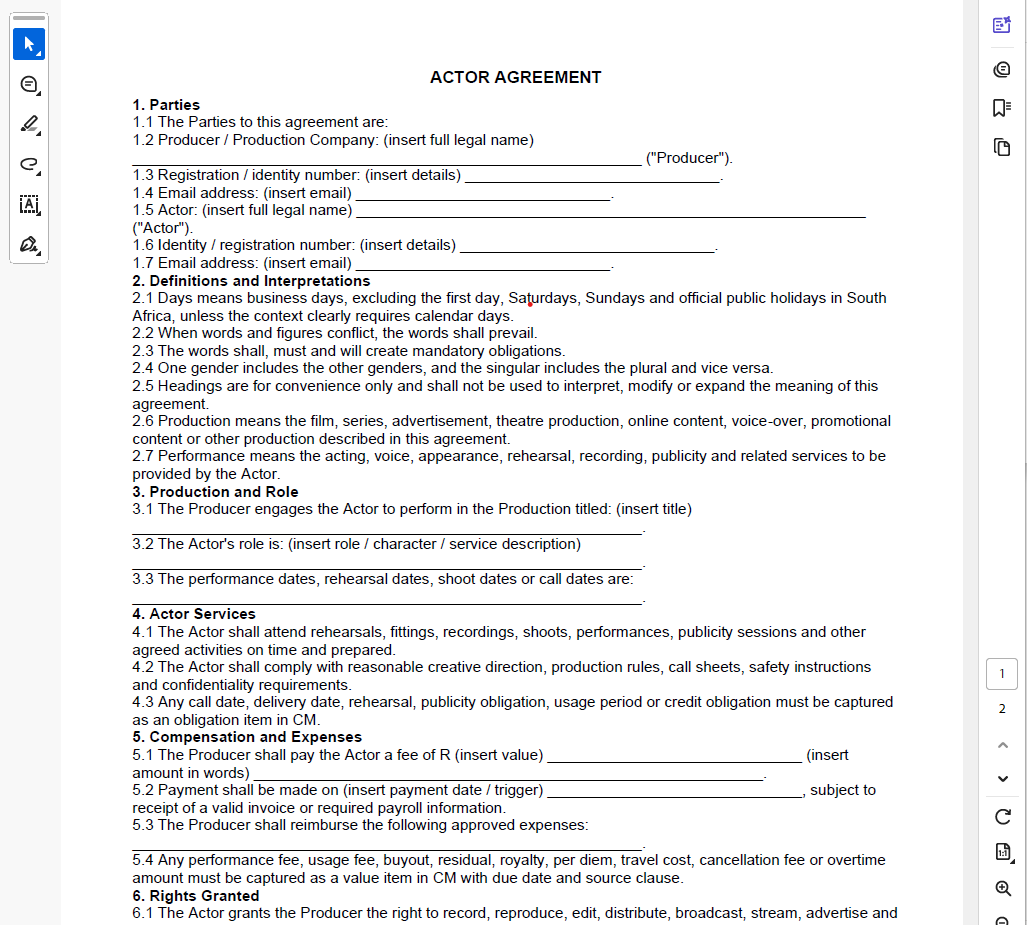
Connect on LinkedInActor Agreement
The templates and resources available through Contract Corridor are provided for general informational purposes only. They do not constitute legal advice, and their use does not create an attorney-client relationship between you and Contract Corridor or any of its affiliates.
While every effort has been made to ensure that the templates are up to date and relevant, Contract Corridor makes no representations or warranties, express or implied, regarding their accuracy, completeness, adequacy, legality, or suitability for any specific purpose. The templates may not reflect current legal developments or the laws applicable in your jurisdiction.
You are solely responsible for reviewing, customising, and validating any template before use, to ensure that any document meets your specific needs and complies with applicable laws and regulations.
To the fullest extent permitted by law, Contract Corridor, its owners, employees, and affiliates disclaim all liability for any loss, damage, or consequence arising directly or indirectly from the use of, or reliance upon, any template, resource, or related material provided on or through this platform.
By accessing, downloading, or using any template, you acknowledge and agree that such use is entirely at your own risk.
Contract Corridor Contract Templates