
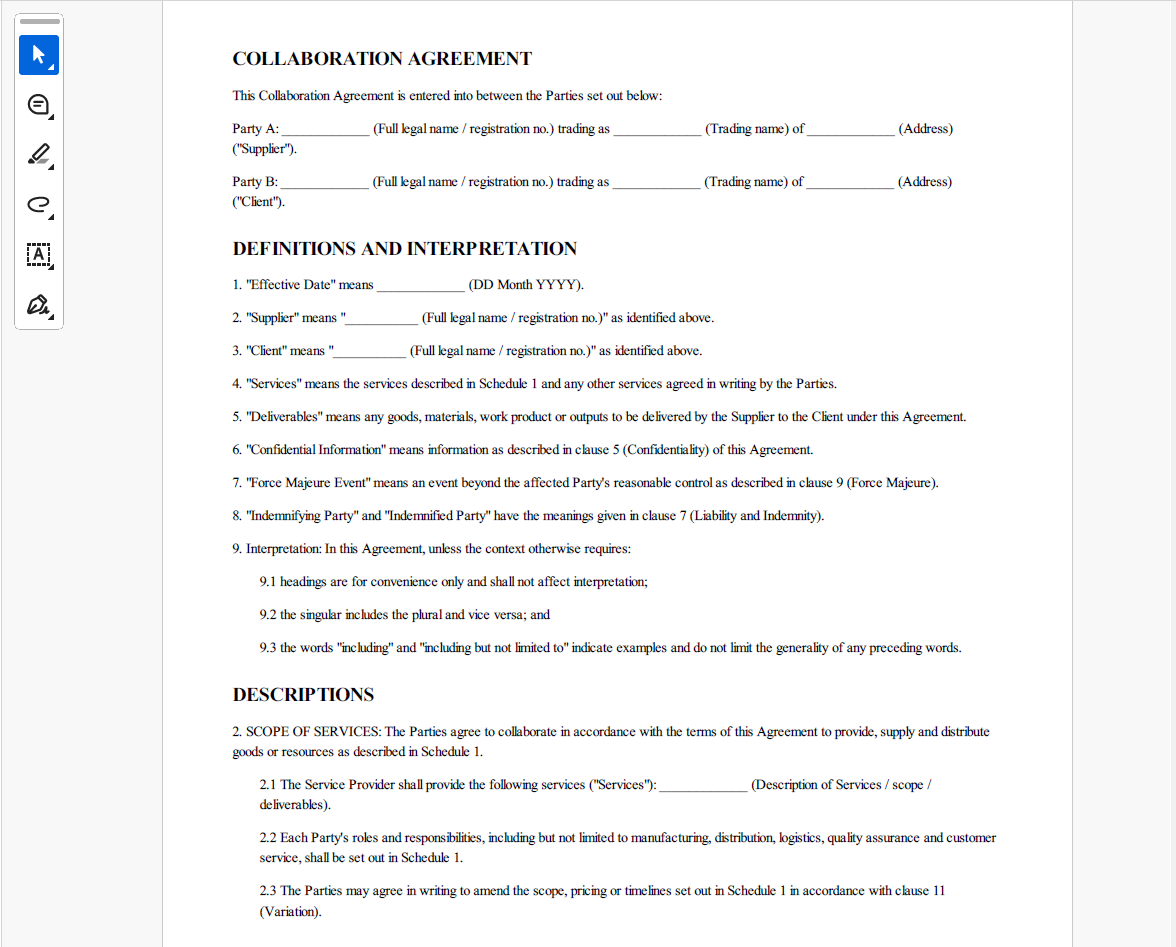
Collaboration Agreement
Key Clauses Every Manager Should Review
Introduction
Many business partnerships fail before they truly begin. In fact, research suggests nearly half of all strategic alliances dissolve earlier than expected. This often happens because teams lack a clear collaboration agreement from the start. Contract Corridor helps you solve this problem by organizing your digital legal assets. Our platform ensures every partner stays on the same page. In this article, you will learn how to build a stronger partnership using a professional collaboration contract. We will cover essential terms and share a collaboration agreement template to guide your team.Quick Answer Summary
What Is a Collaboration Agreement?
A collaboration agreement is a formal document between separate entities. These parties decide to pool their efforts for a specific project. For example, two tech companies might build a new app together. This document serves as the foundation for their working relationship. It is often called a contract of collaboration or a joint venture agreement. Historically, these documents evolved from simple partnership laws. Today, they are much more detailed to cover modern technology and global markets. In the legal world, this document sits between a simple service contract and a full merger. Specifically, players keep their independence while sharing specific risks. Using a collaborative agreement template helps you outline these complex boundaries clearly.Why It Matters
Partnerships without a collaboration contract face massive financial risks. Without a signed paper, a court might decide how you share your profits. Furthermore, you might lose ownership of the inventions your team creates.The Impact of Clear Agreements
- Financial Protection: Defined budget terms reduce surprise costs by 40%.
- Conflict Resolution: Teams with written rules resolve disputes 3 times faster.
- Intellectual Property: 70% of legal battles in tech involve disputed ownership.
Key Components & Elements
- Scope of Work: This section explains exactly what the group will achieve.
- Resource Contribution: Partners list the money, tools, or staff they provide.
- Intellectual Property (IP): This determines who owns the final product or any new inventions.
- Confidentiality: This clause prevents partners from sharing secret trade data with outsiders.
- Profit Sharing: You must state how the group splits revenue or saves on costs.
- Termination: This part explains how a party can leave the deal safely.
- Dispute Resolution: Parties agree to use mediation or arbitration before going to court.
Types & Categories
Different projects require different structures. You can use a collaboration agreement sample to find the right fit. Below is a comparison of common types.
| Type | Description | Best For | Key Consideration |
|---|---|---|---|
| Project-Based | Short-term work on one specific goal. | Small marketing campaigns. | Clear deadlines. |
| Research & Development | Focuses on inventing new technology. | Pharma or Tech startups. | Detailed IP clauses. |
| Distribution | One party makes a product and another sells it. | Manufacturers and Retailers. | Sales quotas. |
| Referral Partnership | Parties send customers to each other. | Service providers. | Commission rates. |
Step-by-Step Implementation Guide
- Define the Objective: Clearly state what you want to build or achieve. This avoids "scope creep" where the project grows too large.
Pro Tip: Use a team contract format to list individual responsibilities first. - Select a Template: Find a legal agreement template between two parties that matches your industry. This saves time on drafting legal language.
- Negotiate Terms: Discuss IP and money before you start working. Early honesty prevents late-stage lawsuits.
- Review with Legal: Ask a lawyer to check your collaboration template. They ensure your specific state laws are respected.
- Sign and Store: Both parties must sign the collaboration agreement template. Always keep a digital copy in a secure location.
Common Mistakes & How to Avoid Them
Many leaders move too fast and skip the paperwork. However, this creates "handshake traps." Use a collaboration agreement samples library to avoid these common errors.
| Mistake | Why It Happens | How to Fix It |
|---|---|---|
| Vague IP Rights | Partners assume they share everything. | State exactly who owns the "new" work. | Teams only focus on the honeymoon phase. | Include a clear "kill switch" clause. |
| Poor Payment Terms | Friends don't like talking about money. | Use a cooperation contract template with a payment schedule. |
| Ignoring Deadlines | Lack of accountability in the group. | Set milestones in your sample of collaboration agreement. |
The most important rule is to define ownership of "Background IP" versus "Foreground IP" before anyone types a single line of code.
Industry Examples & Use Cases
Technology: Two software firms use a collaboration contract sample to build a data tool. They agree that Firm A owns the code, but Firm B gets exclusive selling rights for three years. This clear split allows both to profit without fighting.
Healthcare: A hospital and a university study a new virus. They sign a collaborative agreement template to handle patient privacy. As a result, they publish a paper safely without leaking sensitive data.
Construction: An architect and an engineer work on a bridge project. They follow a collaboration agreements checklist to share liability. When a delay occurs, the contract clearly shows who pays the late fees.
Content Creation: Two YouTubers launch a joint series. They use a template contract between two parties to split ad revenue 50/50. This keeps their friendship strong while their channels grow together.
Frequently Asked Questions
What is a collaborative agreement in business?
It is a legal contract where two parties join forces for a specific venture. It manages expectations and protects assets while they work together.
How is it different from a Partnership Agreement?
Standard partnerships often involve a permanent legal entity. Conversely, these agreements are usually for a limited time or a specific project.
Can I use a free collaboration agreement templates online?
Yes, you can use these as a starting point. However, always customize them to fit your specific project goals and local laws.
Who owns the work created in the partnership?
This depends on the contract. Usually, the parties decide to share ownership or grant one party a license to use the work.
How Contract Corridor Helps
Managing a collaboration agreement requires more than just a signature. You need a way to track changes and store your documents safely. Contract Corridor provides the tools you need to stay organized. First, our platform helps you find the right collaboration agreement templates for your specific industry. We simplify the search for legal documents. Second, we provide a secure hub for all your collaboration agreement samples. This ensures your team can view the live contract at any time. Finally, we automate reminders for important dates and deadlines. This keeps your project on schedule and avoids costly breaches. Ready to protect your next big idea? Contract Corridor makes managing your partnerships simple and secure. Start organizing your legal documents today to build a better future for your team.
About the Author: Melissa Jooste
Melissa Jooste is the Head of Marketing at Contract Corridor, where she shapes the voice, narrative, and market positioning of a leading contract lifecycle management platform. Recognized for her expertise in contract lifecycle management content, Melissa is known for producing insightful, high-impact thought leadership that challenges conventional approaches to contract management. Her work goes beyond surface-level marketing, offering clear, strategic perspectives on how organizations can unlock value, reduce risk, and gain control through more effective contract lifecycle practices. Her writing is widely valued for its clarity, depth, and relevance, bridging complex legal, financial, and operational concepts into content that is both accessible and commercially meaningful. By combining strong storytelling with data-driven insight, she consistently delivers content that resonates with senior business leaders, legal professionals, and operational teams alike. Through her work, Melissa plays a key role in establishing Contract Corridor as a leading voice in the contract lifecycle management space, shaping how organizations think about contracts, not as static documents, but as dynamic drivers of business performance.
Connect on LinkedIn
About the reviewer: Jenna Kretzmer
Jenna Kretzmer, CA(SA) is an Executive at Contract Corridor, where she plays a key role in shaping the strategic direction and market positioning of a leading contract lifecycle management platform. A global executive with over a decade of experience, Jenna has led large-scale, international operations and driven growth, transformation, and market expansion across multiple regions. She is recognized for her ability to operate at the intersection of strategy, execution, and commercial performance. Jenna is a leading voice in the contract lifecycle management space, known for her perspectives on contract governance, revenue optimization, and operational efficiency. Her work challenges traditional approaches to contract management, advocating for a shift toward greater visibility, accountability, and value realization across the entire contract lifecycle. She is driving Contract Corridor to enable organizations to move beyond static contract storage toward proactive, value-led contract management, where contracts are treated not as legal documents, but as dynamic instruments that drive measurable business outcomes.
Connect on LinkedInCollaboration Agreement
The templates and resources available through Contract Corridor are provided for general informational purposes only. They do not constitute legal advice, and their use does not create an attorney-client relationship between you and Contract Corridor or any of its affiliates.
While every effort has been made to ensure that the templates are up to date and relevant, Contract Corridor makes no representations or warranties, express or implied, regarding their accuracy, completeness, adequacy, legality, or suitability for any specific purpose. The templates may not reflect current legal developments or the laws applicable in your jurisdiction.
You are solely responsible for reviewing, customising, and validating any template before use, to ensure that any document meets your specific needs and complies with applicable laws and regulations.
To the fullest extent permitted by law, Contract Corridor, its owners, employees, and affiliates disclaim all liability for any loss, damage, or consequence arising directly or indirectly from the use of, or reliance upon, any template, resource, or related material provided on or through this platform.
By accessing, downloading, or using any template, you acknowledge and agree that such use is entirely at your own risk.
Contract Corridor Contract Templates